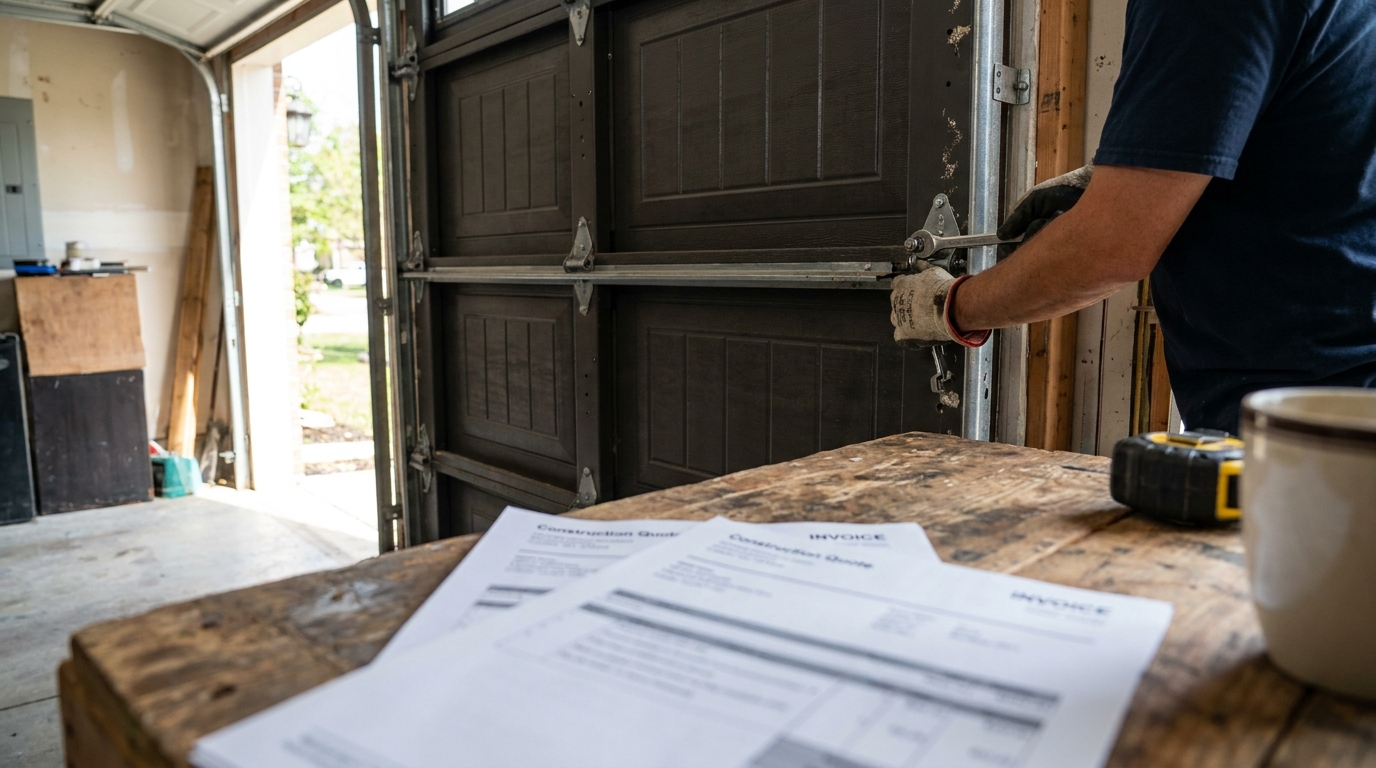
If you priced a garage door in 2024 and you are pricing one again now, the new number probably stung. Same house, same opening, often the same brand, and the quote lands hundreds to more than a thousand dollars higher. There is a reason, and it is not your dealer padding the bill. It traces back to a federal tariff on steel that doubled in 2025 and then quietly expanded to cover finished steel goods like garage doors. Here is the plain-English version of what happened and what a replacement actually costs today.
What actually changed
The U.S. has taxed imported steel and aluminum under a trade rule called Section 232 since 2018. For years that tax sat at 25%. On June 4, 2025, it doubled to 50% on both steel and aluminum (the United Kingdom was held at 25% under a separate deal). That alone raised the cost of the raw metal that goes into a huge range of products. Source: White & Case; Congress.gov / CRS.
The bigger change for homeowners came a couple of months later. On August 18 and 19, 2025, the Bureau of Industry and Security added 407 more product categories to the list of "derivative" goods covered by the tariff. In plain terms, the government moved from taxing just raw steel to taxing many finished steel products, and that sweep pulled steel garage doors into the 50% net for goods entering the country on or after August 18, 2025. Source: Bureau of Industry and Security; PwC.
One detail worth knowing: this list is not frozen. New derivative products can be added during three two-week windows each year, in the first two weeks of May, September, and January. That is part of why these costs have kept creeping rather than spiking once and settling. Source: Federal Register; White & Case.
Why Customs treats a garage door as a steel product
It helps to picture what a standard door is made of. A typical 16-by-8-foot two-car residential door carries roughly 225 pounds of steel, and industry estimates put steel and aluminum at somewhere around 40 to 60% of the total manufacturing cost. When that much of a product's cost is metal, a tax on the metal does not stay hidden in a factory ledger. It passes from the mill to the manufacturer, from the manufacturer to your local dealer, and from the dealer onto your quote. The tariff is assessed on the steel and aluminum content value of the product, so the more metal a door holds, the more duty it carries. Source: First Line Garage (industry trade blog, estimate); U.S. Customs and Border Protection.
The numbers, sourced honestly
You may have seen claims that garage door prices spiked 55 to 63% at the 2025 peak and now sit roughly 35 to 40% above 2024 levels. Those specific percentages come from a garage-door industry blog, First Line Garage, not from a government price index or an independent statistical agency. Treat them as a knowledgeable industry tracker's estimate, not official data. Source: First Line Garage.
What we can pin down more firmly are the installed-cost ranges that independent dealer guides report for 2026, which are not tied to any tariff claim:
-
Single-car insulated steel door, installed: commonly $1,000 to $1,800.
-
Double-wide insulated door, installed: commonly $1,800 to $3,200.
Source: Champions Garage Door Repair (2026 guide). Prices vary by region, door style, insulation level, window options, and how much old hardware has to be hauled away, so treat these as planning ranges, not promises.
To make the tariff effect concrete, take a mid-range single door that might have run about $1,200 to $1,800 installed in 2024. Apply the industry-estimated 35 to 40% bump and you land somewhere in the neighborhood of $1,700 to $2,500 today. A double door that sat near $1,800 in 2024 can push past $2,400 on the same math. Your actual quote depends heavily on door choice and local labor, but the direction is consistent across the market.
The manufacturer paper trail
If you want proof these increases are real and ongoing rather than a one-time blip, look at the manufacturers' own price-increase letters. In 2026 alone, dealers have logged a string of them:
-
C.H.I. Overhead Doors: 6% increase (some lines up to 10%) effective April 6, 2026.
-
Amarr: 5% increase effective April 27, 2026.
-
Clopay: prices raised in mid-March 2026.
Those follow earlier 2025 actions, including a reported 25% jump from LiftMaster and 6 to 10% from Clopay. The pattern of multiple major brands raising prices within a 60-day span is the clearest signal that the cost pressure is industry-wide, not dealer-specific. Source: First Line Garage.
Why these increases tend to stick
It is fair to hope a tariff comes off and prices snap back. History suggests patience over optimism here. The original 25% Section 232 steel tariff took effect June 1, 2018. One year later, producer prices for primary metals were up about 6% and for fabricated metals about 4%, and the duties largely stayed in place rather than reversing. Tariffs that get imposed tend to settle in, and the prices that rise with them rarely fully roll back. Source: Tax Foundation; Congress.gov / CRS.
The rules are also still moving. A June 1, 2026 proclamation (effective around June 8, 2026) restructured the metals tariffs again, keeping 50% on primary metals and on certain derivatives "made entirely or almost entirely" of the metal, while setting 25% on another category of derivatives only "substantially" made of steel, aluminum, or copper. Exactly which bucket a given garage door falls into depends on its specific tariff classification, which is not nailed down in the public sources here, so do not assume a particular rate for your door. Source: GEODIS.
Which materials dodge some of the duty
Because the tax is tied to metal content, an all-steel door absorbs the most. Doors built largely from wood, fiberglass, or composite carry less steel and aluminum, so in theory they shoulder less of the duty. That is a reasonable factor to weigh, but be careful: the exact tariff classification for each material is not spelled out in these sources, so no one should tell you a non-steel door is flatly exempt. The honest framing is that lower metal content generally means lower tariff exposure, not zero. If you were already considering a wood-look or composite door for looks or maintenance reasons, the current climate is one more point in its favor. Source: U.S. Customs and Border Protection.
How to time and buy a replacement
A few practical moves can save you real money:
-
Watch the spring cadence. The 2026 manufacturer increases clustered in March and April. If you see a brand announce an effective date a few weeks out, locking a quote and a deposit before that date can preserve the older pricing.
-
Get quotes in writing with a clear validity window. Ask how long the price holds. In a rising market, a quote good for 30 days is worth more than a verbal estimate.
-
Weigh repair versus replace. If the door panels are sound and the problem is a broken spring, opener, or rollers, a repair may carry far less steel cost than a full replacement. Save the big spend for a door that is genuinely failing.
-
Compare materials, not just brands. Price an all-steel option against a fiberglass or composite one. The metal-heavy choice is the one most exposed to the tariff.
-
Budget regionally. Use the $1,000 to $1,800 single and $1,800 to $3,200 double ranges as a starting point, then expect labor and disposal to swing the final number by your local market.
Red flags to watch: a contractor who blames the tariff for a price wildly outside these ranges, anyone who pressures you to sign today without a written quote, and any dealer who cannot show licensing and insurance. A real cost increase is not a license for a bad deal.
Bottom line
Here is what is firmly documented: the Section 232 tariff doubled to 50% on June 4, 2025; finished steel garage doors were swept into coverage by the August 2025 expansion of 407 product categories; multiple major manufacturers issued price-increase letters through 2025 and into 2026; and the 2018 precedent shows these costs tend to stick. Here is what is an industry estimate rather than official data: the 55 to 63% peak and the 35 to 40% above-2024 figures. Budgeting somewhere in the $1,000 to $1,800 range for a single door and $1,800 to $3,200 for a double, adjusted for your region and material, is a sound place to start. If a replacement is on your horizon, getting quotes ahead of the next spring price letter is the move most likely to keep money in your pocket.
Related reading
-
Your AC Now Runs on R-454B, and That's Why a 2026 Replacement Costs 10 to 20% More Than Last Year's
-
[Canadian Lumber Duties Just Roughly Doubled: Why Your 2026 Deck, Fence, and Framing Quotes Are Climbing Again](/guides/canadian-lumber-duties-2026-deck-fence-framing-costs)
-
[A 50% Quartz Tariff Just Cleared the ITC: Why Your 2026 Countertop Quote Is About to Add $500 to $1,000 Per Kitchen](/guides/quartz-tariff-2026-countertop-cost-increase)
Sources
-
Bureau of Industry and Security: 407 product categories added
-
First Line Garage: tariffs and the garage door industry (industry blog estimate)
-
Tax Foundation: how Section 232 tariffs affected the economy
-
Congress.gov / CRS: Section 232 tariffs on steel and aluminum
Note: This article contains AI-assisted content and has been reviewed by our editorial team.
ABOUT THIS SERVICE: CallTheLocal.com is a directory and lead generation service, not a contractor or service provider. Submitting this form does not obligate you to hire anyone or purchase any service. Your information will be shared with licensed, insured home service professionals in your area who may provide quotes for your project. CallTheLocal.com does not guarantee the quality, timeliness, or outcome of any work performed by service providers you connect with through this service. Always verify licensing, insurance, and references before hiring. Get everything in writing before work begins.