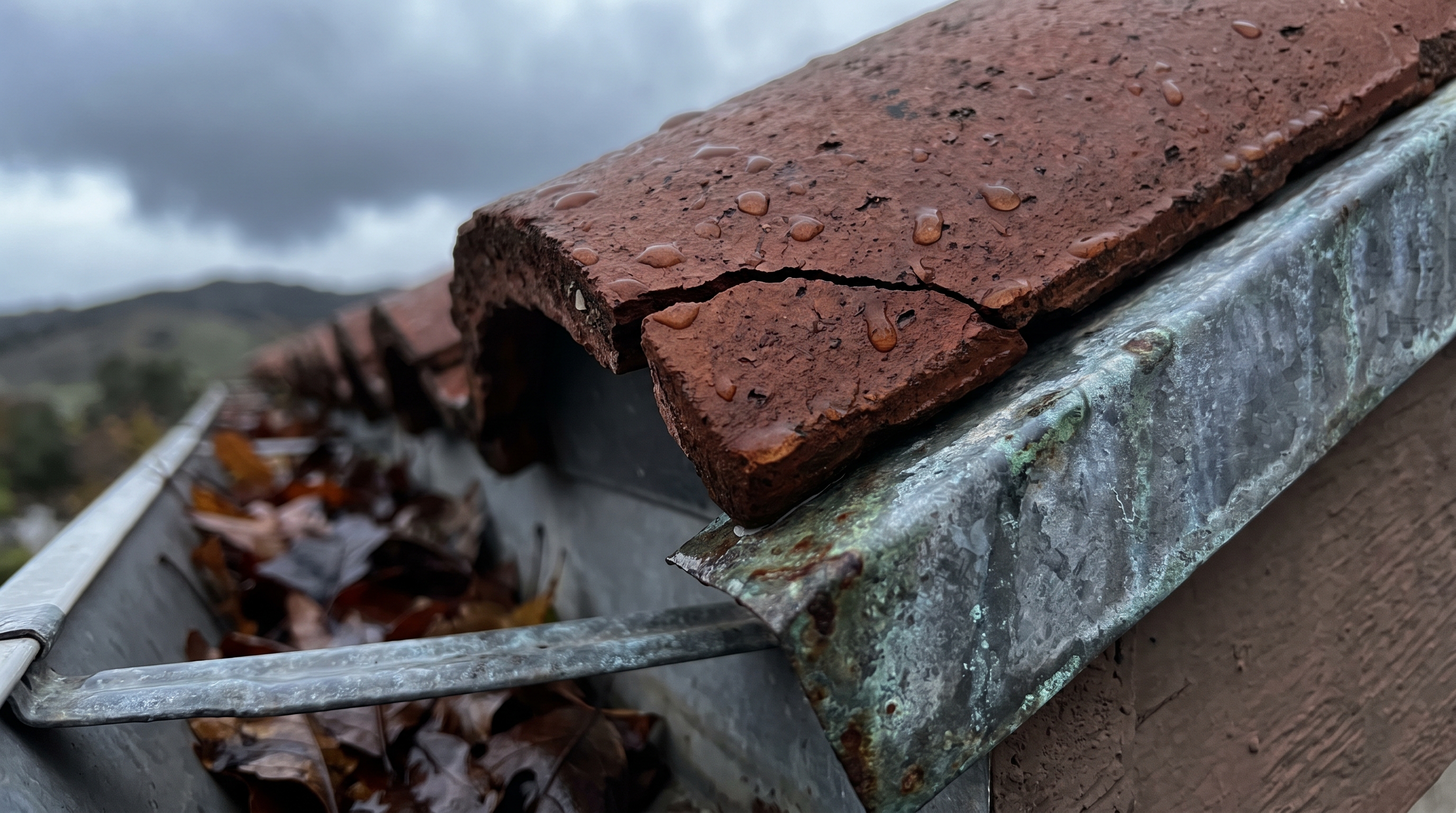
A roof inspection before rainy season should happen now, before the first big storm. Clear gutters and downspouts, trim branches over the roof, scan for missing or cracked tiles and shingles from the ground, check the attic for stains, and look at flashing. Then book a licensed roofer's inspection, which runs about $200 in San Diego.
The quick pre-storm roof checklist
-
Clear gutters and downspouts so water flows away from your foundation.
-
Trim branches that hang over the roof.
-
Scan the roof from the ground (binoculars help) for missing, cracked or slipped tiles or shingles. Don't walk on a tile roof.
-
Check the attic and ceilings for water stains or damp spots.
-
Look at flashing around chimneys, skylights and vents for gaps or lifted edges.
-
Book a paid inspection with a licensed C-39 roofing contractor and ask for a written report with photos.
-
Verify the license with the Contractors State License Board (CSLB) before anyone climbs a ladder.
Why this winter is different
The NOAA U.S. Winter Outlook, released Oct. 15, 2026 and covering December through February, says "wetter-than-average conditions [are] likely across the southern U.S., from California to Florida." It also says a very strong El Niño is expected. Ken Graham, Director of NOAA's National Weather Service, put it this way: "As we know from decades of observations, a very strong El Nino will likely bring a southward and eastward shift to the jet stream for the contiguous U.S., which tilts the odds toward stormier weather across the South."
The Climate Prediction Center's Oct. 8 discussion has an El Niño Advisory in effect. It says a strong to very strong El Niño is likely through January-March 2027, with the chance "remaining greater than an 83% chance," and it reports the Niño-3.4 index at +2.1°C. ABC News reported that NOAA sees "significant chances of a very wet winter in parts of California and Arizona." For Northern California, NOAA says warmer-than-average temperatures are favored.
The rain isn't the only risk. Ariel Cohen of the National Weather Service told ABC7 Los Angeles that very strong El Niño events "increase the odds of dangerous weather and coastal conditions, including flash floods, burn scar debris flows, severe thunderstorms with damaging winds and tornadoes, coastal flooding, beach erosion and dangerous rip currents."
Officials are already acting. Gov. Gavin Newsom issued a statewide emergency proclamation on Sept. 21, 2026, and San Diego County followed with its own on Sept. 30, according to the San Diego County News Center.
Why you should book now instead of after the first storm
Emilio Lopez owns San Diego Roof Doctor in San Marcos and has more than 40 years in roofing. He told NBC 7 San Diego what happens to homeowners who wait: "Because then prices go up, people are going to be busy, they're going to start turning down business where you're going to be calling all kinds of different roofers and everybody's going to be busy."
Forecasts are about odds, not promises, and that's a reason to prepare, not to skip it. Michelle L'Heureux, a physical scientist at NOAA's Climate Prediction Center, told ABC News: "It is really important to emphasize that even if this ends up being a historic El Nino, there will be impacts in some locations that do not align with the expected El Nino impact." Your neighborhood could get more rain than the map suggests, or less. A sound roof covers you either way.
What you can check yourself, from the ground
Most of the prep doesn't require a ladder. In a CBS Los Angeles story quoting LA County Public Works, the advice was simple: "Clear gutters, downspouts, and nearby storm drains of leaves and debris, and inspect your roof for leaks so your home is ready to handle heavy rain." NBC 7 San Diego's checklist covers the same ground: regular inspections, maintained gutters and downspouts, trimmed branches, and gutters clear enough that water moves away from the foundation.
-
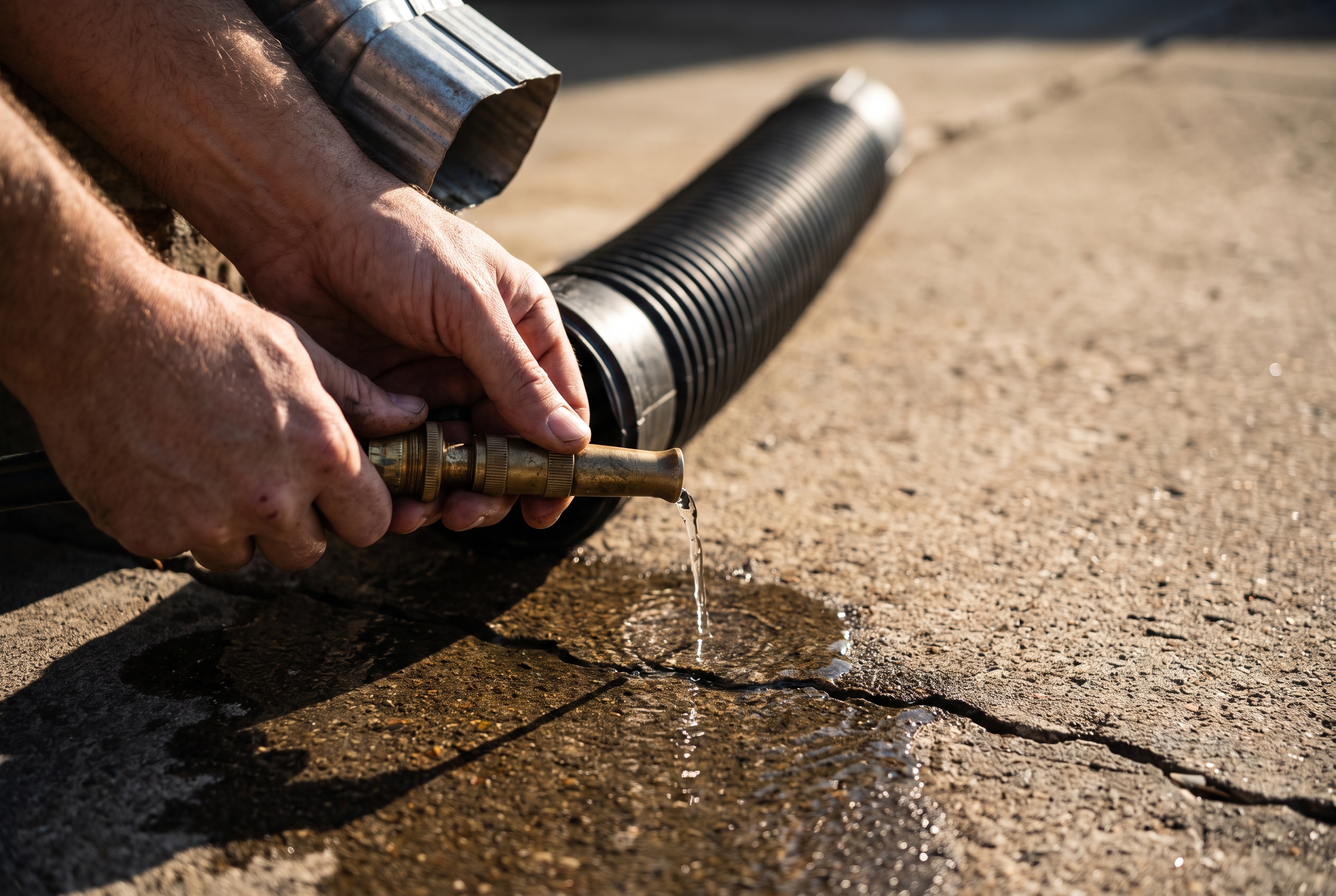
Gutters and downspouts: Pull out leaves and debris, then run a hose to make sure water comes out the bottom of each downspout and drains away from the house.
-
Trees: Branches over the roof drop debris into gutters and can scrape or crack roofing in high winds.
-
Roof surface: Walk the yard with binoculars. Look for gaps where tiles or shingles are missing, cracked pieces, or tiles that have slid out of line.
-
Inside: Check the attic with a flashlight, and look at ceilings for brown rings or soft spots, especially below chimneys and skylights.
-
Flashing: From the ground, look at the metal around chimneys, skylights and vent pipes. Lifted or separated flashing is a common leak point.
Tile vs. shingle: why tile roofs need a gentler approach
Much of Southern California sits under concrete or clay tile. RoofVista's California repair cost guide says repair work in the LA metro and San Diego is mostly tile, and coastal San Diego also sees salt-air corrosion. Tile behaves differently from shingle, so keep these points from InterNACHI in mind:
-
"Interlocking concrete tiles are moisture-resistant only." The tile isn't the waterproof layer. The underlayment beneath it does that job, which is one reason a pro inspection is worth paying for.
-
"Anytime you walk on concrete tile, you risk breaking it." Stay off. Look from the ground or a ladder at the eave.
-
"Missing tiles are relatively easy to spot. Tiles may be lost due to breakage or fastener failure." If you see gaps, note where they are and tell the inspector.
What a paid roof inspection covers
According to Fixr, a standard inspection looks at the condition of the roof covering, the attic (for water damage or leaks), gutters and flashing, penetrations such as skylights and chimneys, and attic ventilation. US Power Roofing, a California roofing contractor, says a paid inspection should include "a written report, photos of problem areas, and condition notes you can hand to an insurance company, a lender, or a home buyer."
Be careful with "free" inspections. Fixr warns they can be a sales tactic. A paid inspector has less reason to find problems that need fixing that week.
Roof inspection prices in California
NBC 7 San Diego reports that a licensed company charges about $200 to inspect a roof. Regional ranges from US Power Roofing's 2026 California guide (a contractor's figures, so treat them as a ballpark):
| Region | Inspection range | Source |
|---|---|---|
| San Diego County | Generally $150 to $450 | US Power Roofing |
| Los Angeles and Orange County | $200 to $450 for a documented inspection | US Power Roofing |
| Bay Area | $150 to $600, driven by higher labor costs and steep, multi-story homes | US Power Roofing |
| National average (context) | $426 average; most pay $307 to $571 | Fixr (updated Jan. 2025) |
Typical roof repair prices if the inspector finds something
These figures come from contractor networks and lead-generation sites, not neutral surveys. Use them to check whether a quote is in a reasonable range, not as a fixed price.
| Repair | Typical range | Source |
|---|---|---|
| Leak repair, San Diego | $960 to $1,324 (assumes 163 sq ft, 4.5 labor hours) | Homeyou, updated Sept. 2026 |
| Leak repair, Los Angeles | $951 to $1,310 (same 163 sq ft basis) | Homeyou, updated Aug. 2026 |
| Leak repair, statewide | $300 to $1,500 | RoofVista |
| Flashing repair, statewide | $500 to $2,500 | RoofVista |
| Emergency tarp, statewide | $200 to $500 | RoofVista |
| Tile replacement, statewide | $400 to $1,200 | RoofVista |
| Shingle area replacement, statewide | $400 to $1,200 | RoofVista |
Regional differences: RoofVista says labor runs 20-30% above the state average in the Bay Area (San Francisco, Oakland, San Jose), 15-25% above in the LA metro, and 10-20% above in San Diego. Its example: "A leak repair that costs $500 in the Central Valley may cost $650 to $750 in San Francisco."
Repair or replace? RoofVista's rule of thumb is that repair usually makes sense when it costs "under 30% of full replacement cost." If a repair quote goes past that line, ask for a replacement quote too so you can compare.
How to vet a roofer before you book
California's CSLB rules give homeowners real protection, as long as you use them. Before you sign:

-
Check the license. Look up the license number on the CSLB website or call (800) 321-CSLB (2752). The number must appear on the contractor's ads, business cards, bids and contracts. Under CSLB rules, anyone doing work valued at $1,000 or more in combined labor and materials must hold a current, valid license.
-
Confirm the C-39 roofing classification and workers' comp. CSLB says C-39 roofing contractors must carry workers' compensation insurance (or a valid Certification of Self-Insurance) whether or not they have employees. If a roofer's license record shows no workers' comp on file, that's a red flag.
-
Note the bond. The required contractor license bond is $25,000, and CSLB notes it may not cover multiple complaints. Treat it as a minimum, not a guarantee.
-
Get at least three written bids on the same scope of work so you're comparing like with like.
-
Get a written contract. CSLB requires one for all home improvement projects over $500.
-
Keep the deposit legal. The down payment can't be more than $1,000 or 10% of the contract price, whichever is less. Progress payments can't exceed the value of the work performed.
Storm-chaser red flags after the first big rain
Once a storm hits, expect door knockers. CSLB's Disaster Help Center offers clear guardrails:
-
No license on a $1,000-plus job. That's illegal in California, no matter how fast they say they can start.
-
No salesperson ID. Ask any door-to-door salesperson for their Home Improvement Salesperson (HIS) registration card and a photo ID.
-
No fixed price. CSLB says contractors must use a fixed-price contract for disaster work.
-
Payments ahead of the work. CSLB's advice: "Never sign any contract or change order that requires a progress payment larger than the value of the work completed."
-
A big deposit up front. Anything above $1,000 or 10% (whichever is less) breaks the rule.
The bottom line: who to call, and when
Call a C-39 licensed roofer now if you see ceiling or attic stains, missing or cracked tiles or shingles, or gaps in the flashing. An inspection of about $200 is cheap compared with storm-season repair prices, and you get a written report you can use with your insurer.
A handyperson or a Saturday afternoon may be enough if the only issue is clogged gutters or overhanging branches and the roof looks intact from the ground.
For flooding around the house, San Diego County recommends signing up for emergency alerts, picking up free sandbags at County and CAL FIRE stations, and checking its "Know Your Hazards Map." Check your own city or county for similar programs.
Related reading
-
Your Solar Installer Went Out of Business. Now Who Fixes the Panels?
-
Portable Generator With Transfer Switch or Whole-House Standby?
-
What Should an Emergency Roof Tarp Cost After Hurricane Isaias?
-
Flat Roof Leak After Heavy Rain? What to Check in Phoenix and Albuquerque as Polo Moves Through
-
How to Find a Licensed Roofer on Kauai When the Whole Island Needs One
Sources
-
NOAA: El Nino looms large over U.S. Winter Outlook (Oct. 15, 2026)
-
Climate Prediction Center: ENSO Diagnostic Discussion (Oct. 8, 2026)
-
ABC News: NOAA forecasts a wet south and warmer north as El Nino impacts winter weather
-
CBS Los Angeles: El Niño could exceed previous events from 1950
-
ABC7 Los Angeles: Powerful El Niño could slam Southern California
-
NBC 7 San Diego: Is your roof ready for possible El Niño rain?
-
San Diego County News Center: County Issues Emergency Proclamation Ahead of El Niño
-
US Power Roofing: Roof Inspection Cost in California 2026 Price Guide
ABOUT THIS SERVICE: CallTheLocal.com is a directory and lead generation service, not a contractor or service provider. Submitting this form does not obligate you to hire anyone or purchase any service. Your information will be shared with licensed, insured home service professionals in your area who may provide quotes for your project. CallTheLocal.com does not guarantee the quality, timeliness, or outcome of any work performed by service providers you connect with through this service. Always verify licensing, insurance, and references before hiring. Get everything in writing before work begins.
Note: This article contains AI-assisted content and has been reviewed by our editorial team.