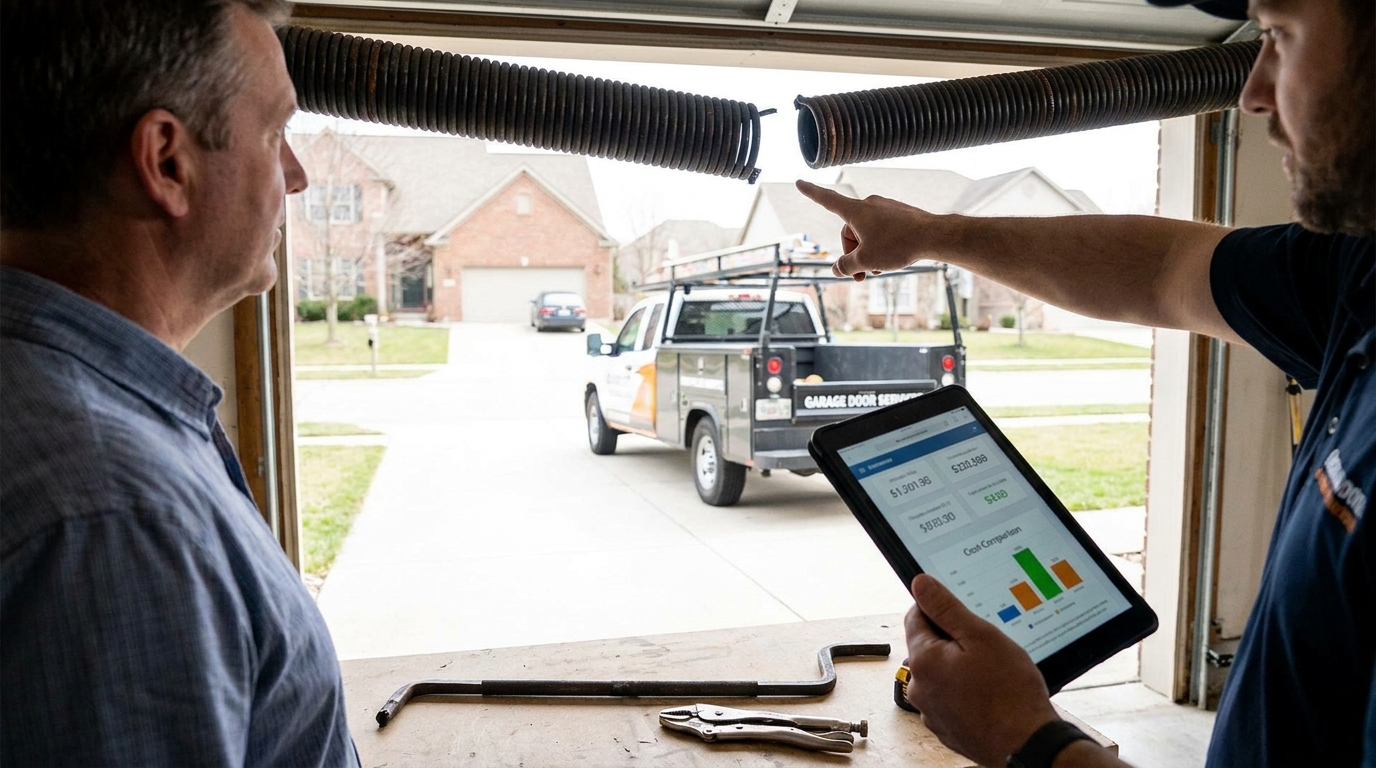
You heard the bang from inside the house. Now the door will not lift, there is a gap in the coiled spring above the opening, and a technician is standing in your driveway quoting two numbers: one to fix the spring, one to replace the whole door. The repair is cheaper today. The question this piece answers is when the cheaper fix stops being the cheaper decision.
Most of the time, a broken spring is a spring problem and nothing more. Replace it, the door works, you move on. But there are three specific conditions where paying for the repair means paying twice, and they are easy to spot in the ten minutes you have to decide.
What fails first, and what each part costs
Garage doors fail in a predictable order, and knowing where your problem sits on that list tells you a lot about whether you are looking at a repair or the beginning of a replacement conversation.
Torsion springs. These carry the weight of the door, and they are the most common failure. This Old House puts torsion spring replacement at $350 to $540 installed and extension springs at $300 to $400. Torsion springs typically last 8 to 15 years, extension springs 7 to 12. They are rated in open-and-close cycles, commonly 10,000 to 20,000, which works out to somewhere around 14 years at ordinary daily use. That rating is a starting point, not a guarantee. The trade association DASMA publishes a technical sheet, TDS-190, Factors Affecting Spring Cycle Life, covering how handling, installation, and usage change what you get in practice.
Rollers, hinges, cables, and brackets. Cheap parts, and the repair visit is usually the bigger line item. This Old House prices hardware at $5 to $250, cables at $4 to $200, and tracks at $40 to $400. A basic single-component repair runs $98 to $300. A multi-component visit lands around $245 to $300, and a complex repair can reach $860. A full overhaul runs $371 to $1,231.
The opener. Openers most often die at the motor, the circuit board, the gears, or the sensors, and replacement units run $150 to $700. Treat the opener as a separate decision from the door. A new door reuses a working opener, and a dead logic board is not an argument for replacing perfectly good steel.
A bent or separated section. Panels themselves cost $400 to $900 as parts. This is the failure that most often tips the whole decision, and it gets its own section below.
What a new door costs installed
Before you can judge a repair quote, you need the number it is being measured against. This Old House's 2026 pricing breaks replacement down by opening size:
-
One-car door: $1,093 to $1,674
-
Two-car door: $2,186 to $3,348
-
Three-car door: $3,279 to $5,022
Material moves the number more than anything else. Steel is the value pick at $1,093 to $1,288. Wood runs $1,674 to $1,869. Composite and glass doors start north of $4,740. A professional install takes 3 to 4 hours on site.
What that price normally includes: the door sections, new tracks, new springs, and the running hardware. What it normally does not include: a new opener, and sometimes not haul-away of the old door. Ask about both before you sign.
Condition one: a bent or separated section
The rule of thumb across the trade is to replace the whole door once repair costs pass roughly half the price of a new installed one. On a $2,600 double door, that is a $1,300 ceiling on repairs, and a bent section plus the labor to swap it climbs toward that line faster than homeowners expect.
There are two practical problems with single-panel repair that the quote will not mention. The first is availability. Door styles get discontinued, and matching a panel from a ten-year-old model often means a special order with real lead time, during which your car sits in the driveway. The second is color. A replacement panel comes from the factory in factory color. Your door has been facing the sun for a decade. The new section will not match, and on a street-facing garage that is the first thing anyone sees.
If the section is bent from a bumper tap and the rest of the door is straight and true, get the quote. If two sections are involved, or the door has separated at a seam, price the replacement.
Condition two: an uninsulated door on a garage you heat
This one gets oversold, so here is the honest version. The Department of Energy's Energy Saver guidance treats an attached garage as sitting outside your home's conditioned envelope. The air barrier and the insulation that matter belong in the wall and ceiling between the garage and your living space, not in the garage door. Sealing that shared wall also limits car exhaust, paint, and solvent fumes from drifting into the house.
So an insulated door earns its keep on energy only if you actually heat the garage. If you do not, buy insulation for what it genuinely delivers: a quieter, stiffer, better-feeling door that takes wind and impact more gracefully.
If you do heat the space, one buying question separates a real product from a marketing number. Ask for the installed U-factor of the door system, not the R-value on the brochure. DASMA's TDS-163 defines garage door R-value as a calculation through the center of a single section, counting air films, facings, and the insulating core. It is not a measurement of the door you are buying, hinges, seams, perimeter, and all. TDS-196 covers U-factor, which describes the whole installed system. A salesperson quoting a big R-number and nothing else is describing one slice of one panel.
Condition three: a second failure inside about a year
One broken spring on a fifteen-year-old door is a part reaching the end of its life. A second failure within roughly twelve months is a pattern, and patterns do not get fixed one part at a time.
Common causes: springs sized for a lighter door than the one hanging there, which happens after an insulated upgrade or a previous repair done by weight guess rather than measurement. A door out of balance, which chews through rollers and puts the opener under load it was never meant to carry. Or simple accumulated wear across every moving part at once.
Add up what you have spent on that door in the last two years. If the running total has quietly crossed half the price of a new installed door, you have already made the replacement decision. You are just paying for it in installments.
About that resale number
You will hear this one from every salesperson, and it is real, but it needs handling. In Zonda's 38th annual Cost vs. Value report, published September 18, 2025, garage door replacement ranked first out of 28 projects for the second straight year: $4,672 national-average job cost, $12,507 value at sale, 267.7 percent of cost recouped.
Two qualifications, both important.
First, where the resale figure comes from. Zonda's methodology pairs Verisk XactRemodel cost estimates with surveys of real estate professionals across 115 markets. The $12,507 is what agents estimate the project adds to a sale price. It is a well-informed estimate of curb appeal value, not a measured sale-price outcome, and it only turns into money when the house actually changes hands. It is not cash you can pull out on a refinance, and it is not a reason to replace a working door if you are staying put.
Second, the two cost numbers in this article are not the same project. Cost vs. Value's $4,672 job cost is a larger, differently specified scope than the $2,186 to $3,348 two-car range from the consumer cost guides. Do not read a $2,400 door as returning $12,000. Those figures come from different sources describing different jobs, and mixing them produces a fantasy.
Two safety items that override the math
Springs are not a homeowner job. DASMA's position is that spring replacement belongs to a trained door systems technician. A torsion spring stores enough energy to break bones, and This Old House gives the same warning. Whatever the video suggests, this is the wrong place to save $200.
Check the date on your opener. Under federal rules published by the Consumer Product Safety Commission, residential garage door openers manufactured on or after January 1, 1993 must have entrapment protection: an external device such as a photoelectric eye or an edge sensor, or a constant-contact wall control. The CPSC had received reports of 54 child entrapment deaths since 1982 when those rules were issued. If your opener predates 1993, or if there are no photo eyes mounted near the floor on both sides of the opening, that is a replace-now item regardless of what the spring math says.
Four questions to ask before you approve the work
-
Single spring or dual, and why for this door? Technicians commonly recommend two springs, each carrying about half the load, on the reasoning that the door stays balanced, the opener sees less strain, and one break does not drop the door. Treat that as the trade's recommendation and ask the technician to explain the choice for your specific door and weight rather than quoting you a number over the phone.
-
What cycle rating does the replacement spring carry, and what is that in years for my household? A spring rated for 10,000 cycles behaves very differently in a house that opens the door twice a day than in one with three drivers coming and going. Higher-cycle springs cost more upfront and are frequently the better buy.
-
Does the quote cover both springs? If your door has two and one broke, the survivor is the same age and has taken the same cycles. Replacing one leaves you with a matched-age spring about to fail and a door pulling unevenly in the meantime. Replacing both at once is standard advice for exactly that reason.
-
Does the service call or diagnostic fee roll into the job? Expect $50 to $75 for the visit. It is commonly waived when you approve the work, but you have to ask. Also ask about timing: technician labor averages around $60 an hour and tops $150 in some markets, and emergency or weekend calls often run double the weekday rate. If the car is not trapped inside, Tuesday morning is cheaper than Saturday night.
What changes the quote where you live
In Florida, a replacement door is not a same-day handshake job. It needs a permit and a state Florida Product Approval, or a Miami-Dade Notice of Acceptance if you are in the High-Velocity Hurricane Zone. Garage doors are wind-load tested to the DASMA 108 standard. You can verify the approval number yourself before signing anything at the Florida Building Code Online product approval search. A contractor who cannot produce an approval number for the door being installed is a contractor to keep shopping past.
Everywhere else, two questions cover most of the variance: does the price include haul-away of the old door and hardware, and is the labor rate on this quote a standard weekday rate or an after-hours one?
The decision, in one paragraph
Repair the springs when the door is straight, the panels are sound, the door balances properly by hand, and this is its first real failure. That is a $350 to $540 job on a door with years left in it, and replacing it instead would be spending $2,500 to solve a $450 problem. Replace the door when a section is bent or separated, when it is uninsulated on a garage you genuinely heat, or when you are writing the second repair check inside a year. And whichever way you go, look at the manufacture date on the opener before the technician packs up.
Related reading
-
The Solar Company Still Offering You "30% Off" Is Claiming a Credit You Cannot
-
Belt, Chain or Wall-Mount Garage Door Opener: Which Is Quietest for the Money?
Sources
-
Zonda's 38th Annual Cost vs. Value Report Confirms Exterior Projects Continue to Deliver the Highest ROI, PR Newswire, September 18, 2025
-
2025 Cost vs. Value Report, Zonda (methodology and figures)
-
Garage Door Spring Replacement Cost (2026), This Old House
-
Garage Door Repair Cost (2026 Pricing), This Old House
-
How Much Does a Garage Door Cost? (2026 Guide), This Old House
-
Garage Door Panel Replacement Cost (2026 Price Guide), This Old House
-
Safety Commission Publishes Final Rules for Automatic Garage Door Openers, U.S. Consumer Product Safety Commission
-
Technical Data Sheet 190: Factors Affecting Spring Cycle Life, DASMA
-
Technical Data Sheet 163: R-Value and U-Factor as Applied to Residential and Commercial Garage Doors, DASMA
-
Florida Product Approval Search, Florida Building Code Online
-
Energy Saver, U.S. Department of Energy
Note: This article contains AI-assisted content and has been reviewed by our editorial team.
ABOUT THIS SERVICE: CallTheLocal.com is a directory and lead generation service, not a contractor or service provider. Submitting this form does not obligate you to hire anyone or purchase any service. Your information will be shared with licensed, insured home service professionals in your area who may provide quotes for your project. CallTheLocal.com does not guarantee the quality, timeliness, or outcome of any work performed by service providers you connect with through this service. Always verify licensing, insurance, and references before hiring. Get everything in writing before work begins.
Related reading
- The 50% Steel Tariff Quietly Made Your Garage Door 35 to 40% Pricier Than 2024: What a Replacement Actually Runs Now
- The Flood Insurance Program Expires September 30. If You Are Closing or Renewing in the Next Four Weeks, Here Is What Actually Stops.
- Congress Is Rewriting the Furnace Rule Right Now, and Some Quotes Are Still Selling You a 2028 Deadline