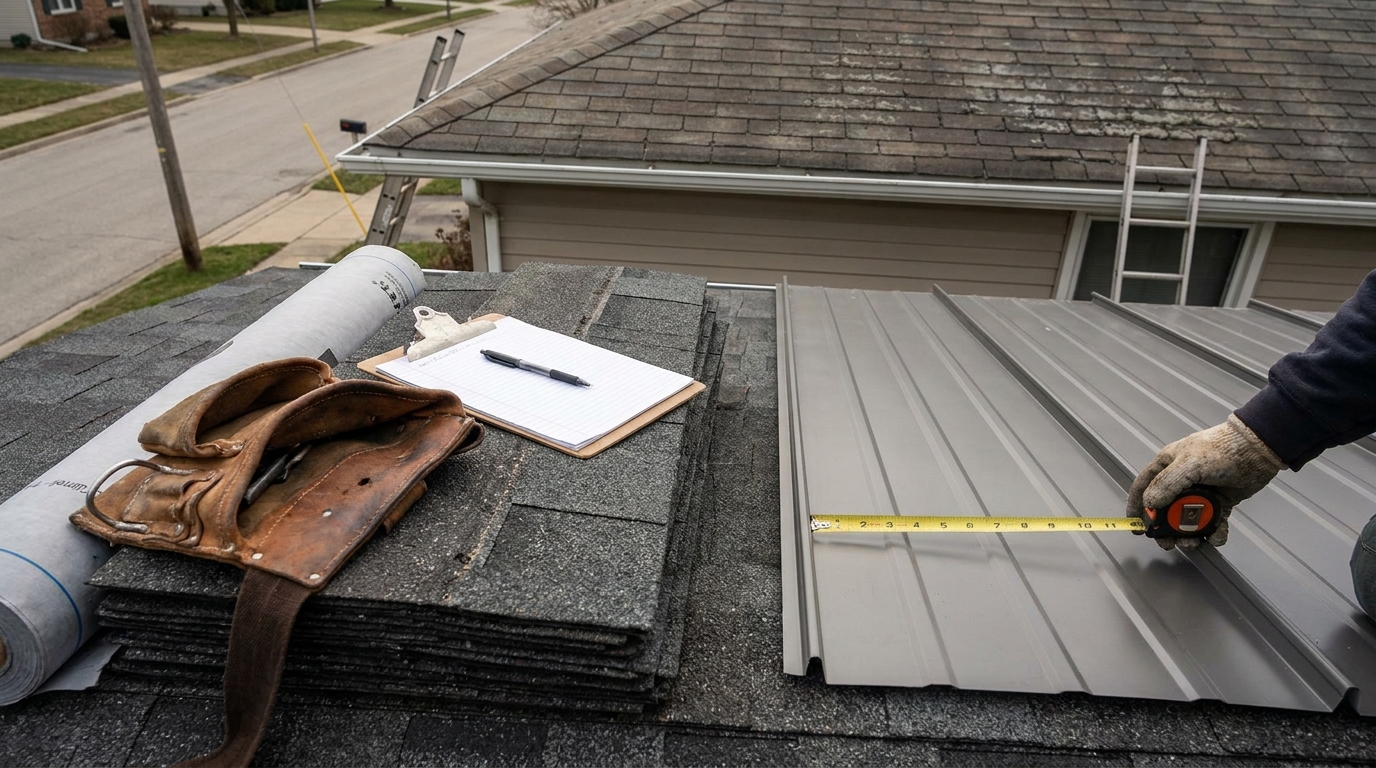
If you got a roofing quote in August 2026 and it landed higher than the number a neighbor quoted you last fall, you are not imagining it and your contractor is probably not padding it. Asphalt shingle prices went up three separate times this spring and early summer, and the increases stack.
Here is the part that gets misreported: those increases did not make metal roofing cheaper than asphalt. Not nationally, not in any region, not close. What they did was narrow the gap on a different measurement, cost per year of service, and shift some real money in the insurance column. That is a smaller and more specific story than "metal is now the better deal," and it is the true one.
What Actually Happened, In Order
Manufacturers announced these in February 2026. Distributors passed them through in June. Homeowners started seeing them in quotes in July and August. That lag is why this feels sudden even though it was telegraphed six months out.
| Effective date | Who | Increase |
|---|---|---|
| Mar 23, 2026 | TAMKO | 4% to 5% |
| Apr 1, 2026 | Atlas | 5% to 8% |
| Apr 1, 2026 | Owens Corning (shingles and accessories) | 5% to 8% |
| Apr 15, 2026 | GAF (residential roofing) | 5% to 8% |
| Apr 15, 2026 | CertainTeed (roofing) | up to 8% |
| Jun 1, 2026 | GAF, Owens Corning, CertainTeed (round two) | roughly 6% to 9% |
| Jun 1, 2026 | SRS Distribution (all residential products) | 6% to 10% |
| Jun 22, 2026 | Mueller Roofing Distributors (steep-slope and accessories) | up to 9% |
Malarkey also took up to 8% in the spring round. The effective dates above come from the actual manufacturer letters archived by Carolina Atlantic Roofing Supply, with percentages compiled by RoofSmart and the summer distributor round logged by Mueller Roofing Distributors.
One correction to how this often gets summarized: the June 1 round is not purely a distributor markup. Three of the big shingle manufacturers took a second increase that same day, and SRS layered its own on top. So it is three increases in ten weeks, from makers and distributors together, not two from makers plus one from middlemen.
The Correction You Need Before Anything Else: Metal Did Not Get Cheaper
There is a claim circulating that metal roofing has dropped to around $4.50 per square foot installed and now undercuts asphalt. Every 2026 pricing source says otherwise.
-
Installed asphalt, 2026: roughly $4.50 to $8.00 per square foot nationally. Architectural shingles in the Mid-Atlantic run $4.80 to $8.20.
-
Installed metal, 2026: roughly $9 to $16 per square foot, with standing seam at $10 to $18.
Metal is still about 2.2 to 2.5 times the cost of asphalt, and per RoofReport's regional breakdown, that ratio holds in every region surveyed. It does not invert anywhere.
So where does $4.50 come from? That is bottom-of-market exposed-fastener corrugated steel. Screws through the face of the panel, visible gaskets, the material you see on pole barns and equipment sheds. It is a legitimate product for the right building, but comparing it to architectural asphalt on a house is comparing two different roofs. A standing seam system, the one people picture when they picture a metal roof, is priced in that $10 to $18 band.
The premise fails a second time on direction of travel. Metal input costs are rising faster than asphalt right now. From the same distributor letter logs: Gibraltar took up to 10% on aluminum trim and flashing plus 8% on steel effective June 1. Metal Sales raised accessories June 8. US Aluminum went 5% to 8% on June 15. ALSCO took up to 10% on aluminum June 26.
Behind those is tariff policy. A June 2026 presidential proclamation re-tiered the Section 232 regime effective June 8, 2026: 50% on articles made entirely of steel or aluminum, 25% on derivative products predominantly composed of those metals, and 10% on derivatives made from U.S.-smelted and melted metal. Rates are set to revert on January 1, 2028. Roofing coil sits in the 50% bucket.
Nobody found production efficiencies. Metal got more expensive too.
So What Did Change: Cost Per Year, Not Cost At Signing
The honest version of the argument is a lifecycle one. Asphalt did not get cheap enough to change your decision, but it got expensive enough that the per-year comparison is worth actually running.
Take a 2,000 square foot roof (20 squares) in the Mid-Atlantic. Using regional per-square figures, asphalt lands roughly $8,000 to $11,000, and a typical full replacement in Pennsylvania comes in around $12,500 once tear-off, decking repairs, and accessories are in. Metal at $900 to $1,400 per square puts the same roof at roughly $18,000 to $28,000.
Now divide by service life. Architectural asphalt is commonly cited at 15 to 25 years, with intense UV exposure pushing toward the low end. For metal, the Metal Construction Association and Zinc Aluminum Coaters Association studied 14 buildings across five U.S. climate regions, combining field inspection with lab corrosion analysis, and concluded that unpainted 55% aluminum-zinc coated (Galvalume) standing seam roofs exceed 60 years of service, with ancillary component replacement costing well under 20% of a full roof replacement over that span.
Run it: $12,500 over 20 years is about $625 a year. $23,000 over 50 years is about $460 a year. Metal comes out ahead on that measure, and this year's shingle increases pushed the asphalt number up while doing nothing to shorten metal's life.
Three caveats, because this arithmetic gets abused. It ignores the time value of money and the fact that you pay metal's premium today in one lump. The MCA study is industry-association research and covers unpainted Galvalume specifically, not every metal product. And a per-year figure is only meaningful if you actually own the house for those years. Which brings us to the section most pro-metal articles skip.
Resale: Where Metal Loses, Consistently
The annual Cost vs. Value Report from Zonda and JLC tracks what home improvements recoup at resale. In the 2025 edition, its 38th, asphalt shingle roof replacement showed a $31,871 job cost against $21,501 in resale value, recouping 68%. Metal replacement showed $51,865 against $25,972, recouping 50%. The 2024 edition told the same story: asphalt 56.9%, metal 48.1%. These figures are restated here; the Cost vs. Value Report is the underlying source and worth checking against the current edition.
The implication is blunt. If you are selling within five to seven years, asphalt is the financially correct answer. You will not get metal's premium back at closing, and you will not be around long enough to collect the per-year advantage that justifies it. There is no version of the lifecycle argument that rescues metal for a short holding period.
The Insurance Chapter, Where Real Money Actually Moved
This is the strongest genuine argument for metal in 2026, and it has two sides.
Roof age and the depreciation cliff
Carriers have been steadily moving older roofs off replacement cost coverage and onto actual cash value. Thresholds get cited around the 10 to 15 year mark, with non-renewal pressure building near 20. Under ACV, depreciation comes out of your payout, so an 18-year-old asphalt roof can be worth a fraction of what it costs to replace when you file a claim.
A roof rated for 40 to 60 years never enters that schedule during a normal ownership period. That is not a discount you can put a number on, but it is a real difference in what your policy is worth after a storm. One important qualifier: percentage-by-age depreciation tables vary by carrier, policy form, and state. Do not trust a table you found online. Ask your own carrier what happens to your roof coverage at year 12, year 15, and year 20, and get the answer in writing.
The counterweight: cosmetic damage exclusions
Cosmetic damage exclusion endorsements remove coverage for hail damage that affects appearance without impairing function. The textbook example in these endorsements is hail dents on metal roofing panels, metal gutters, and flashing. They are most common in hail-prone states including Texas, Colorado, and Missouri, and they are spreading.
Here is the trap. These are endorsements, not part of the standard HO-3 form, so they will not show up unless you read your declarations page. A metal roof in a hail state can earn an impact-resistance credit and simultaneously carry an exclusion that makes hail dents non-claimable. You get the discount and lose the claim. Check for this before you sign a metal contract in hail country, not after.
Impact-Resistant Credits, Stated Accurately
Roofing materials that pass impact testing are classed 1 through 4, with Class 4 earning the highest premium credit. The Texas Department of Insurance explicitly lists formed metal panels or sheets as eligible for these ratings.
The essential caveat, straight from TDI: the discount amount is set by each insurance company on a company-by-company basis. It is not a mandated rate. If you see an article promising a specific percentage off your premium for a Class 4 roof, that number came from somewhere other than your policy. Call your carrier, give them the specific product and class rating you are considering, and ask what credit they apply. Do that before you buy, because the answer sometimes changes the whole calculation.
The Four Myths, Handled Briefly
Per Sheffield Metals (a manufacturer-affiliated source, so weigh it accordingly):
-
Noise. Properly installed metal over solid decking with underlayment is not measurably louder than other roof types. The "loud metal roof" reputation traces to uninsulated open barns and warehouses, which is a different assembly entirely. The qualifier matters: decking, insulation, and install quality are what make this true.
-
Denting. Typical hailstorms are unlikely to dent metal, and metal products can achieve UL 2218 Class 4, the top impact-resistance class. Gauge matters here. Pair this with the cosmetic exclusion point above, because "unlikely to dent" and "covered if it dents" are separate questions.
-
Lightning. Metal roofs do not attract lightning.
-
Rust. Depends entirely on the metal. Bare steel rusts. Galvalume (55% aluminum, 43.4% zinc, 1.6% silicon) resists it. Aluminum forms white rust rather than red. Copper and zinc patina. Ask what specific alloy and coating you are being quoted.
Regional Spread
Per-square (100 square feet) installed costs for 2026:
| Region | Asphalt per square | Metal per square | Typical 2,000 sq ft project (asphalt) |
|---|---|---|---|
| Southeast | $350 to $450 | $750 to $1,200 | $6,500 to $11,000 |
| Mid-Atlantic and Northeast | $400 to $550 | $900 to $1,400 | $10,000 to $15,000 |
| Mountain West | $350 to $475 | $800 to $1,200 | $7,000 to $11,500 |
The Southeast benefits from proximity to shingle manufacturing. The Mid-Atlantic and Northeast carry higher labor rates and stricter code requirements. The Mountain West deals with hail exposure and high-altitude UV, which is the region where the impact-resistance conversation is most worth having. Note that the metal-to-asphalt ratio stays roughly 2.2x to 2.5x across all three.
For Mid-Atlantic texture, Coolwater's 2026 price report documented a 28-square job in York County, Pennsylvania at $13,500 to $15,500 in April 2026, against roughly $12,000 to $13,500 for comparable work in 2025. That is about a 3% to 6% year-over-year move on a real job, which is roughly what you would expect the spring manufacturer round to produce once it works through labor and overhead.
Who Metal Actually Wins For
Not a verdict, a checklist. Metal makes financial sense when you can check most of these:
-
You expect to own the house 18 or more years. This is the load-bearing item. Without it, nothing else on the list matters.
-
You have hail or wildfire exposure and you have called your carrier and gotten a confirmed credit amount in writing.
-
You have checked your declarations page for a cosmetic damage exclusion and it is not there, or you have confirmed you can get it removed.
-
Your roof geometry suits panels. Long straight runs, simple planes, minimal penetrations. Complex cut-up roofs with many valleys, dormers, and hips drive metal labor costs up disproportionately.
-
You have no plan to sell soon.
Metal does not win if you are selling inside seven years, if you need the lowest possible number this year, if your roof is heavily cut up, or if you are in a hail state with a cosmetic exclusion on your policy. In those cases architectural asphalt is the right answer and paying the 2026 increase is simply the cost of a roof this year.
Timing and How To Read Your Quote
Waiting does not help. The 2026 increases were announced in February and landed in two discrete waves. They reset a baseline rather than starting a monthly climb. And the tariff structure driving metal and accessory costs runs through the end of 2027 before reverting, so there is no near-term relief on that side either.
There is no federal tax credit coming for either material. The Section 25C Energy Efficient Home Improvement Credit applies only to qualifying property placed in service before December 31, 2025, and per the IRS list of qualifying expenses, roofs and roofing materials were never on it. Only solar shingles and solar roof tiles ever qualified, and that was under a different section (25D). If a salesperson mentions a roofing tax credit, that is a red flag about everything else they are telling you.
Check the date on your quote. Anything written before mid-March 2026 predates all three increases and will be re-priced. If a contractor is honoring an older number, get the honor-until date in writing.
Ask for a line-item re-price. Have the contractor break out shingles, underlayment, ridge and hip accessories, flashing and drip edge, disposal, and labor separately. The accessory line is where a lot of this year's increase hides, since several manufacturers raised accessories alongside or ahead of the shingles themselves. A quote that gives you one lump number makes it impossible to tell whether you are absorbing a real material increase or a margin adjustment.
Get three quotes and compare the same product. If one bid is dramatically lower, look at what shingle line it specifies (3-tab versus architectural) and what metal profile (exposed-fastener versus standing seam) before you conclude anything.
The Takeaway
Asphalt got expensive enough to make metal worth pricing. It did not get expensive enough to make metal the default. If you are staying put for two decades, have hail exposure, and can get a carrier to put a credit number in writing, run the metal quote and run it seriously. If you are selling in five years, buy the architectural shingles, get the increase re-priced line by line, and move on.
Related reading
Sources
-
Price Increase Announcements & Letters, Carolina Atlantic Roofing Supply (archive of the actual manufacturer letters and effective dates)
-
Vendor News, Mueller Roofing Distributors (summer 2026 distributor round and metal-side increases)
-
How Much Have Manufacturers Increased Roof Material Prices in 2026?, RoofSmart
-
Roofing Price Report 2026: What Mid-Atlantic Homeowners Are Paying, Coolwater
-
MCA/ZAC study on steel roof service life (industry association research, covers unpainted Galvalume standing seam)
-
Metal Roofing Myths, Sheffield Metals (manufacturer-affiliated)
-
Roof Replacement ROI & Resale Value Report, The Roofing Brief (restating Zonda/JLC Cost vs. Value Report figures)
-
Energy Efficient Home Improvement Credit, Internal Revenue Service
-
Producer Price Index: Asphalt Felts and Coatings (WPU136), FRED, St. Louis Fed (official BLS index if you want to track asphalt input prices yourself)
Note: This article contains AI-assisted content and has been reviewed by our editorial team.
ABOUT THIS SERVICE: CallTheLocal.com is a directory and lead generation service, not a contractor or service provider. Submitting this form does not obligate you to hire anyone or purchase any service. Your information will be shared with licensed, insured home service professionals in your area who may provide quotes for your project. CallTheLocal.com does not guarantee the quality, timeliness, or outcome of any work performed by service providers you connect with through this service. Always verify licensing, insurance, and references before hiring. Get everything in writing before work begins.