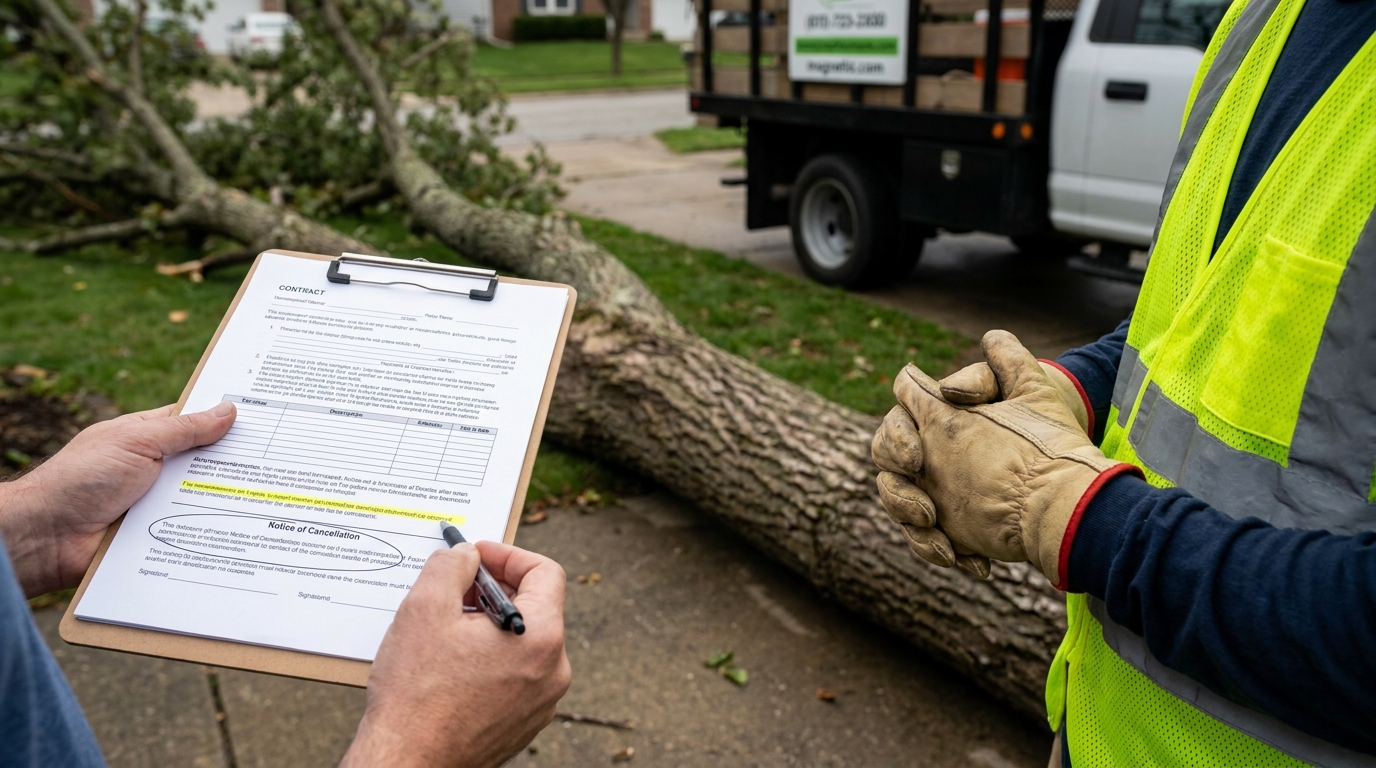
Two trees were down on an elderly Lake County homeowner's property after the August storms. The crew that showed up quoted $40,000 to take them out, then came down to $35,000. According to the state of Indiana, she paid because she felt she had no time to think about it. Corinne Gilchrist of the attorney general's office described it plainly: she felt pressured to act quickly, and pay.
On Sept. 2, 2026, Indiana Attorney General Todd Rokita announced civil lawsuits over that job and others like it. "When you're at your lowest emotionally, and you're weary, that's when the bad guys will be bad guys," Rokita said, per WRTV Investigates. "We are going after you. This isn't the end. This is the beginning."
Here is the useful part for anyone with a blue tarp on their roof right now: nearly every allegation in those complaints describes something a homeowner can catch on the driveway, before signing, in about five minutes. Not with legal training. With a phone and a willingness to say "come back tomorrow."
What the state says these crews did
The suits target four companies: TimberCut Tree Experts LLC, Shade Tree Service Co., Garrison McKinney Tree and Bridge, and Storm Support Emergency Tree Removal LLC. Coverage from WFYI also names an individual contractor, David Foster.
The alleged conduct falls into four buckets, and they repeat across defendants:
-
Working without the required license. TimberCut and Shade Tree Service are both accused of removing trees without proper licensing.
-
Never disclosing rates or estimates. Storm Support Emergency Tree Removal is tied to five identified homeowners from northern Indiana down to Indianapolis, allegedly charged thousands more than they expected.
-
Contracts missing terms Indiana law requires. More on that below, because this is the one you can check fastest.
-
Telling homeowners insurance would simply cover it. A promise no contractor is in a position to make.
The state wants injunctions, restitution, and civil penalties. The $5,000 figure in news coverage traces to Indiana Code 24-5-0.5-4, which allows up to $5,000 per knowing violation of the Deceptive Consumer Sales Act, and up to $15,000 per violation of a resulting injunction. Rokita said these are civil cases but did not rule out criminal referrals.
Worth knowing how the office found them: according to WISH-TV's I-Team, the AG's outreach staff visited more than 40 storm-hit communities and knocked on more than 750 doors in August. Two additional civil investigative demands went out alongside the lawsuits.
Over $150, it has to be in writing
This is the line that starts everything. Indiana Code 24-5-11-4 defines a real property improvement contract as one where the price exceeds $150. Above that, IC 24-5-11-10 requires the contract be written in a form you can reasonably read and understand, and requires it to contain all of the following:
-
Your name and the property address
-
The contractor's name, address, and email
-
A named contact, with phone and email, for when something goes wrong
-
The date it was submitted and any deadline for you to accept
-
A reasonably detailed description of the work
-
A statement that specifications will be delivered before work starts, if they are not already attached
-
Approximate start and completion dates
-
Contingencies that could push the completion date
-
The total contract price
-
Disclosure of any subcontractors or third-party vendors
-
Signature lines with legibly printed names for the contractor and every homeowner signing
Changes have to be signed in writing to be enforceable. A verbal "we found more damage, it'll be another four grand" is not a change order.
And here is the ten second tell. The contractor has to sign before you are asked to sign or hand over any money. If a clipboard comes at you with a blank contractor signature line, you are already outside the statute, and you have learned everything you need to know about how this company operates.
Three business days to cancel, and the clock may not have started
For contracts signed after June 30, 2017, IC 24-5-11-10.6 gives you until midnight of the third business day to cancel. The part almost nobody reports: that clock runs from the later of the day you signed or the day you receive your insurer's written coverage determination.
Picture the common version of this. You sign on Aug. 14 with water still coming in. Your adjuster's written decision lands Sept. 8. Your three days do not start until that letter arrives. Most homeowners assume the window died three weeks earlier and never ask.
The contractor also has to hand you a detachable NOTICE OF CANCELLATION in at least 10-point boldface, showing the address and email where you send it. If you cancel, they have ten business days to return all payments, deposits, and any evidence of indebtedness you signed.
Separately, if the crew came to your door uninvited, Indiana's home solicitation sales law (IC 24-5-10) layers on its own three business day cancellation right for transactions of $25 or more, with two copies of a written notice in 10-point bold on a separate document, refund within ten business days, and no waiving it.
The exception that matters most in a storm
Do not read the paragraph above as "I can cancel and get everything back." You cannot, and being wrong about this mid-storm is expensive.
Both IC 24-5-11-10.6 and IC 24-5-11-10.5 let a contractor keep reasonable compensation for emergency or temporary work you approved in writing before it was performed to prevent further damage to the property. That is exactly the tarp-over and board-up scenario. If you pre-approved it in writing, canceling does not claw it back.
Which gives you the single best move available on a bad night: sign a small, separately priced emergency stabilization authorization for the tarp or the board-up, and nothing else. Keep the permanent roof or the tree removal on its own contract, signed later, that you can still cancel. Crews that want the whole job locked in inside the emergency paperwork are counting on you not knowing the difference.
"We'll cover your deductible" means walk away
IC 24-5-11-10.5(a) bars a contractor from advertising, offering, or promising to pay or rebate any part of your insurance deductible to get the job. Any part, in any form: allowances, discounts, compensation, gifts, prizes, referral fees. There is no clever version of this that is legal.
The companion red flag is less famous and just as useful. Subsection (d) bars the contractor from acting as a public adjuster. So the crew offering to "handle the whole claim for you" is describing a role Indiana law says they cannot fill. Your adjuster works for your insurer. A public adjuster, if you want one, is a separately licensed person who is not also swinging a hammer on your roof.
"FEMA will pay for all of this" is a lie
The federal major disaster declaration for the Aug. 11 storms, DR-4933-IN, was approved Aug. 25, 2026. Individual Assistance covers 21 counties: Carroll, Dearborn, Decatur, Delaware, Fayette, Franklin, Hamilton, Hancock, Henry, Lake, LaPorte, Madison, Marion, Morgan, Porter, Pulaski, Randolph, Rush, Tipton, Union, and Wayne. Public Assistance covers 11.
None of that is a payment guarantee to a repair crew. In FEMA's own words, the agency does not endorse any commercial business, product, or service. FEMA and SBA staff never charge for disaster assistance, inspections, or help with an application. FEMA inspectors verify damage; they do not hire, endorse, or recommend contractors. And FEMA money goes to survivors as a supplement after insurance, which is why applicants are told to file with their insurer first.
The real path is DisasterAssistance.gov, the FEMA app, or 800-621-3362. The Individual Assistance application deadline has been reported as Oct. 25, 2026; check fema.gov/disaster/4933 before you rely on it, because these get extended. If someone claims a FEMA connection to get your money or your application information, report it to StopFEMAFraud@fema.dhs.gov or the National Center for Disaster Fraud hotline at 866-720-5721.
The tree number nobody volunteers
A tree already lying in your yard is one of the cheapest removals in the business. National pricing from Fixr, updated January 2025, puts a storm tree that is already down at $75 to $150. That figure is your direct rebuttal to a four-figure "emergency" quote on a trunk that is not going anywhere.
Genuine emergency work, meaning a standing hazard leaning on your house or into a service line, is a different job and a different price. The national ranges:
| Job | National range |
|---|---|
| Tree removal, national average | $435 (typical $400 to $1,100) |
| Up to 30 ft | $150 to $400 |
| 30 to 60 ft | $450 to $700 |
| 60 to 100 ft | $900 to $1,200 |
| 100+ ft | $1,300 to $2,000 |
| Storm tree already on the ground | $75 to $150 |
| Emergency removal (standing hazard) | $450 to $5,000 |
| Debris removal and chipping | $150 to $300 |
| Stump grinding, per stump | $100 to $500 |
| Crane-assisted work, 80+ ft | $1,500 to $2,500 |
What legitimately moves a quote: crane access when there is no drop zone, proximity to the house or to power lines, hauling and disposal, and true after-hours crew time. What does not move it is your stress level. Two trees at $35,000 is not any of the ranges above, in any region, under any conditions.
What a fair emergency invoice looks like
Emergency tarp and board-up pricing varies too widely by roof pitch, square footage, and region for us to quote a single number honestly, and we would rather say that than print one we cannot stand behind. What we can tell you is what the paperwork should look like, because that is where you actually have leverage.
A fair emergency invoice is itemized: crew hours and rate, equipment, materials, disposal. A lump sum labeled "emergency services" with a dollar figure and nothing else tells you nothing and cannot be disputed later. And the stabilization scope should be priced separately from the repair, on its own document, for the cancellation reason above.
If a crew will not break out hours and equipment on a tarp job, ask yourself what the itemization would reveal.
Three documents before any deposit
-
The signed contract, with every required term above and the detachable cancellation notice attached. Contractor signature already on it.
-
A certificate of insurance for general liability and workers' compensation, sent to you directly by the insurance agency. Not a photocopy from the truck, not a phone screenshot. Call the agency on the certificate and confirm the policy is active. If an uninsured worker gets hurt in your yard, that becomes your problem.
-
Proof of the local license or permit for the city or county your house actually sits in, not the one the truck is registered in.
On deposits: a reasonable one covers materials, not the contractor's payroll for the month. Large up-front cash, especially cash specifically, is the pattern that shows up in every one of these cases. And no change order is real until it is signed by both of you.
The five minute lookup is three tabs, not one
Say this clearly, because a lot of storm crews rely on the confusion: Indiana does not license general contractors or tree services at the state level. There is no statewide tree removal license and no statewide GC license. A crew telling you "we're state licensed" for tree work has told you nothing at all.
So the check is a sequence:
-
Tab one, your city or county. This is where contractor licensing actually lives. In Marion County it runs through the Indianapolis Department of Business and Neighborhood Services, searchable on the public Citizen Access portal under Business Licenses and the Permits and Contractors tab. Outside Marion County, call your city or county office. Separately, a crew working your neighborhood door to door needs a county transient merchant license under IC 25-37-1, filed with the county auditor, and some cities such as Richmond and Gas City run their own solicitation permits. A door-knocking crew with neither is unlicensed in exactly the sense the attorney general is using.
-
Tab two, the Secretary of State. Search INBiz for the business name printed on the contract. You are confirming the entity legally exists, under that name, and is not a truck magnet invented last week.
-
Tab three, credentials. mylicense.in.gov verifies the professions Indiana does license at the state level, including plumbers and home inspectors, and searches by name, license number, city or county, DBA, and status. If a crew claims ISA Certified Arborist status, verify it at the ISA certificate directory. That credential signals real training, and it is voluntary. It is not a government license and it is not permission to work.
The paperwork is the price protection
One last thing, and it is the part that reframes everything above. Indiana's price-gouging statute, IC 4-6-9.1, covers fuel. Only fuel. There is no general anti-gouging law for storm repair in this state.
That is why the attorney general charged these cases as unlicensed work, undisclosed rates, and defective contracts rather than as overcharging. No agency is going to rule that $35,000 was too much for two trees. The remedy runs through the Deceptive Consumer Sales Act and what the paperwork does or does not say.
Which means your price protection is not a statute waiting to rescue you. It is a written scope, an itemized invoice, and one second bid. Even at 9 p.m. with a tree on the garage, a second phone call costs you an hour and can cost the crew the job.
To report a contractor, contact the Indiana Attorney General's Consumer Protection Division at IndianaConsumer.com or 1-800-382-5516 (confirm the current line on the office's page). The office also publishes a storm chaser consumer guide, and back on Aug. 18 it told Hoosiers the same three things it is now suing over: get everything in writing, demand written change orders, and refuse any contractor offering to cover your deductible.
Rokita's line about the lawsuits was that this is the beginning, not the end. Your version of that is simpler. The crew that will still be there tomorrow morning is the one worth signing with.
Related reading
-
[Repair the Springs or Replace the Whole Garage Door?](/guides/repair-garage-door-springs-or-replace-door)
Sources
-
WRTV Investigates: Indiana Attorney General files lawsuits against storm contractors for scams
-
WISH-TV I-Team: Indiana Attorney General files lawsuits against storm contractors
-
WFYI / IPB News: Rokita warns scammers taking advantage of state disaster
-
Insurance Journal: Indiana Attorney General Warns Residents of Scammers Following Storms
-
Indiana Code 24-5-11-4: real property improvement contract, $150 threshold
-
Indiana Code 24-5-11-10: required contract terms
-
Indiana Code 24-5-11-10.6: right to cancel, notice, refunds, emergency services
-
Indiana Code 24-5-11-10.5: insurance deductibles and public adjusters
-
Indiana Code 24-5-0.5-4: Deceptive Consumer Sales Act remedies
-
Indiana Code 4-6-9.1-2: price gouging (fuel)
-
Indiana Code 24-5-10: home solicitation sales, right to cancel
-
FEMA: Major Disaster Declaration for Indiana, county lists
-
FEMA Disaster DR-4933-IN
-
FEMA: Beware of Fraud and Scams
-
Indiana DHS: August 2026 Disaster
-
Indiana Attorney General: Consumer Protection Division
-
Indiana Professional Licensing Agency: license verification
-
Indianapolis / Marion County Citizen Access Portal
-
ISA Certified Arborist verification directory
-
Fixr: Tree Removal Cost (national, updated Jan. 31, 2025)
Note: This article contains AI-assisted content and has been reviewed by our editorial team.
ABOUT THIS SERVICE: CallTheLocal.com is a directory and lead generation service, not a contractor or service provider. Submitting this form does not obligate you to hire anyone or purchase any service. Your information will be shared with licensed, insured home service professionals in your area who may provide quotes for your project. CallTheLocal.com does not guarantee the quality, timeliness, or outcome of any work performed by service providers you connect with through this service. Always verify licensing, insurance, and references before hiring. Get everything in writing before work begins.
Related reading
- Florida's License Lookup Says 'Active.' A New Investigation Explains Why That Doesn't Mean 'No Complaints.'
- The Crew That Didn't Show Up: 349,000 Missing Workers and Why Your Start Date Keeps Sliding
- One in Three Skilled Tradespeople Are Immigrants: How the 2026 Labor Crackdown Is Stretching Your Project Timeline and Quote