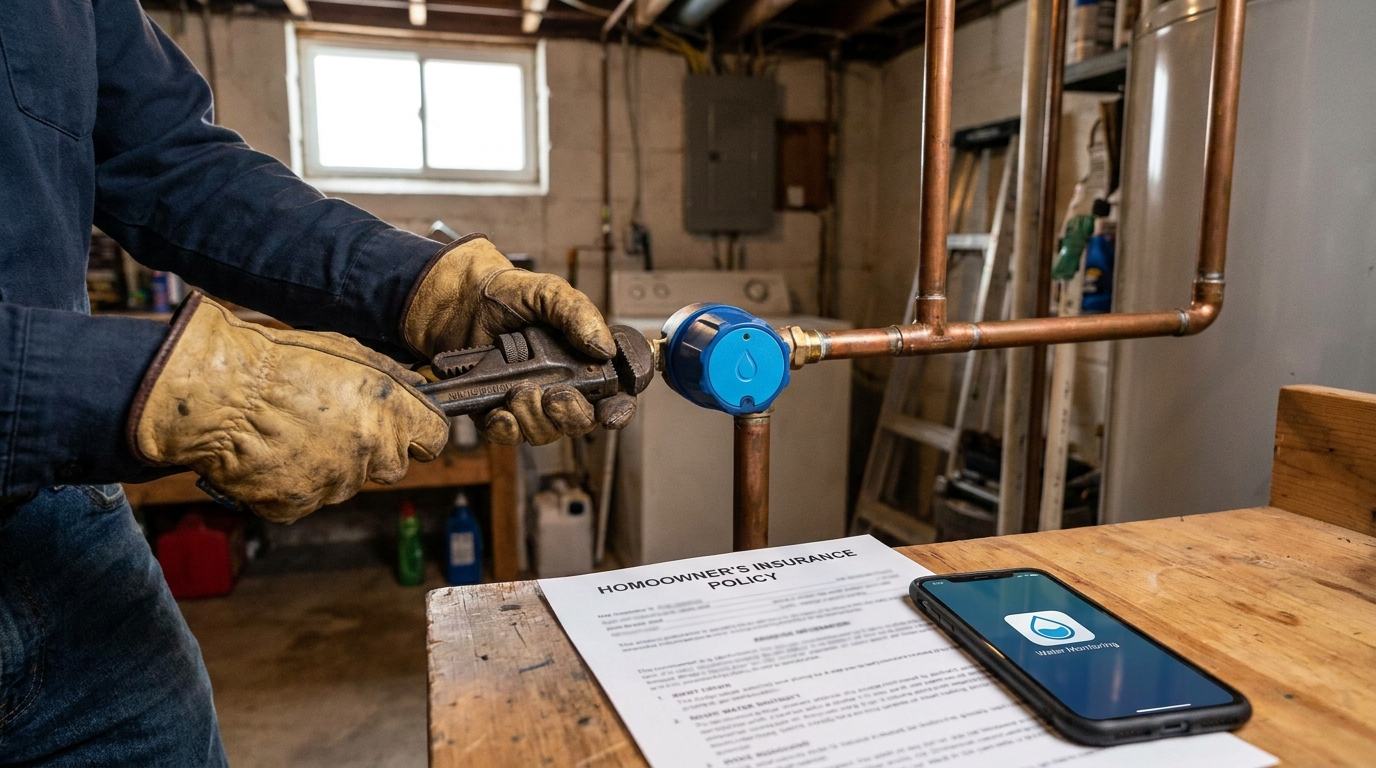
There is a new line showing up on renewal notices, and it is not a rate increase. It is a request for hardware. Your carrier wants an automatic water shutoff device installed on your main water line, and depending on where you live and how old your house is, it is either dangling a premium credit to get you to do it or making it a condition of keeping the policy.
If you assumed fire or theft was driving your homeowners premium, the numbers say otherwise. Water is the quiet, chronic peril, and it is the one insurers are now trying to engineer out of your house. Here is what the devices cost, what the discounts are actually worth, what the research does and does not prove, and the coverage gaps nobody selling you a valve is going to mention.
Why water, not fire, is driving this
Start with the industry data. According to the Insurance Information Institute, water damage and freezing claims averaged $13,954 each over the 2018 to 2022 period, at a rate of 1.61 claims per 100 house-years. More telling is the trend: the peril accounted for 19.6% of all homeowners losses in 2020 and 27.6% by 2022. More than a quarter of everything carriers pay out on home policies is water.
California carriers have been the loudest about it. In an April 2021 announcement, Mercury Insurance said that more than 40% of a home's premium in California is attributable to the non-weather water peril alone. That is burst supply lines, failed water heaters, and slow leaks, not storms. Mercury's own 2017 to 2020 claims data showed non-weather water claims were five times more likely than theft and ten times more likely than fire.
Read that again, because it reframes the whole conversation. The thing most likely to generate a claim on your house is not a burglar or a kitchen fire. It is a pipe.
Two different letters: a discount offer and a requirement
Homeowners are running into two separate things right now, and it matters which one landed in your mailbox.
The discount offer. Mercury currently runs leak detection discounts in Arizona, California, Georgia, Illinois, New Jersey, Nevada, Oklahoma, Texas and Virginia. Its program page states average annual premium savings of about $75 for a monitor-only device like Flume and about $100 for a qualifying device with automatic shutoff. When the program launched in 2021, it also included a $400 subsidy toward professional installation of a Flo by Moen unit, paired with a 10% discount applied to a portion of the homeowners policy. Hold onto that phrase. It comes back later.
The requirement. This is the newer development, and it is concentrated in California. According to a broker summary citing the trade publication Property Insurance Report, State Farm began requiring automatic shutoff valves in February 2023 for California policyholders with $2 million to $4 million in replacement cost, having previously applied the rule to secondary homes at $1.5 million and up. Farmers has reportedly required them since 2022 on California homes over 30 years old whose plumbing has not been updated in 20 years, or with replacement values of $1 million and up. The Hanover has begun requiring them on new standard and high-net-worth policies.
Treat those thresholds as trade-reported rather than carrier-confirmed. The underlying report is paywalled and the numbers come to us secondhand. If your renewal hinges on this, call your agent and get the requirement in writing with the specific deadline attached. Do not plan around a blog post, including this one.
The three tiers of leak hardware
Consumer Reports sorts these products into three categories, and the split is genuinely useful because it maps to whether you need a plumber.
Tier 1: battery puck sensors (they alarm, that is all)
These are hockey-puck sensors you set on the floor next to the water heater, behind the toilet, under the kitchen sink. Wirecutter's top pick, the YoLink Water Leak Sensor 4, runs roughly $23 to $35 per sensor with multi-year battery life and a loud local alarm.
What they do: scream when water touches them. What they do not do: turn anything off. They also only work if water physically reaches the puck, which is a real limitation we will come back to.
Tier 2: clamp-on valve actuators (no plumber, no cut pipe)
This is the tier most homeowners have never heard of, and it is the sweet spot for a lot of houses. A Guardian by Elexa unit clamps over your existing metal quarter-turn ball valve, sized 1/2 inch to 1-1/4 inch, and physically turns it. No pipe cutting, no plumber, no hub required. When its sensors get wet, it closes the main.
The best feature is one you will appreciate on vacation: it triggers shutoff even when your internet is down. It is also sensor-triggered, which means it inherits Tier 1's blind spots. It closes the main only after a puck gets wet.
Tier 3: in-line whole-home valves (the ones carriers usually mean)
These get plumbed directly into your main line and continuously watch what is flowing through it. Two dominate the category:
-
Moen Flo Smart Water Monitor and Shutoff, $623.99 for the device, available in 3/4 inch, 1 inch and 1-1/4 inch. Moen recommends installation by a licensed plumber.
-
Phyn Plus (2nd generation), $579.99, which uses high-definition pressure-wave analysis instead of flow measurement. It needs Wi-Fi and an electrical outlet within 12 feet, and adapters are sold separately.
Phyn does not hedge on installation. Its install page states plainly that DIY installation is not recommended for most homeowners. The main line has to be cut, the unit goes in after the main shutoff valve and the pressure regulator, and a plumber should budget one to two hours.
What it actually costs
Device price is the easy part. Add to any Tier 3 purchase: plumber labor, adapters, and whatever your particular main line does to complicate the job.
Here is the honest warning. If you search for installed cost, you will find widely circulated estimates in the $3,000 to $5,000 range. Those numbers are not credible for a standard install and they appear to be aggregator content rather than plumber pricing. Get two written quotes from local licensed plumbers instead. Labor rates vary substantially by metro, and a main line that is buried, tucked into a crawlspace, or short on accessible straight pipe raises the job materially. A main sitting exposed in an accessible basement is a very different ticket than one behind finished drywall.
Also worth pricing: monitor-only options. Flume 2 is $149 for the monitor alone, or $269 bundled with Flume Insight at $49.99 per year. It straps to your water meter, so no plumber. It also never shuts your water off.
Does the discount pay for the device?
Run the arithmetic before you get excited. Typical credits land in the neighborhood of $75 to $150 per year. Against a $580 to $624 device plus a plumber, you are looking at a multi-year payback at best on the discount alone.
And there is a catch in how percentage credits work. Mercury's 2021 launch offered 10% on a portion of the policy, not 10% off the whole premium. Percentage credits are frequently applied to a coverage sub-line, so a "10% discount" can translate to a much smaller dollar figure than you would assume from your total bill. Ask for the projected dollar amount, not the percentage.
So no, the discount is usually not the reason to buy. The reasons that actually hold up are these two: avoiding a catastrophic loss that averages just under $14,000 and comes with a deductible, a claim on your record, and weeks of your life spent on repairs; and, for a growing set of policyholders, staying eligible for coverage at all. If your carrier has made this a renewal condition, the payback math is irrelevant. The alternative is shopping the non-admitted market.
What the evidence actually shows
You will see one statistic everywhere in this category. In May 2020, LexisNexis Risk Solutions reported that homes with a Flo by Moen in-line shutoff saw a 96% drop in water claim events and 72% lower claim severity in the year after installation, while an uninstalled control group saw claims increase 10%.
That is a striking result and it points in the right direction. It is also not a clean randomized trial, and three caveats deserve to travel with the number:
-
The study covered 2,306 Flo homes. That is a real sample, not a huge one.
-
It was run using the manufacturer's data, in partnership with the manufacturer.
-
LexisNexis itself noted that Flo homes had elevated claims severity before they bought the device. People who buy leak hardware are disproportionately people who have already had a water problem or worry they will. That self-selection cuts both ways and it is not controlled for.
Treat 96% as directional evidence that these devices work, not as a guarantee you will never have a water claim.
What a shutoff valve will never catch
This is the part that gets left out of the sales pitch, and it is the most important section here.
A main-line valve only sees water passing through the main. That is a structural limit, not a product flaw. Invisible to it: drain lines, sewer backup, your dishwasher and washing machine drain hoses, HVAC condensate, and roof intrusion. If your basement floods because the sewer backed up during a storm, a $624 valve on your supply line does exactly nothing.
Floor sensors only catch water that pools on a floor. A supply line leaking inside a wall can run down a stud bay and into a cavity without ever touching a puck. A water heater pan that drains to a floor drain never pools either.
Slow drips can hide inside normal usage. Flow-based systems trip on continuous flow, so a genuinely slow supply-side drip can blend into your household's normal consumption. State Farm's consumer guidance notes that some whole-house systems detect flows as small as a half-ounce per minute, which is impressive but still a threshold. Phyn attacks this from a different angle with its Plumbing Check function, which runs a pressure test with the water shut off at the main and can surface pinhole leaks and bad seals in minutes. That is a meaningfully different detection method, and it is a good argument for the pressure-based approach if slow leaks are your worry. It still does nothing for drain-side water.
The practical takeaway: a whole-home valve plus a handful of pucks in the right places covers substantially more than either alone, and neither covers the drain side.
The fine print
Subscriptions. Flume Insight is $49.99 per year for budgets, custom leak alerts, and indoor versus outdoor breakdown. Moen's app is free, but the optional FloProtect plan, roughly $16 to $17 per month on the three-year bundle, is what carries the extended warranty and up to $5,000 of deductible coverage. Know which features you are renting.
Connectivity and power. Alert-only devices are worthless if you are on a plane with your phone in airplane mode. That is the single strongest argument for a device that closes the valve by itself. Guardian's offline shutoff is the clearest example of the behavior you want: it acts without the internet.
Meter compatibility. Meter-mounted monitors like Flume depend on a compatible residential water meter. An incompatible or newer digital meter can make the cheapest monitoring tier a non-starter. Check compatibility before you buy, not after.
The EPA's checklist. The WaterSense tech sheet on leak detection and flow monitoring systems is the closest thing to a neutral buyer's guide. It confirms that insurers may provide premium discounts or credits, particularly for devices connected to automatic shutoff, and it flags what to verify: some products fail under higher water pressure or with certain water meter models; the device should monitor all water use in the home, irrigation included; an in-line unit needs enough accessible pipe length; and installation must not interfere with a fire sprinkler system. That last one is not optional. If your home has sprinklers, raise it with the plumber before anything gets cut.
What to ask your agent before you buy anything
Buy the device your carrier will actually credit, installed the way your carrier will actually accept. Work through this list on one phone call:
-
Exactly which devices and models qualify for the credit?
-
Is the credit a percentage of the full premium or of a sub-line, and what is the projected dollar amount on my policy?
-
Does it stack with other credits I already have?
-
What proof of installation do you require, and does it have to go through a specific partner? Mercury, for example, routes professionally installed shutoffs through Beagle Services. A device installed and never reported earns you nothing.
-
Does the company subsidize the hardware or the install?
-
Does installing one change my water deductible?
-
If this arrived as a renewal condition: what is the deadline, and what happens if I miss it?
Ask about hardware discounts separately from premium credits. They are different things. State Farm publishes manufacturer discount codes for its customers covering FloLogic, Water Hero, PipeBurst Pro, WaterCop and Water Security Solutions, with offers listed as valid through December 31, 2026. That is money off the device, not off your premium, and nobody will volunteer it.
Renters, condo owners, and older homes
If you do not control the main, Tier 3 is off the table and that is fine. The low-cost baseline is genuinely effective and you can deploy it this weekend: puck sensors at the water heater, behind the washing machine, under the dishwasher, and under every sink. At roughly $23 to $35 each, a whole-house set of six runs less than $200 and the alarm is loud enough to matter when you are home.
Condo owners should also ask the association whether the building has any shared shutoff or monitoring, and whether your unit's supply lines are your responsibility or the HOA's. That answer determines who pays when a line fails.
Older homes deserve extra attention here, since home age and un-updated plumbing are exactly the factors carriers are reportedly using to trigger mandates. If your plumbing has not been touched in 20 years, assume this conversation is coming to you eventually.
Detection is half the job. Response time is the other half
The reason carriers care about automatic shutoff rather than alerts is straightforward: the size of a water loss is a function of how long the water runs. A supply line that fails at 9 a.m. on a Tuesday while everyone is at work produces a fundamentally different loss than the same failure caught in 30 seconds. That is the whole argument for a valve over a chirping sensor.
Once water is in the structure, you are on the clock in a different way. Drying has to start fast to keep a plumbing repair from becoming a mold remediation and drywall replacement project. If you are already in that situation, get a licensed water damage restoration company out the same day, and get the scope of work in writing before demolition starts. If you are not in that situation yet, the average water claim of just under $14,000 is a reasonable way to think about what the hardware is really buying you, and it is a bigger number than any discount on the table.
Related reading
Sources
-
Facts + Statistics: Homeowners and renters insurance, Insurance Information Institute
-
Mercury Insurance Water Leak Detection Program, Mercury Insurance newsroom, April 20, 2021
-
Water Leak Detection Services, Mercury Insurance
-
Leak Detection and Flow Monitoring Systems Tech Sheet (TRM-11), EPA WaterSense
-
In-Line Water Shutoff Reduces Escape-of-Water Home Insurance Claims by 96%, LexisNexis Risk Solutions, May 5, 2020
-
Phyn Plus Installation, Phyn
-
Whole House Water Leak Detection Systems, State Farm Simple Insights
-
Smart Home Devices That Stop Leaks and Water Damage, Consumer Reports
-
More Insurers Insist on Homes Having Automatic Water Shutoff Valves, The Bennett Group Insurance Consultants, citing Property Insurance Report
Note: This article contains AI-assisted content and has been reviewed by our editorial team.
ABOUT THIS SERVICE: CallTheLocal.com is a directory and lead generation service, not a contractor or service provider. Submitting this form does not obligate you to hire anyone or purchase any service. Your information will be shared with licensed, insured home service professionals in your area who may provide quotes for your project. CallTheLocal.com does not guarantee the quality, timeliness, or outcome of any work performed by service providers you connect with through this service. Always verify licensing, insurance, and references before hiring. Get everything in writing before work begins.
Related reading
- A 'Super El Niño' Just Cut the 2026 Hurricane Forecast to One Major Storm, and It's Quietly Moving Your Home Risk From Wind to Water
- Your Home Sale Could Freeze on September 30: The Federal Flood Insurance Program Hits Its Deadline Again, and 40,000 Closings a Month Hang on It
- Search "AC Repair Near Me" and the First Five Results May Be Fake: Inside the AI Contractor Sites Costing Homeowners Real Money