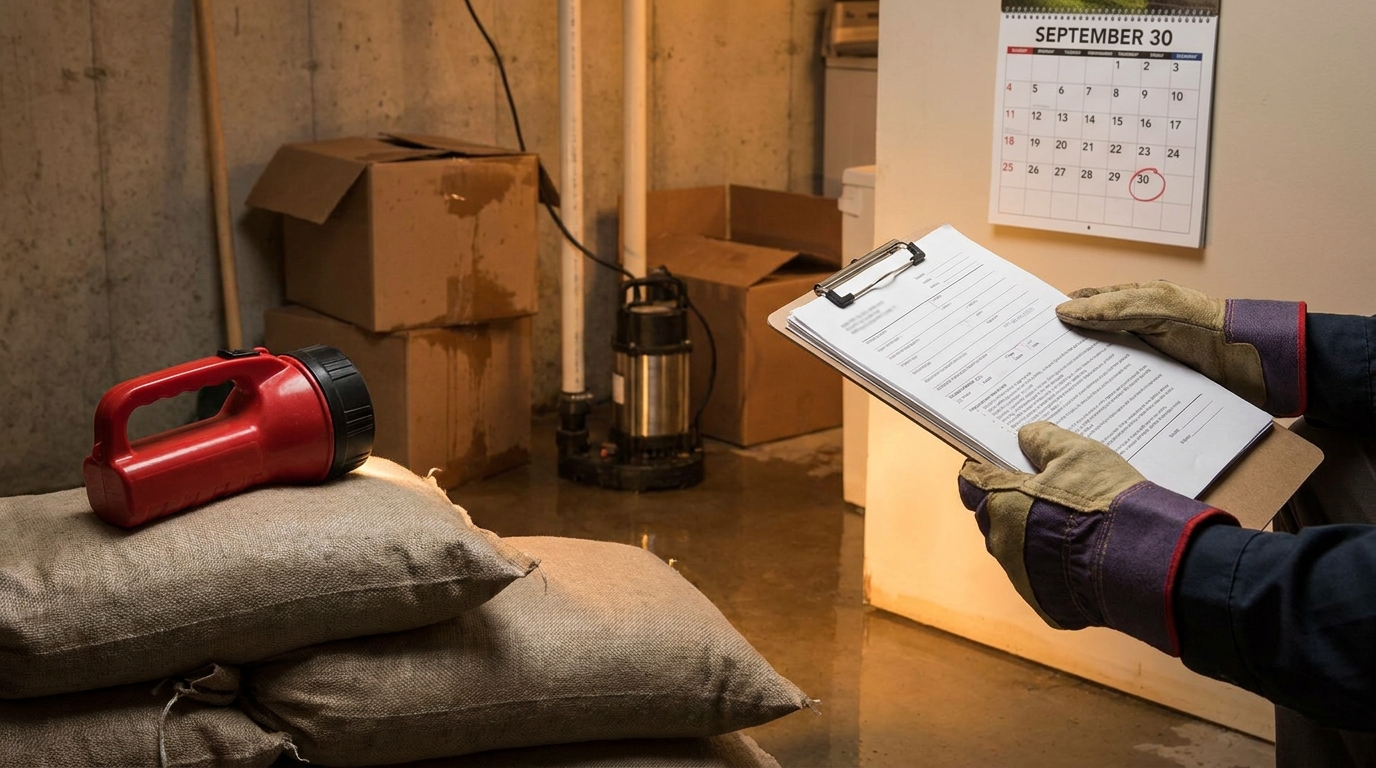
The National Flood Insurance Program's authority to write and renew policies expires at 11:59 p.m. Eastern on September 30, 2026. That is 28 days from today.
If that date feels familiar, it should. This is the fourth time in twelve months homeowners have had to care about it. The program lapsed on October 1, 2025 and stayed lapsed for 43 days during the government shutdown. The bill that reopened the government extended the program only to January 30, 2026. It lapsed again on February 1, and on February 3 the President signed a retroactive extension covering January 30 through September 30, 2026. That signature is the only reason the current deadline exists.
Here is the part that most coverage buries: a lapse is narrow. It is not a program collapse, FEMA does not stop paying claims, and your existing policy does not evaporate at midnight. Stop panicking and start triaging.
What actually stops, and what keeps running
During a lapse, FEMA cannot do two things:
-
Issue new NFIP policies. No new contracts, at all.
-
Renew existing NFIP policies. Renewals are new contracts under the statute.
That is the entire mechanism. Everything else about the program keeps operating, per the National Association of REALTORS and the Association of State Floodplain Managers:
-
Existing policies stay in force through their expiration date, including the standard 30-day premium grace period.
-
Claims keep getting adjusted and paid "as long as FEMA has funds." That caveat is real, not boilerplate. During a lapse, FEMA's authority to borrow from the Treasury drops from $30.425 billion to $1 billion, according to the Congressional Research Service. If a major storm lands mid-lapse, that ceiling matters.
-
Communities keep enforcing local floodplain rules. Permits, elevation requirements, and inspections do not pause.
-
The private flood market is completely unaffected. Private carriers are not backed by NFIP and do not need congressional authorization to sell you a policy on October 1.
One more thing that does not switch off: the mandatory purchase requirement. That rule is enforced by lenders and their federal regulators, not by FEMA, so it survives a lapse intact. More on that below, because it is where readers get the worst advice.
The number that matters if you are mid-transaction
NAR estimates that roughly 1,300 property sales per day and about 40,000 closings per month are affected when the program lapses. Insurance Journal cited a figure closer to 1,400 sales per day during the January 2026 episode. NFIP supports something like 500,000 home sales a year.
Regionally, Florida carries the heaviest exposure at roughly 14,870 affected closings per month. Gulf Coast and coastal Mid-Atlantic markets follow. If you are buying in a low-risk inland county with no lender flood requirement, this article is background reading. If you are buying anywhere with a Special Flood Hazard Area designation on the parcel, keep going.
This is not hypothetical. It happened for 43 straight days last fall.
"I am closing in the next four weeks"
Do these in order. The order is the whole point.
1. Find out today whether flood coverage is even required
Two questions, one phone call each. Is the property in a Special Flood Hazard Area? Your lender's flood determination will say. And does your loan require flood insurance to fund? If the answer to both is no, you can relax about the deadline and treat coverage as optional risk management. Only about 4% of American homeowners carry flood insurance at all, per Insurance Business America, which tells you how many people never ask.
2. Ask whether the seller has an in-force NFIP policy you can take over
This is the single most useful workaround, and almost nobody brings it up unprompted. NAR states it plainly: "Insurers may assign the seller's NFIP policy to the buyer simply by substituting names, so coverage on the property is maintained."
That works during a lapse because it is not a new policy. It is a name change on a contract that is already in force. If the seller bought a flood policy in March 2026, that contract runs to March 2027 no matter what Congress does in October.
Call the listing agent this week and ask two things: does the seller have an active NFIP policy, and what is its expiration date? A policy expiring in November is far less useful to you than one expiring next spring, because the renewal problem simply moves down the calendar.
3. If there is no policy to assign, bind one before September 30
NFIP's standard 30-day waiting period is waived when flood insurance is purchased in connection with making, increasing, extending, or renewing a mortgage loan. Coverage can be effective at loan funding.
Read that exception carefully, because it is widely misused. It is a reason to bind coverage before September 30, not a reason to relax. During a lapse the exception is worthless, because no new policy can be issued at all. There is nothing for the waiver to apply to.
If the premium is being paid at the closing table, there is a second timing rule worth knowing: NFIP allows a 30-day window from the closing date for the title company or lender to get the payment to the carrier while preserving the immediate effective date. Payment that arrives on day 31 forfeits that and triggers the full 30-day wait. Ask your title company, in writing, when they actually remit. "We usually get to it" is not an answer.
4. Get a private flood quote in parallel
Not instead of. In parallel. It costs you an hour and it is the only backstop that works if the calendar runs out.
5. Get your loan officer's lapse policy in writing
During the 2025 lapse, federal regulators gave lenders discretion, and some lenders suspended the flood requirement so closings could proceed. Some did not. That was a lender-by-lender decision, never a blanket rule, and a loan officer telling you "the requirement is suspended" is describing their institution's posture, not federal law. It also does not necessarily bind whoever buys your loan later. Fannie Mae's Selling Guide sets flood requirements for conventional loans that sit above any individual lender's judgment call.
Ask your loan officer directly: how did your institution handle the October 2025 lapse, and what is the written plan for October 2026? Email, not a phone call.
"I am renewing" and the timing trap
Renewals have their own rule, and it is unforgiving in one specific way.
Under FEMA's lapse guidance, if your insurer issued the renewal offer before the lapse begins, and receives your premium before or within the 30-day grace period, the renewal can go through. If your premium arrives during the lapse and after the grace period has run out, it cannot.
Translated into a to-do: if your policy renews in October or November 2026, pay it now. Do not wait for the due date. Do not assume your mortgage servicer's escrow calendar lines up with the grace window, because escrow disbursement schedules are built around convenience, not around congressional deadlines. Call the servicer, confirm the disbursement date, and if it falls late, ask them to move it or pay it yourself and get reimbursed.
The cost of getting this wrong is not a fee. It is a gap in coverage you cannot close until Congress acts.
Why private flood insurance is genuinely unaffected
Private flood is not a workaround of last resort anymore. Private insurers held roughly 13% of direct flood premiums written a decade ago and about 27% in 2024, per Insurance Journal. By a narrower measure, share of primary flood policies, Burns & Wilcox put private carriers around 10% as of October 2025. Private residential flood policies have grown roughly 20% a year since 2020.
Federal agencies may accept a private flood policy toward the mandatory purchase requirement when it provides coverage "at least as broad as" NFIP coverage, a standard set in statute and explained in CRS report R45242 and in the Federal Reserve's Consumer Compliance Outlook. That is why one lender accepts a private policy in a day and another stalls for a week: some acceptance is mandatory, some is discretionary, and the two look identical from the borrower's side of the desk.
The coverage comparison favors private more than most people expect:
-
Limits. NFIP residential caps out at $250,000 building and $100,000 contents. Private carriers write up to $7 million.
-
Temporary living expenses. Many private policies include it. NFIP does not cover it at all, which is a nasty surprise for a family living in a hotel for six weeks.
The honest caveats: private carriers have rate freedom and non-renewal freedom. NFIP will always renew you. A private carrier can re-rate you hard after a bad catastrophe year or decline to renew entirely. That trade is worth making during a lapse. Whether it is worth making permanently depends on how much you value a policy that cannot walk away from you.
The part that outlives the deadline: what your policy actually pays for downstairs
Suppose you do everything right. Policy bound, premium paid, coverage in force on October 1 regardless of what Congress does. Water comes into the basement anyway.
A fully paid, fully in-force NFIP policy will not make a finished basement whole. This is the most misunderstood coverage gap in residential insurance, and a lot of consumer articles get the details wrong.
What FEMA does cover in a basement
Per FEMA's own basement flooding fact sheet, building property coverage in a basement includes:
-
Furnace, hot water heater, central air conditioner, heat pump
-
Electrical junction boxes and circuit breaker boxes
-
Sump pumps, well water tanks and pumps
-
Fuel tanks and the fuel inside them
-
Nonflammable insulation
-
Staircases attached to the building
-
Foundation elements and anchorage systems
-
Drywall for walls and ceilings, but only unfinished and untaped drywall
That drywall condition is the detail everyone flattens. It is not true that NFIP ignores basement drywall. Bare, untaped sheets are covered. The moment that drywall is taped, mudded, and painted, it becomes a basement improvement and falls outside coverage.
What FEMA does not cover
-
Finished walls, floors, and ceilings. Taped and painted drywall, carpet, tile, laminate, finished ceilings, built-ins.
-
Essentially all personal property in a basement. Basement contents coverage is limited to a short list: washers, dryers, food freezers and the food in them, and portable air conditioners. Furniture, electronics, the guest bed, the boxes in the corner, all excluded.
So the gap is real, just for a different reason than you may have read. FEMA pays for the mechanicals and the bare shell. You pay for everything that made it a room.
The dollar math on that gap
Split it into two line items, because insurance touches them differently.
Line item one: dry-out. Extraction, drying, and sanitizing runs $4 to $12 per square foot depending on how contaminated the water is, per 2026 pricing from Angi and HomeGuide. The category breakdown:
-
Category 1, clean water from a supply line or rainwater: about $3.50 to $4.25 per square foot
-
Category 2, grey water: about $4.10 to $5.00
-
Category 3, black water including sewage and most river flooding: about $6.25 to $7.25
By project size:
-
500 square feet, minor: $1,500 to $3,800
-
1,000 square feet, moderate: $3,000 to $7,500
-
2,000 square feet, severe: $6,000 to $15,000
National average for flooded basement cleanup lands around $4,000, with a typical range of $2,000 to $7,000.
Line item two: rebuild. Every dollar above is before a single new sheet of drywall goes up, before flooring, before trim, before paint. If the basement was finished, budget the rebuild separately and expect it to be the larger number. That is the half your NFIP policy is not designed to reach.
One practical timeline note: professional dry-out typically takes three to five days of equipment running before rebuild can start, and reputable restoration firms will document moisture readings daily. If a contractor wants to close up walls on day two, that is a red flag.
Mitigation that lowers next year's bill
FEMA publishes its own numbers in its agent guidance on reducing insurance costs. These hold up:
-
Elevating one foot above Base Flood Elevation often results in about a 30% reduction in annual premiums.
-
A basement in a high-risk area carries a 15% to 20% premium increase. Backfilling the basement eliminates that surcharge.
-
Proper flood openings: at least two openings on different exterior walls, one square inch of opening per square foot of enclosed area, with the bottom of each opening no higher than 12 inches above grade.
-
Community Rating System participation can cut premiums by up to 45%. This one is not on you, it is on your municipality, but it is worth asking your local floodplain administrator whether your town participates and at what class.
Timing tip that saves real money: some of this only gets done during a rebuild. If the walls are already open after a loss, that is the cheapest moment you will ever have to elevate mechanicals or add openings. Bring it up with the restoration contractor before demo is finished, not after.
Why your premium keeps climbing
Under Risk Rating 2.0, FEMA prices policies toward a property's full-risk rate. Annual increases are capped at 18% for most policyholders by statute, and premiums climb that glide path each year until the full-risk rate is reached, then stop. The GAO found a median annual premium of $689 as of December 2022 against a $1,288 full-risk target, with Pre-FIRM discounted policies averaging around $2,400.
The counterweight is worth stating plainly, because none of this is an argument that coverage is cheap. A December 2025 study summarized by the Environmental Defense Fund found Risk Rating 2.0 associated with an 11% to 39% decline in new NFIP policies and a 5% to 13% decline in existing policies, scaled to the size of the premium increase. In Louisiana and other flood-prone states, increases well over 100% have pushed tens of thousands of homeowners to drop coverage entirely. Better risk signals and affordability are pulling in opposite directions, and the people caught in the middle are the ones with the most exposure.
What to watch between now and September 30
The pending vehicle is H.R. 5577, the NFIP Extension Act of 2026, introduced by Rep. Andrew Garbarino. House Financial Services ordered it reported 53 to 0 on December 17, 2025, and it was reported with H. Rept. 119-456 on January 15, 2026. It has not been enacted. The CBO cost estimate confirms what it does: extend NFIP's authority to underwrite and renew policies, and to borrow from Treasury, through September 30, 2026. A separate bipartisan reform bill has been introduced by Reps. Carter, Ezell, Fields, Letlow, Fletcher, and Higgins.
Realistically, an extension is expected to ride on FY2027 appropriations. That is also exactly how the last two deadlines went, one of which produced a 43-day gap.
The last thing to plan for is the backlog. In November 2025, NAMIC's Jimi Grande predicted "a rush of activity as would-be homeowners who were looking to close a mortgage for the last 40 days seek to gain new coverage and existing policyholders obtain their renewals." A fast fix in early October does not mean a fast policy. If you are closing that month, build queue time into your contract dates now.
For the live authorization status, FEMA maintains a congressional reauthorization page. Check the date at the top before you make a decision on it, because it changes the moment Congress acts.
Your four-week checklist
Week of September 2: Confirm whether the property is in a Special Flood Hazard Area and whether your lender requires coverage. Ask the listing side whether the seller has an in-force NFIP policy and get its expiration date. If you are renewing, look up your renewal date and your escrow disbursement date.
Week of September 9: If assignment is available, start the name-substitution paperwork with the seller's carrier. If not, get an NFIP quote and a private flood quote side by side. Email your loan officer asking how their institution handled the October 2025 lapse.
Week of September 16: Bind coverage. Do not wait on the closing date to trigger the waiting-period waiver, because the waiver only helps while the program can issue policies. If you are renewing, pay the premium now regardless of when it is due.
Week of September 23: Confirm in writing that the carrier has the premium in hand, not just that the title company or servicer has mailed it. Confirm the effective date on the declarations page. If anything is still open on September 29, call your agent that morning, not that afternoon.
Related reading
-
The Solar Company Still Offering You "30% Off" Is Claiming a Credit You Cannot
-
The Energy Star Handover Plan Lands September 1. Your Label Is Not Changing Owners That Day
-
California Moves to Set the First Rules for Smoke Damaged Homes
Sources
-
FAQ: National Flood Insurance Program Expires September 30, 2026, National Association of REALTORS
-
The NFIP Has Lapsed. Here's What It Means., Association of State Floodplain Managers
-
NFIP Reauthorized With Passage of Funding Bill to End Government Shutdown, Insurance Journal, November 13, 2025
-
Opportunity for Private Flood Insurers With Threat of Another NFIP Lapse, Insurance Journal, January 29, 2026
-
Private Insurers Fill the Gap as NFIP Lapse Leaves Homeowners in Limbo, Insurance Business America, October 7, 2025
-
What Happens If the National Flood Insurance Program (NFIP) Lapses?, Congressional Research Service IN10835
-
Private Flood Insurance and the National Flood Insurance Program, Congressional Research Service R45242
-
Congressional Reauthorization for the National Flood Insurance Program, FEMA
-
What Does Flood Insurance Cover in a Basement?, FEMA NFIP fact sheet
-
Reducing Insurance Costs, FEMA NFIP agent resources
-
Flood Insurance: FEMA's New Rate-Setting Methodology Improves Risk Reflection, U.S. GAO GAO-23-105977
-
Study Finds FEMA's New Flood Insurance Pricing Is Improving Risk Signals, Reducing Coverage, Environmental Defense Fund, December 2025
-
H.R. 5577, NFIP Extension Act of 2026, 119th Congress, and the CBO cost estimate
-
Overview of Private Flood Insurance Compliance Requirements, Consumer Compliance Outlook, Federal Reserve, 2024
-
B7-3-06, Flood Insurance Requirements for All Property Types, Fannie Mae Selling Guide
-
How Much Does It Cost to Clean Up a Flooded Basement? (2026 Data), Angi
-
How Much Does Flooded Basement Cleanup Cost? (2026), HomeGuide
Note: This article contains AI-assisted content and has been reviewed by our editorial team.
ABOUT THIS SERVICE: CallTheLocal.com is a directory and lead generation service, not a contractor or service provider. Submitting this form does not obligate you to hire anyone or purchase any service. Your information will be shared with licensed, insured home service professionals in your area who may provide quotes for your project. CallTheLocal.com does not guarantee the quality, timeliness, or outcome of any work performed by service providers you connect with through this service. Always verify licensing, insurance, and references before hiring. Get everything in writing before work begins.
Related reading
- Your Insurer Now Wants a Water Shutoff Device in Your Basement, and It Will Discount Your Premium to Get One
- A 'Super El Niño' Just Cut the 2026 Hurricane Forecast to One Major Storm, and It's Quietly Moving Your Home Risk From Wind to Water
- Congress Is Rewriting the Furnace Rule Right Now, and Some Quotes Are Still Selling You a 2028 Deadline