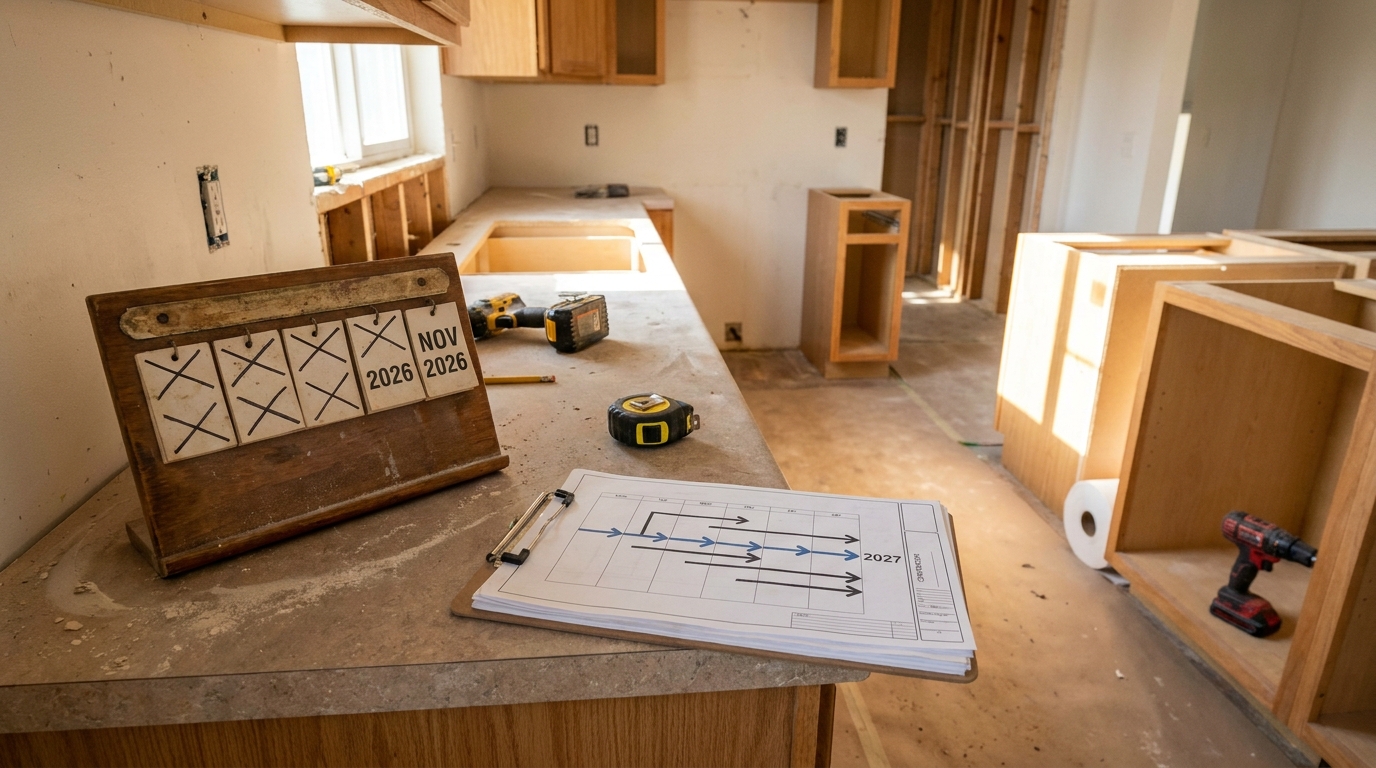
If you have called around for kitchen remodel quotes lately, you already know something feels off. The good crews are booked out for months. The bids came back higher than you expected. And the start date a contractor is willing to commit to keeps sliding further into next year. You are not imagining it, and you did not call at a bad time. A real labor squeeze is reshaping how long projects take and what they cost in 2026.
Here is the honest version of the headline. In the busiest markets, the total elapsed time from signing a contract to cooking your first meal in the new kitchen really can stretch toward eleven months once you add the wait just to get a crew on the calendar. And in those same tight markets, bids are landing meaningfully higher than a year ago. But those are worst-case numbers, not national averages. Below, we separate the parts that are well documented from the parts that depend heavily on where you live.
The symptom: longer waits, higher bids, fewer crews
A typical mid-range kitchen remodel runs roughly $27,000 to $35,000 nationally in 2026, and skilled-trade labor usually eats up 40% to 60% of that total, according to contractor cost data for 2026. The actual hands-on work might only be six to ten weeks. The problem is everything around it. The good trades are booked months out, so the calendar, not the construction, is what stretches your timeline.
This is not anecdotal. A national workforce survey from the Associated General Contractors of America found that 78% of contractors had at least one project delayed in the past 12 months, and 45% blamed those delays on workforce shortages, making labor the single leading cause of delays. On top of that, 92% of contractors reported difficulty filling positions. When nine out of ten firms cannot staff up, the wait lands on you.
The structural shortage: a 349,000-worker gap
The deepest cause is demographic, and it was coming with or without anything else. Associated Builders and Contractors projects that the construction industry needs to attract about 349,000 net new workers in 2026, climbing to 456,000 in 2027. The important detail most coverage skips: the majority of that 2026 demand is about replacing retirees, not building more. An experienced generation of tradespeople is leaving faster than younger workers are coming in to replace them.
That matters for your kitchen because experience is exactly what you are buying. A crew that has hung a hundred cabinets installs yours faster and cleaner than one still learning. As veterans retire, that depth gets thinner, and the remaining experienced crews get more in demand and harder to book.
The immigration-enforcement layer
Layered on top of the slow demographic squeeze is a faster, sharper one. The same AGC workforce survey found that 28% of construction firms were affected by immigration enforcement actions in the six months before the survey. Breaking that down: 5% had ICE visit a jobsite, 10% lost workers to actual or rumored raids, and 20% said those concerns caused their subcontractors to lose staff. On-the-ground reporting from NPR documented crews leaving jobsites and workers staying home out of fear, which thins the labor pool even where no raid actually happens.
This is not evenly spread. More than half (52%) of the roughly 3 million immigrant construction workers in the U.S. live in just four states, California, Texas, Florida, and New York, per data summarized by Scotsman Guide. If you are remodeling in those states or their major metros, you are likely to feel this more than someone in a smaller market.
Which trades got hit hardest
This is where it gets specific to kitchens and baths. The finish trades, the ones that make a remodel look finished, depend the most on immigrant labor. Based on 2024 Census data compiled by the National Association of Home Builders, the immigrant share by trade looks like this:
-
Drywall and ceiling-tile installers: 57%
-
Plasterers and stucco masons: 56%
-
Roofers: 53%
-
Painters: 53%
-
Carpet, floor, and tile installers: 51%
-
Construction laborers: 43%
-
Carpenters: 35%
Look at that list against a kitchen project. Drywall, tile, paint, and trim carpentry are most of what happens after the cabinets go in. Overall, foreign-born workers now make up a record share of about 26.3% of the total U.S. construction workforce, roughly one in three craft workers. The Harvard Joint Center for Housing Studies has documented that remodeling in major metros leans especially heavily on immigrant labor. So when these specific trades thin out, the finish stages of your kitchen are the first to stall.
Price and timeline: keep the two stories separate
It is easy to lump every cost increase together, but there are really two different things happening, and they behave differently.
The labor story. Construction wages are running roughly 4% to 5% higher year over year in most markets, per BLS-cited figures. That is the honest national number. In genuinely tight markets, specialized trades like master electricians and plumbers, who are also being pulled toward big data-center and AI construction projects, command premium rates and are booked months out. That is where you start hearing about high-single-digit increases. So a 9% jump is real in some hot markets, but it is an upper bound, not what most homeowners will see.
The materials story. This one is separate and easy to confuse with labor. Cabinet tariffs rose to 50% on January 1, 2026, which has pushed cabinet costs up roughly 15% to 25% compared with mid-2025, according to 2026 kitchen remodel cost analysis. Since cabinets are one of the biggest line items in any kitchen, that materials shock can move your total bid more than the labor increase does. When a contractor's number comes in high, ask them to break out labor versus materials so you can see which story is driving it.
How to read a suspiciously fast or cheap bid
In a market this tight, the bid that should worry you is the one that looks too easy. If everyone else is booked four months out and one contractor can start next week at a price well below the others, that is a signal worth questioning, not a lucky break. Here are the red flags that a contractor may not have a stable crew behind them:
-
A start date dramatically sooner than every other bid you received.
-
A price noticeably below the pack with no clear reason for it.
-
Vague answers about who actually does the work and whether they are employees or day-by-day subs.
-
Reluctance to put the schedule, scope, and payment milestones in writing.
-
No proof of license and insurance, or a brush-off when you ask for it.
-
Pressure to pay a large deposit immediately to hold a slot.
None of these guarantees a bad contractor, but together they often mean the crew is not stable, and an unstable crew is exactly what causes a job to stall halfway through tile.
A realistic 2026 timeline and the questions that reveal a real crew
Plan your expectations around the calendar, not just the construction. A realistic 2026 sequence looks roughly like this: several weeks to a few months to get on a good contractor's schedule, two to four weeks for design and final selections, several weeks of lead time on cabinets and special-order materials (longer now because of the tariff scramble), and then six to ten weeks of actual work, with finish trades being the most likely stage to wait on a crew. Add it all up in a hot market and you can see how the total reaches toward eleven months. In a calmer market, the same project might wrap in four to six months.
The screening questions below are designed to reveal whether a contractor can actually staff and finish your job, not just sell it:
-
"Are the people doing my drywall, tile, and paint your own crew or subcontractors? Have you worked with them before?" Stable, repeat relationships are what get jobs finished on schedule right now.
-
"What is your honest start date, and what is the soonest you would actually have a crew on site each day?" You want a real date, not an optimistic one.
-
"How many other jobs will your crew be running at the same time as mine?" Crews spread across too many sites are how projects stall.
-
"Which materials have long lead times right now, and have you already accounted for cabinet delays?" A contractor paying attention in 2026 will mention cabinets and tariffs without being prompted.
-
"Can I see your license and proof of insurance, and can you put the schedule and milestones in writing?" A real operation says yes without hesitation.
-
"What happens to my timeline if you lose a crew member mid-project?" Their answer tells you whether they have depth or are running on one irreplaceable person.
The labor crunch is real, but it is not a reason to panic or to grab the first crew that says yes. It is a reason to plan earlier, budget with some cushion, and screen harder. The homeowners who do best in 2026 are the ones who book a stable crew well in advance, get everything in writing, and treat a too-good-to-be-true bid as the warning it usually is.
Related reading
-
The HVAC Tariff Got Cut From 25% to 15% in June, So Why Did Your AC Quote Still Go Up?
-
[Copper Just Hit $6 a Pound for the First Time Ever: Why Your Rewire and Repipe Quotes Jumped 25 to 35% in Three Months](/guides/copper-6-dollars-pound-rewire-repipe-quotes-2026)
-
[Your Roof Quote Jumped Again June 1: Why GAF, Owens Corning, and CertainTeed Just Raised Shingle Prices 6 to 9% for the Second Time This Year](/guides/roof-quote-jumped-june-1-2026-shingle-price-increase)
Sources
-
Associated Builders and Contractors: Construction Industry Must Attract 349,000 Workers in 2026
-
NAHB Eye On Housing: Which States and Construction Trades Depend the Most on Immigrant Workers?
-
Associated General Contractors of America: Workforce Shortages Are Leading Cause of Project Delays
-
NPR: Trump's immigration crackdown is hurting the construction industry
-
Scotsman Guide: Immigrant workers reach record share of U.S. construction workforce
-
Fin Home Contracting: How Much Does It Cost to Remodel Your Kitchen in 2026?
-
[CostFlowAI: Kitchen Remodel Cost 2026: The Tariff Truth](https://costflowai.com/blog/kitchen-remodel/)
Note: This article contains AI-assisted content and has been reviewed by our editorial team.
ABOUT THIS SERVICE: CallTheLocal.com is a directory and lead generation service, not a contractor or service provider. Submitting this form does not obligate you to hire anyone or purchase any service. Your information will be shared with licensed, insured home service professionals in your area who may provide quotes for your project. CallTheLocal.com does not guarantee the quality, timeliness, or outcome of any work performed by service providers you connect with through this service. Always verify licensing, insurance, and references before hiring. Get everything in writing before work begins.