A whole house generator cost starts at $3,500 to $7,000 for the standby unit alone, according to Consumer Reports, and installation can more than double that. A portable generator ($400 to $2,000) plus an installed transfer switch ($500 to $1,500) usually comes to roughly $900 to $3,500 in total.
That price gap is the starting point. It's also the question a lot of Gulf Coast homeowners are asking this week.
Why this question matters right now
Hurricane Isaias made landfall near Destin, Florida, on Friday night, Oct. 9, as a Category 2 storm. NBC News reported maximum sustained winds of 105 mph. NatureWorldNews reported that more than 884,000 customers in Florida, Alabama and Georgia had no power early Saturday. By Sunday night, Florida's count had dropped to a little over 170,000.
One of the deaths came from a generator. In Escambia County, Florida, NBC News reported that a man was found dead in his closed garage with a generator running inside. NatureWorldNews reported that four family members, ages 4 to 72, were taken to a hospital, and put the storm's death toll at at least four. Gov. Ron DeSantis warned, as quoted by NBC: "Don't run the generator inside. It's something that can be fatal."
If you're thinking about backup power before the next storm, you have two realistic setups. Below we cover what each one costs, what a fair bid includes, the permits involved, how much fuel each burns, and where it can safely go.
The two setups in plain terms
Option 1: Portable generator plus a transfer switch or interlock
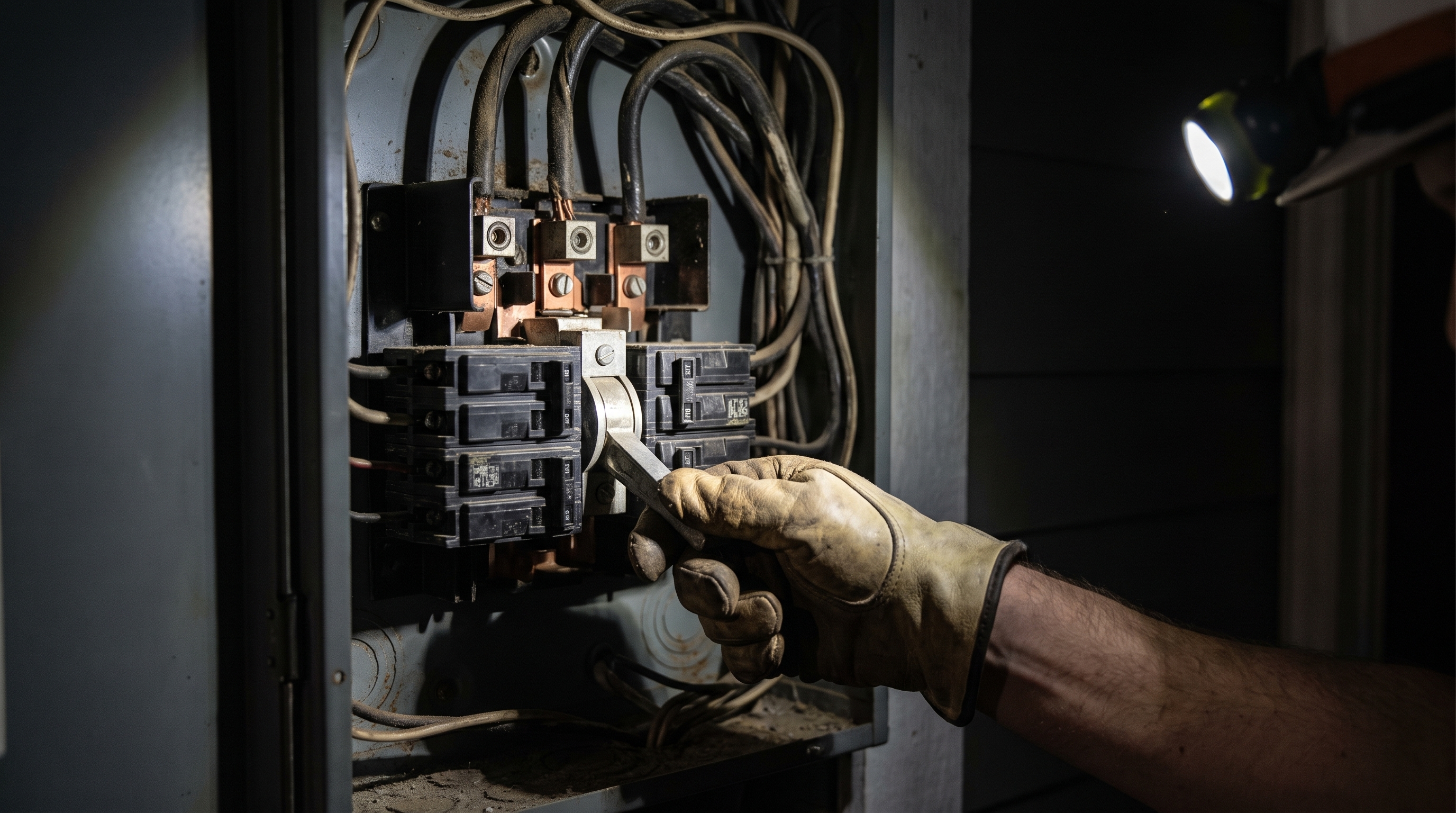
The portable lives in your shed or garage, and you roll it outside when the power goes out. You start it, plug it into an inlet on the house, and flip the switch. It then runs the circuits you picked ahead of time, such as the fridge, a few lights, fans, a well pump or a window AC. The transfer switch or interlock kit is the part an electrician installs at your panel. It lets the generator power house circuits without sending electricity back out onto the utility lines.
Option 2: Whole-house standby generator
A standby unit is installed permanently on a pad outside your home. It runs on natural gas or propane and turns itself on when the grid goes down. You don't wheel anything out, pour gas or plug in cords. Depending on its size, it can carry most or all of the house.
What each setup costs
Portable route
-
Portable generator: $400 to $2,000 (Consumer Reports buying guide). Inverter models range from $300 to $5,000.
-
Transfer switch: Consumer Reports says to "budget between $500 and $1,500 for the switch, including installation, which usually takes less than a day" (CR transfer switch guide).
-
Interlock kit (the cheaper alternative): $50 to $150 for the kit, plus $400 to $800 for labor, per the same CR guide.
As a real-world example, Generac's GP7500E dual-fuel portable lists an MSRP from $1,049 and works with a manual transfer switch.
Ballpark total: about $850 to $3,500, depending on the generator and whether you use an interlock or a switch.
Skip the shortcut. Consumer Reports says connecting a generator to your panel without a transfer switch or interlock is "dangerous and, in many cases, illegal," because power can backfeed into the lines and endanger utility crews working to restore service.
Standby route
-
Unit only: $3,500 to $7,000 without installation, which "can more than double the cost" (Consumer Reports).
-
Entry equipment price: Generac lists standby equipment starting at $3,769 for a 10kW unit, unit only. Generac says regional pricing comes from local dealers.
-
Installed price, northern New Jersey example: MDL Electric, a New Jersey contractor, cites Generac's published installed range of $8,000 to $16,000. It also cites HomeGuide's figures of $6,000 to $11,000 for standard units, and $9,500 to $24,000 for long runs or units over 20 kW.
Generac also notes that installation costs less when the generator sits closer to the gas line and electric meter. The longer the gas and wire runs, the higher the bid.
What a standby bid should list
When you compare quotes, each one should spell out these items separately:
-
The generator itself (brand, model, kW rating)
-
Automatic transfer switch
-
Pad and anchoring
-
Gas piping from the meter or propane tank
-
Utility gas application and any meter upgrade
-
Permits and inspections
-
Startup and testing
Permit fees vary by town. MDL Electric's New Jersey examples: West Orange charges $200 for a 10.1 to 35 kW generator plus $100 for gas piping, and Montclair charges $125 plus $46 for gas piping. The utility side can take the longest. MDL Electric says a PSE&G gas "Adding Load" application can take "up to six weeks," and meter upgrade charges may apply. Ask whether your bid assumes your current gas meter is big enough.
That lines up with Generac's installation guide, which says installation "usually takes hours, but the process of preparing for it takes multiple weeks." Dealer availability, site prep, gas line work and permits drive the schedule. In practice, a unit you order after a storm probably won't be running for the next week's outage.
Permits: Miami-Dade as a model
Rules vary by county, but Miami-Dade County's generator permit page shows the typical tiers clearly:
-
Portable running a few appliances on cords: no building permit needed.
-
Portable connected to house circuits: electrical permit required.
-
Permanent generator: a building permit, signed and sealed plans, and a site plan showing distances and the fuel tank. Electrical details (transfer switch, one-line diagram, grounding), gas piping details, and pad and anchoring details are also required.
Check with your own city or county building department. Ask your electrician whether the permit is included in the quote and who pulls it.
Fuel: the part people underestimate
Portable: Generac's GP7500E runs about 10 hours on its 7.9-gallon gas tank at half load, or about 5 hours on a 20 lb propane tank. Run around the clock at half load, that works out to roughly 19 gallons of gas a day. You'd need to store it safely and refill the generator every 10 hours, including overnight.
Standby: Generac's 22kW standby (22 kW on propane, 21 kW on natural gas) burns 221 cubic feet of natural gas per hour at 50% load and 327 at full load. On propane it uses 2.53 gallons per hour at 50% load and 3.71 at full load. At half load, that's roughly 60 gallons of propane a day. If you don't have natural gas service, ask your installer how long your propane tank would last during a multi-day outage. The unit comes with a 5-year limited warranty.
Safe placement
Portable generators
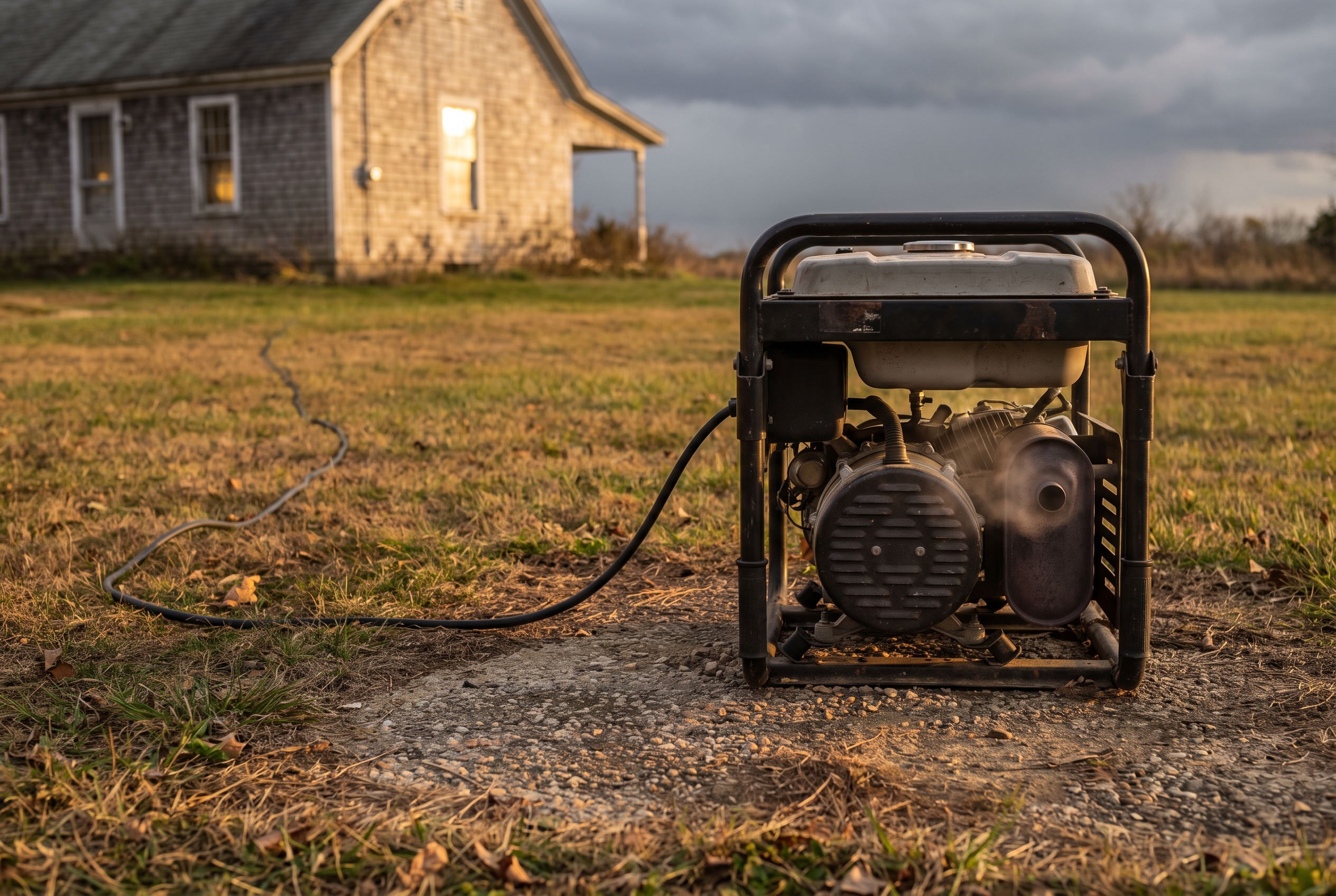
The U.S. Consumer Product Safety Commission says to "operate generators outdoors only, at least 20 feet from homes and buildings, with exhaust directed away from windows, doors and vents." Never run one in a home, garage, basement, crawlspace or shed, even with the door open. The Alabama Department of Public Health and CDC gave the same 20-foot guidance during Isaias, according to Medical Daily. The outlet said CDC estimates unintentional carbon monoxide poisoning kills more than 400 people a year in the U.S.
-
Install CO alarms on every level and outside sleeping areas, and test them monthly (CPSC).
-
Buy a model with CO shut-off. CPSC says models meeting PGMA G300-2023 and UL 2201-2023 include CO safety technologies. The GP7500E above has Generac's COsense feature.
The CO shut-off feature is worth paying for. A 2022 CPSC report linked portable generators to an estimated 790 non-fire CO deaths since 2008, or nearly 80 a year. CPSC estimated that UL 2201-compliant generators would avert nearly 100% of those deaths and PGMA G300-compliant ones nearly 87%.
A note for South Florida: Miami-Dade's county rule says portables must be at least 10 feet from windows, doors and other openings. CPSC advises 20 feet, so use the larger distance.
Standby generators
Standby units come with an engineered enclosure and their own clearance rules. Under NFPA 37 Sec. 4.1.4, as explained by the New York Electrical Inspection Agency, engine enclosures must be at least 5 feet from wall openings and from structures with combustible walls. A closer spot is allowed if nearby walls have a 1-hour fire rating, or if the noncombustible enclosure is shown not to ignite outside materials. Most manufacturers require at least 18 inches from the building. Your installer's site plan should show these distances, and Miami-Dade requires that.
Florida HOA note
If your HOA has pushed back on a generator, Florida law is on your side. Florida Statute 720.3035 includes "exterior fixed generators, fuel storage tanks" in its definition of hurricane protection. HOAs must adopt specifications, which can cover things like color and style, and they "may not deny an application" that meets those specs. Ask the board for its written specifications before you sign a contract.
Which one fits your home?
A portable plus a transfer switch or interlock makes sense if:
-
Your budget is under about $3,500
-
Your outages are usually short
-
Someone in the house can safely set up, run and refuel it every 10 hours or so, and you have a spot at least 20 feet from the house
-
You only need essentials, not central AC for the whole house
A whole-house standby makes sense if:
-
Multi-day outages are common where you live
-
Someone in the home relies on powered medical equipment
-
Nobody in the household can safely handle hauling and refueling, or you travel often
-
You have natural gas service or room for a properly sized propane tank, and a budget in the high four to five figures
Questions to ask the electrician
-
Is the permit included in your price, and who pulls it?
-
For a portable: are you quoting an interlock kit or a transfer switch, and why?
-
Which circuits will it power, and can my generator handle them?
-
For a standby: does my gas meter or service need an upgrade, and who files the utility application?
-
Where will the unit sit, and what clearances does your site plan show?
-
How long until it's running, counting permits and utility approval?
Get at least two written bids with these items listed separately. That makes the comparison straightforward.
Related reading
-
How to Winterize Outdoor Faucets Before the First Hard Freeze
-
Can Flooded Hardwood Floors Be Saved After Isaias? What to Dry and What Must Go
-
How to Restore Power Safely After Floodwater Reaches the Breaker Box
-
DIY EV Charger Installs Are Ending, But Not Everywhere and Not on the Date You Were Told
Sources
-
NBC News: At least 4 dead as Isaias moves inland (live blog)
-
CPSC: Generator, Carbon Monoxide and Fire Hazards Ahead of Hurricane Season (May 27, 2026)
-
CPSC: Voluntary Standards Can Reduce Risk of CO Death (Feb. 23, 2022)
-
Consumer Reports: Why a Portable Generator Needs a Transfer Switch
-
MDL Electric: Whole House Generator Cost in New Jersey, 2026
-
NYEIA: Minimum Distance a Standby Generator Must be Installed from Combustible Siding
ABOUT THIS SERVICE: CallTheLocal.com is a directory and lead generation service, not a contractor or service provider. Submitting this form does not obligate you to hire anyone or purchase any service. Your information will be shared with licensed, insured home service professionals in your area who may provide quotes for your project. CallTheLocal.com does not guarantee the quality, timeliness, or outcome of any work performed by service providers you connect with through this service. Always verify licensing, insurance, and references before hiring. Get everything in writing before work begins.
Note: This article contains AI-assisted content and has been reviewed by our editorial team.