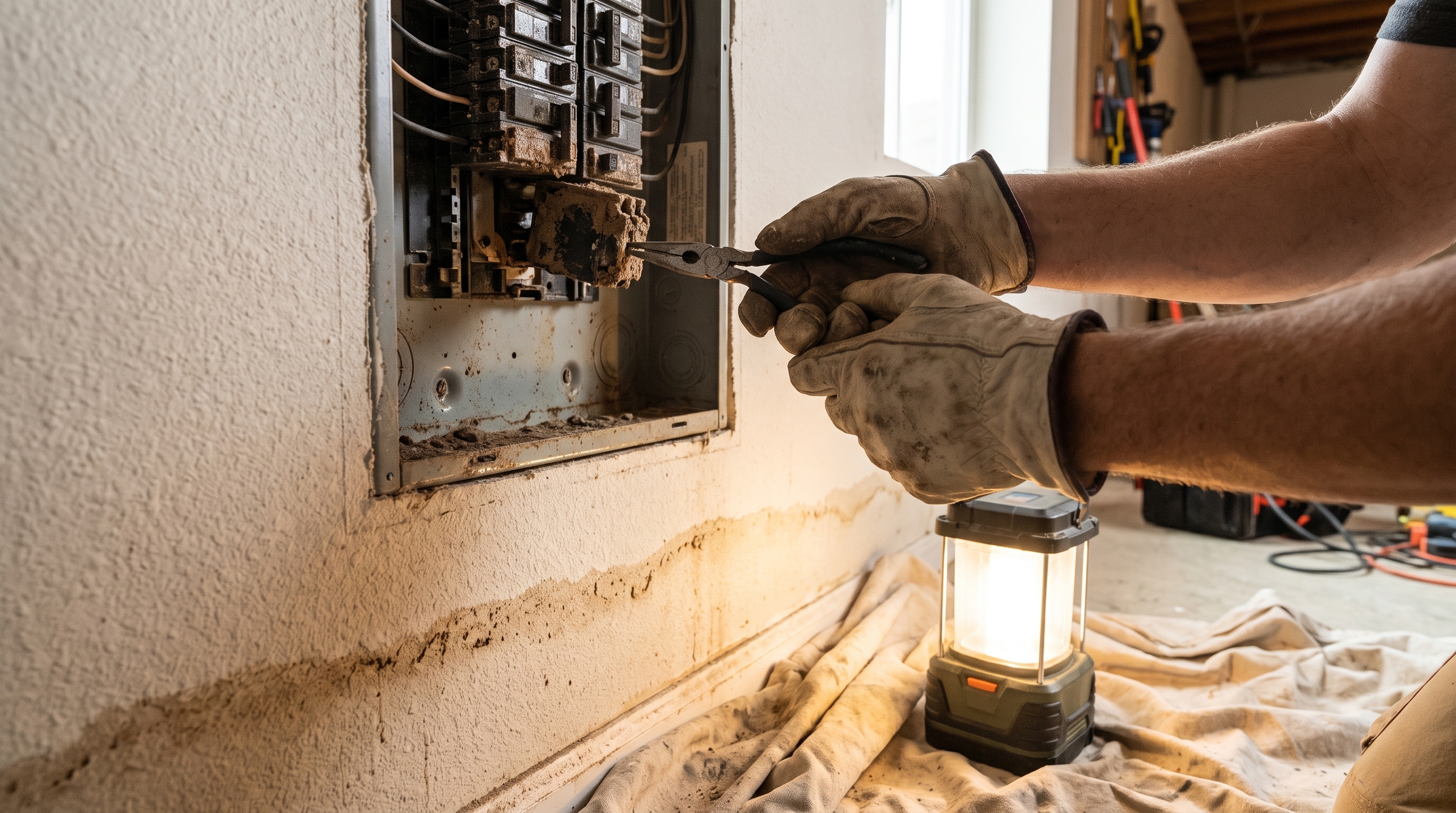
If your electrical panel flooded, don't touch it while you're standing in water. If you can reach it from dry footing, shut off the main breaker. Then have a licensed electrician replace every breaker, fuse, GFCI, outlet and switch that went under water, get any required inspection, and only then ask your utility to reconnect.
The short version
-
Stay away from the panel, the breakers and any cords if you're standing in water.
-
If you can reach the panel from dry ground, turn off the main breaker. If you can't, leave it alone and call Entergy or a licensed electrician.
-
Hire a licensed electrician to replace whatever was submerged. These parts get replaced, not dried out and reused.
-
Get the permit filed and any local inspection your city requires.
-
Call Entergy at 1-800-368-3749 to ask for reconnection.
What Edouard left behind
Tropical Storm Edouard made landfall on Sept. 1 near Johnson Bayou, Louisiana, about 15 miles south-southeast of Port Arthur. It had 60 mph sustained winds, and Port Arthur recorded a 90 mph gust, according to Fox Weather. The coast didn't get the worst of the rain. Deep East Texas did: parts of Hardin, Tyler and Polk counties got more than 20 inches (storm summary), and weather.com reported observed totals up to 21 inches north of Beaumont. The National Weather Service in Lake Charles estimated an 18 to 20 inch bullseye near Kountze. A flash flood emergency was issued for all three counties, and no deaths have been reported.
Louisiana mostly dealt with wind and surge. Holly Beach recorded a 67 mph gust, and the surge at the Freshwater Canal Locks reached 2.3 feet.
Entergy Texas says about 80,000 customers lost power at the peak. In its Sept. 4, 9 a.m. update, more than 90% had been restored and about 6,000 were still out. Maybe the lines on your street are live again but your house is still dark. Maybe you're looking at a panel that sat in floodwater. Either way, you need to work out what's safe to touch, who to call and what a fair price is for the fix.
First, stay out of the water
Entergy's guidance for flooded customers is simple: don't step in water to reach your fuse box or breaker panel. If water rose above your outlets but stayed below the meter, Entergy says to turn off the main breaker and have repairs made.
Only shut off the main if you can do it from dry ground. If the panel is in a garage or utility room that's still wet, leave it alone and let Entergy or a licensed electrician take it from there. Nothing in that panel is worth a shock.
If you're running a generator in the meantime, the Consumer Product Safety Commission says to keep it outdoors only, at least 20 feet from the house. If you smell gas, the City of Beaumont says to call CenterPoint at 800-296-9815.
AI workflows for revenue teams
Placeholder house ad for Conservus.ai. Swap with final creative when brand assets are ready.
Partner with Conservus.aiWhere the water reached decides the job
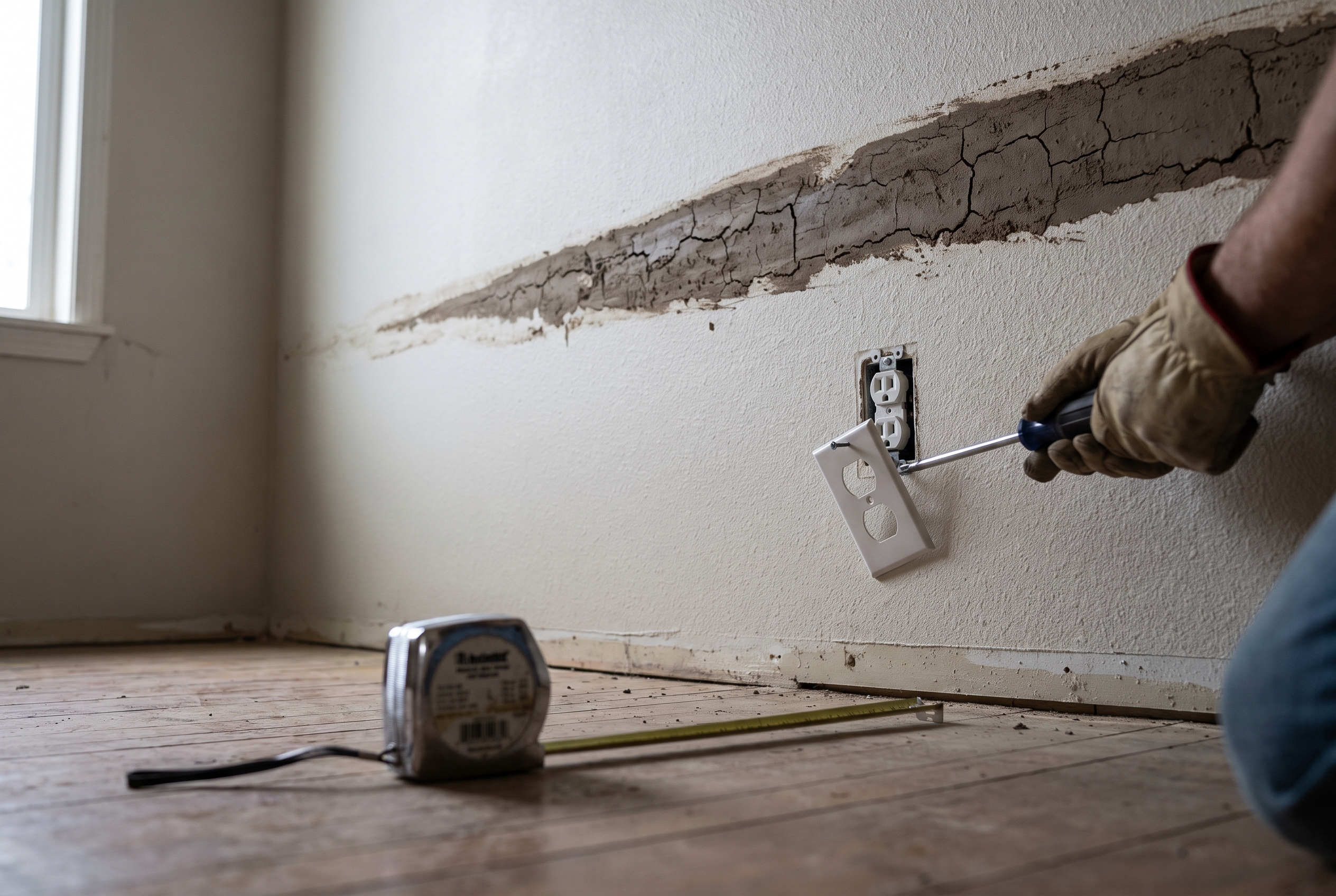
The height of the waterline tells you roughly how big the job is. Look at the stain on the wall before you call anyone.
-
Below the outlets. The outlets and switches probably stayed dry. The CPSC still recommends having a professional or the utility evaluate the home after a flood, and anything that did go under water gets replaced.
-
Above the outlets but below the meter. Entergy's flooded-customer guidance covers this case directly: turn off the main (without stepping in water) and have repairs made. Every outlet, switch and run of wiring that went under is now on the replacement list. Entergy suggests having an electrician inspect "even if their city or county does not require inspection."
-
Up to the panel or the meter base. This is the biggest job. It means panel interiors and breakers, and possibly the meter base, which you own. Entergy says a licensed electrician has to repair damaged equipment before it can restore service, and a local authority may need to inspect the repairs first.
What gets replaced, not dried out
This part surprises a lot of homeowners. Once a breaker has been under floodwater, it's done, even if it snaps on and off like normal. The CPSC's warning to flood victims says submerged gas control valves, circuit breakers, GFCIs and fuses "are unfit for continued use and cannot be repaired," even if they seem to work. The damage is inside, where you can't see it. Silt and corrosion can cause shorts, explosions or fires later.
The electrical industry's standard for water-damaged equipment is published by NEMA. Texas's licensing agency hosts a copy of the NEMA guide, and the Minnesota Department of Labor and Industry sums it up in plain language. If it was submerged, plan on replacing:
-
Panelboard interiors and circuit breakers
-
Fuses and fuse blocks
-
Disconnects
-
Switches and receptacles (outlets), including GFCIs. Replacement receptacles need GFCI protection wherever the National Electrical Code requires it.
-
Submerged wiring
-
Submerged water heaters, furnaces and boilers
So if an electrician offers to "clean up" your breakers and flip them back on, get a second opinion. Replacing them is what you're paying for.
Check the water heater and furnace too
People forget about the appliances. The CPSC's 2024 flood guidance says to have a professional or the utility evaluate the home and replace all gas control valves, electrical wiring, circuit breakers and fuses that were under water. The NEMA-based list goes further: submerged water heaters, furnaces and boilers get replaced.
The gas side is usually a job for a qualified plumber or HVAC technician, not the electrician, so expect a separate visit and a separate quote. Ask the electrician which appliances they looked at and which ones you need to hand off.
AI workflows for revenue teams
Placeholder house ad for Conservus.ai. Swap with final creative when brand assets are ready.
Partner with Conservus.aiWho owns what at the meter
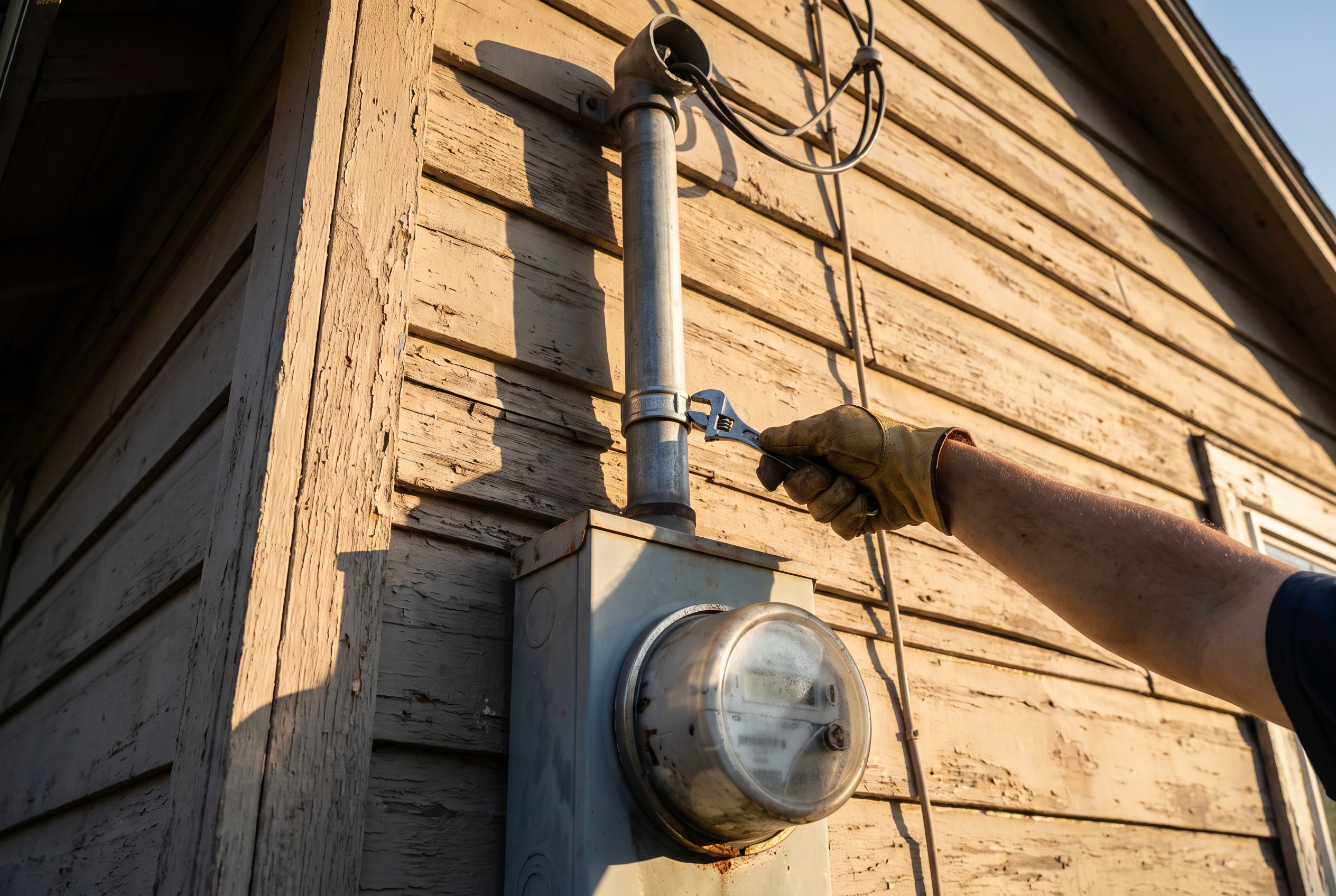
This decides whether a repair is your bill or Entergy's. According to Entergy's "What's yours? What's ours?" page, the equipment on the side of your house is mostly yours:
| Equipment | Who owns it | Who repairs it |
|---|---|---|
| Weatherhead (the cap where the wires enter) | You | Your licensed electrician |
| Conduit riser (the pipe running up the wall) | You | Your licensed electrician |
| Meter base (the box the meter plugs into) | You | Your licensed electrician |
| Meter | Entergy | Entergy |
| Service wire from the pole | Entergy | Entergy |
If the meter base took on water or the riser or weatherhead got damaged, Entergy won't fix it. Your electrician does that work, and then Entergy reconnects.
The reconnect sequence, in order
-
Main breaker off, safely. Only from dry ground, as described above.
-
Licensed electrician repairs. Entergy's update is clear: "A licensed electrician must repair damaged equipment before Entergy can safely restore service."
-
Permit and inspection. Entergy says repairs may need to be "inspected by a local authority before we can restore your power." In Beaumont, the city says emergency repairs can go ahead, but the permit application has to be filed with the City "as soon as practicable." If you live somewhere else, ask your city or county what it requires before the electrician packs up.
-
Call Entergy. Once repairs are done and any inspection is signed off, call 1-800-368-3749 to request a reconnect.
Two more things while you're at it. Beaumont residents can call 3-1-1 to have City staff inspect a structure they think is unsafe, and everyone can report storm damage through the state's iSTAT survey at damage.tdem.texas.gov. Also, Entergy notes that dehumidifiers and fans used to dry out the house can run up your electric bill, so don't be surprised by next month's statement.
What it costs
We couldn't find reliable published prices for Southeast Texas specifically, so here are national ranges from two pricing services. Use them as a ballpark and get local quotes.
| Service | Typical price | Source |
|---|---|---|
| Electrical inspection | $100 to $400 (about $150 average) | HomeAdvisor |
| Full-home electrical inspection | $250 to $400 | HomeAdvisor |
| Infrared inspection | $150 to $350 | HomeAdvisor |
| Panel and fuse box inspection | $217 to $663 (most pay around $389) | Thumbtack |
| Panel upgrade, if needed | $850 to $2,500 | HomeAdvisor |
The two services define the job a little differently, which is why the ranges don't match. Don't read either one as the "right" price.
Replacement work is where the real money goes, and it's priced either per device or as a panel job. Those published inspection and upgrade numbers aren't quotes for flood repair, so ask for an itemized estimate. A few things will move the number:
-
How high the water got, which decides how many outlets, switches and runs of wiring have to be replaced
-
Whether the electrician replaces the panel interior or the whole panel
-
Whether the meter base, riser or weatherhead needs work
-
Whether the water heater or furnace was submerged, which brings in a second trade
Get two or three written quotes if you can, and compare them line by line.
AI workflows for revenue teams
Placeholder house ad for Conservus.ai. Swap with final creative when brand assets are ready.
Partner with Conservus.aiHow to vet an electrician after a storm
After a big storm, you'll get knocks on the door from people you've never heard of. Some are legitimate and some aren't. Here's how to sort them out.
-
Check the license. In Texas, anyone doing non-exempt electrical work has to be licensed and work through a licensed electrical contractor, according to the Texas Department of Licensing and Regulation. Use TDLR's online license search to look up both the person doing the work and the company.
-
Ask for proof of insurance. A current certificate, not a verbal "we're covered."
-
Settle who pulls the permit. If the answer is "you don't need one," remember that Entergy may need an inspection before it reconnects you. Get the permit responsibility in writing.
-
Be careful with deposits. Watch out for anyone who wants a large cash payment before any work starts, or who pushes you to sign on the spot. Pay in a way that leaves a paper trail.
-
Get an itemized scope. The estimate should list each breaker, device and length of wiring being replaced, so you can compare bids.
Your checklist before you call Entergy
Take these questions to the electrician:
-
What's your TDLR license number, and which licensed electrical contractor are you working under?
-
Which parts went under water, and are you replacing all of them? Can I see that itemized?
-
Is the meter base, riser or weatherhead damaged?
-
Who files the permit, and who schedules the inspection?
-
Will the new outlets get GFCI protection where code requires it?
-
Do I need a plumber or HVAC tech to look at the water heater or furnace?
Call Entergy at 1-800-368-3749 once the repairs are finished and any required inspection has passed. If the electrician did the job right and the paperwork is in order, that call is what gets your lights back on.
Related reading
-
Roofers Have Open Calendars in the Quietest Season Since 1941
-
DIY EV Charger Installs Are Ending, But Not Everywhere and Not on the Date You Were Told
AI workflows for revenue teams
Placeholder house ad for Conservus.ai. Swap with final creative when brand assets are ready.
Partner with Conservus.aiSources
-
Tropical Depression Edouard slams Texas and Louisiana, Fox Weather
-
Entergy Texas Tropical Storm Edouard update, Sept. 4, 2026, 9 a.m.
-
Entergy Provides Important Information for Flooded Customers
-
Minnesota DLI: Recommendations for electrical equipment damaged by floodwaters
-
NEMA: Evaluating Water-Damaged Electrical Equipment (TDLR-hosted copy)
-
City of Beaumont: Residents Encouraged to Report Storm Damage (Sept. 2, 2026)
ABOUT THIS SERVICE: CallTheLocal.com is a directory and lead generation service, not a contractor or service provider. Submitting this form does not obligate you to hire anyone or purchase any service. Your information will be shared with licensed, insured home service professionals in your area who may provide quotes for your project. CallTheLocal.com does not guarantee the quality, timeliness, or outcome of any work performed by service providers you connect with through this service. Always verify licensing, insurance, and references before hiring. Get everything in writing before work begins.
Note: This article contains AI-assisted content and has been reviewed by our editorial team.