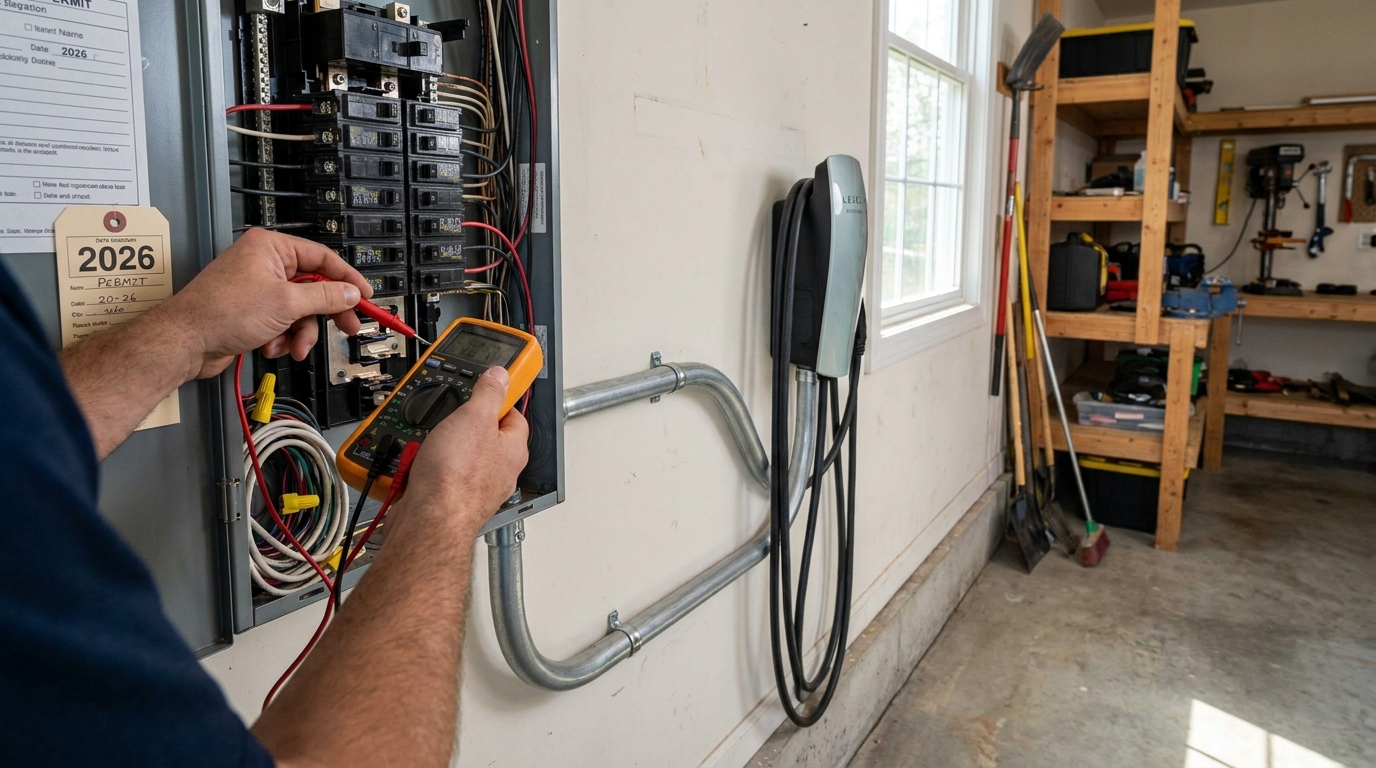
Information current as of August 20, 2026. Electrical code adoption changes month to month, so confirm anything here with your local building department before you spend money.
You have probably seen the claim by now: starting this fall, plugging in your own EV charger becomes illegal in most states, and you will have to hire an electrician. There is a real rule underneath that, and it is worth understanding. But the headline gets two important things wrong, and the difference between the headline and the reality is worth roughly a thousand dollars to you.
Here is the short version. Yes, the 2026 National Electrical Code adds a new requirement that permanently installed EV charging equipment be installed by qualified persons. No, there is no national date when that kicks in. The NEC is not law anywhere until your state or your city adopts it, and as of this writing most states are still enforcing the 2023 edition or older. September 1, 2026 is Texas's date. It is not the country's date.
And the change that has already made home charger installs more expensive for a lot of households is not a code change at all. It is the federal EV charger tax credit, which stopped applying to property placed in service after June 30, 2026. That one is certain, already in effect, and worth up to $1,000.
What the new rule actually says
The 2026 edition of the NEC adds Section 625.4, which requires that permanently installed electric vehicle power transfer system equipment be installed by qualified persons. This is new language. It came through the NFPA process and survived a motion to delete it at the June 2025 technical meeting, so it is settled code text rather than a draft that might disappear. Trade coverage of the EV-related changes is summarized well by [LightNOW's rundown of the 2026 NEC lighting and EV charger updates](https://www.lightnowblog.com/2025/12/top-lighting-ev-charger-changes-in-the-2026-nec/).
Now the nuance that most coverage skips. The code says "qualified person," not "licensed electrician." Those are not the same phrase, and the NEC chose one of them on purpose. A qualified person, as the NEC defines the term, is someone with demonstrated skills and knowledge related to the construction and operation of electrical equipment and installations, plus safety training to recognize the hazards involved.
Could a genuinely skilled homeowner meet that definition? On paper, maybe. In practice, that is a judgment call for your authority having jurisdiction, meaning your local inspector or building department. Most jurisdictions are expected to read it as requiring a licensed electrician, and an inspector is not in the business of auditing your personal skill set. So the practical effect in adopting jurisdictions is that you hire someone. But if a contractor tells you the code says "licensed electrician," they are paraphrasing, not quoting.
The date confusion, cleared up
NFPA issued the 2026 NEC on August 20, 2025, with a standards-document effective date of September 9, 2025. That is a publishing milestone. It has nothing to do with enforcement at your address. The NEC becomes enforceable only where a state or local government adopts it, and that rollout historically takes two to four years to reach most of the country.
Here is what is actually verified as of August 2026:
| Jurisdiction | 2026 NEC effective date | What to know |
|---|---|---|
| Massachusetts | April 24, 2026 | Adopted as 527 CMR 12.00. The earliest confirmed adoption, months before the supposed national date. |
| Denver, Colorado | August 1, 2026 | Applies to new project submittals. Projects submitted for plan review before that date may still use the 2023 NEC. |
| Texas (statewide) | September 1, 2026 | Voted unanimously by the Commission of Licensing and Regulation on July 28, 2026. Applies inside and outside city limits and to licensing exams. Texas kept its own GFCI amendment for outdoor HVAC. |
| Most other states | Not yet | The large majority still enforce the 2023 NEC or earlier. Several states are reported to be in or near adoption, and most large states are still mid-rulemaking. |
Texas also spells out the rule that answers the question everyone actually has, which is "does this apply to my project?" In Texas, permits pulled on or after September 1, 2026 follow the 2026 NEC. Where no permit is required, the code in effect when the installation materials go in is what applies. The details are laid out in the IEC Fort Worth Chapter's summary of the Texas adoption, and Denver's grandfather provision for pre-August submittals is on the City and County of Denver's announcement.
One warning about research. Online adoption trackers and vendor blogs go stale fast and sometimes flatly contradict each other. One installer blog published in August 2026 claims no state has adopted the 2026 NEC at all, which the Massachusetts, Denver, and Texas sources above disprove. The only reliable answer is your own building department.
How to find out what applies to you
Call your city or county building department and ask three questions:
-
Which edition of the NEC do you currently enforce, and is a newer edition scheduled?
-
Do you issue homeowner permits for a new 240V EV charging circuit, or does the permit have to come from a licensed contractor?
-
If the code edition changes while my project is in progress, does the permit date or the installation date control?
That last question matters more than people expect. If your jurisdiction is adopting soon and uses permit-date timing, pulling the permit before the switchover can keep your project under the older rules.
The homeowner exemption most coverage misses
The viral framing usually claims that big states like California, Florida, and Texas already required a licensed electrician, so nothing changes there. That is overstated. All three keep a path for a homeowner to do work on their own home.
-
California: You can pull an owner-builder permit for your own primary residence without holding a C-10 electrical license. But anyone you hire to do the work must hold a C-10. Every Level 2 install needs a permit in California. There is no blanket exemption for EV circuits.
-
Florida: Owner-builder permits are available for a primary residence, typically conditioned on not selling or leasing the property for one year afterward. Otherwise, permitted electrical work requires a licensed electrician, and Level 2 installs require permits in the major metro counties.
-
Texas: The Texas Department of Licensing and Regulation exempts a homeowner living in the home from licensing to do their own electrical work, but only if that work is not regulated by city ordinance. Most Texas municipalities do regulate it, so the exemption is narrow in practice. It is real, though, and you can read the conditions in the TDLR electricians compliance guide.
Before you take the self-permit route, know what you give up. You take on the liability personally. You have no contractor to go back to if something fails. And a self-permitted electrical circuit can create friction with your insurer after a claim and with buyers during a home sale inspection. For a circuit that runs continuously at high amperage in an attached garage, that is a meaningful tradeoff, not a technicality.
What a permitted install actually costs
The price range in the headline holds up. A Level 2 home charger install typically runs $749 to $2,500, with an average around $1,700. The breakdown, according to installer network Qmerit's cost data:
-
Hardware (the charger itself): $300 to $900
-
Electrician labor and permitting: $500 to $1,200
-
Materials (conduit, wire, breaker): $200 to $500
Permit fees themselves range from $50 to $800 depending on where you live, averaging around $310. That spread is almost entirely regional. Dense metros with plan-review requirements sit at the high end, while smaller jurisdictions with a simple electrical permit sit near the bottom.
Two things drive most of the variation in your quote: how much capacity your existing electrical panel has, and how far the charger sits from that panel. A charger mounted on the garage wall directly behind the panel is a short, cheap run. A charger at the far end of a detached garage means trenching, more conduit, and more labor hours.
As for permits generally, Qmerit's guidance is that a new EV charging circuit requires a permit in most cities, with the main exception being installs that reuse an existing 240V receptacle. You may see a specific statistic floating around claiming roughly three-quarters of US cities require a permit. We could not find a source for that number, so treat it as unsupported.
The bigger 2026 cost story nobody is posting about
If your install feels more expensive than your neighbor's did last year, the code is probably not why. The federal Alternative Fuel Vehicle Refueling Property Credit, Section 30C, gave eligible homeowners 30% of the cost back, up to $1,000 per port. It applied to property placed in service from January 1, 2023 through June 30, 2026, and it has now lapsed.
Two details matter. The IRS test was "placed in service," meaning installed and working, not purchased or scheduled. And the residential credit already carried an eligibility condition tied to low-income or non-urban census tracts, so plenty of households never qualified for it in the first place. The full rules are on the IRS page for the credit.
So the honest framing for fall 2026 is this. The code change may or may not apply where you live. The tax credit expiring applies to everyone who was counting on it, and it is a swing of up to $1,000 on a job that averages $1,700.
Panel upgrades: genuinely needed, or upsold?
This is where quotes blow up. A service upgrade to 200 amps adds roughly $1,500 to $3,000. Going from 200A to 400A adds roughly $1,500 to $4,000. That can double or triple your total.
Sometimes it is legitimately necessary. An older 100A panel serving a house with electric heat, an electric range, and a dryer may genuinely not have room for a 48A continuous load. But the way to know is a written load calculation, not a glance at the panel door. Ask for that calculation in writing. Any electrician who recommends a service upgrade should be able to produce one.
Ask about load management devices too. These monitor total household draw and throttle or pause charging when the rest of the house is busy, which can let an existing panel handle a charger without a service upgrade. They are not right for every home, but they are often cheaper than a new service.
One more thing to raise with your electrician, with a caveat. Trade and vendor coverage of the 2026 NEC reports revisions to the Article 220.83 load calculation that lower the first-tier general load figure and the per-square-foot lighting load, which would mean fewer homes calculate as needing an upgrade. We have not been able to confirm that against the licensed code text, so treat it as a question to ask rather than a fact to quote. If it is accurate, it cuts against panel-upgrade upselling in adopting jurisdictions, which makes it worth asking about.
Hardwired versus plug-in, handled honestly
You may hear that you can dodge the new rule by buying a plug-in charger instead of a hardwired one. That is partly a real code distinction and partly a bad idea, and it is worth separating the two.
The real part: Section 625.4 reaches permanently installed equipment. A cord-connected Level 2 unit plugged into a pre-existing NEMA 14-50 receptacle is not squarely covered by it.
The catch: if that receptacle does not already exist, installing it is permitted electrical work in its own right. The workaround moves the licensed work, it does not eliminate it. And if someone suggests permitting the receptacle as a "stove outlet" or a general-purpose 240V outlet when everyone knows it is for a car, that is misrepresentation on a permit application. It creates exactly the kind of paper trail problem you do not want after a garage fire, when an insurer is reading your permit history.
There are also legitimate reasons to prefer hardwired: no plug connection to loosen or heat up over years of daily 40A cycles, and typically higher continuous current capacity. Plug-in has its own advantages, mainly portability and easier replacement. Choose on the merits, not to dodge an inspector.
Red flags in a quote this year
-
No permit line item. If the quote does not mention a permit and your jurisdiction requires one, ask why. "We do not usually pull permits for these" is a reason to get another bid.
-
An installer citing the 2026 NEC in a jurisdiction that has not adopted it. This is the specific upsell risk of 2026. Ask which edition your building department currently enforces, then check that against what the bidder told you.
-
A panel upgrade recommended without a written load calculation. This is the single most expensive add-on in the category. Make them show the math.
-
Anyone offering to skip inspection. The inspection is the part that protects you, and it is the part that a future buyer's home inspector or your insurer will look for.
-
A quote that assumes you are still getting the tax credit. If a salesperson is netting out a $1,000 federal credit on a job being installed today, they are working from outdated material, and you should question the rest of their numbers too.
Your checklist before you sign anything
Three questions for your building department:
-
Which NEC edition are you enforcing right now, and is an update scheduled?
-
Do you issue homeowner permits for a new EV charging circuit?
-
Does the permit date or the installation date determine which code applies?
Three questions for every bidder:
-
Is the permit fee included in this price, and who pulls it?
-
If you are recommending a panel upgrade, can I see the written load calculation?
-
What is the total run distance from panel to charger, and how much of this quote is that run?
Get three bids. Verify license and insurance directly with your state licensing board rather than trusting a card or a website badge. And get the scope in writing before anyone opens your panel.
A note on sourcing
Code adoption status changes monthly, and the online trackers that summarize it are frequently out of date or wrong. Everything in this article reflects what could be verified as of August 20, 2026. Your building department is the only authority that can tell you what applies at your address today. Call them first, then get your bids.
Related reading
-
[The Grid Browned Out Before Your AC Died: What Record Summer Demand Actually Does to a Compressor, and the $300 Part That Prevents It](/guides/grid-brownout-ac-compressor-damage-surge-protector-cost)
Sources
-
Texas Adopts the 2026 NEC Effective September 1, 2026, IEC Fort Worth Chapter
-
Electricians Compliance Guide, Texas Department of Licensing and Regulation
-
New Electric Standards to Be Effective Aug. 1, City and County of Denver, Community Planning and Development
-
Top Lighting and EV Charger Changes in the 2026 NEC, LightNOW
-
Understanding Your EV Home Charging Station Costs for Installation, Qmerit
-
Do I Need a Permit to Install an EV Charger in My Home?, Qmerit
-
Alternative Fuel Vehicle Refueling Property Credit for Individuals, IRS
-
[NEC 2026 EV Charger Rules: What Changed and What It Means for Your Install](https://evchargeright.com/blog/nec-2026-ev-charger-rules), ChargeRight (cited for reported technical changes only; its claim that no state has adopted the 2026 NEC is contradicted by the Massachusetts, Denver, and Texas sources above)
Note: This article contains AI-assisted content and has been reviewed by our editorial team.
ABOUT THIS SERVICE: CallTheLocal.com is a directory and lead generation service, not a contractor or service provider. Submitting this form does not obligate you to hire anyone or purchase any service. Your information will be shared with licensed, insured home service professionals in your area who may provide quotes for your project. CallTheLocal.com does not guarantee the quality, timeliness, or outcome of any work performed by service providers you connect with through this service. Always verify licensing, insurance, and references before hiring. Get everything in writing before work begins.