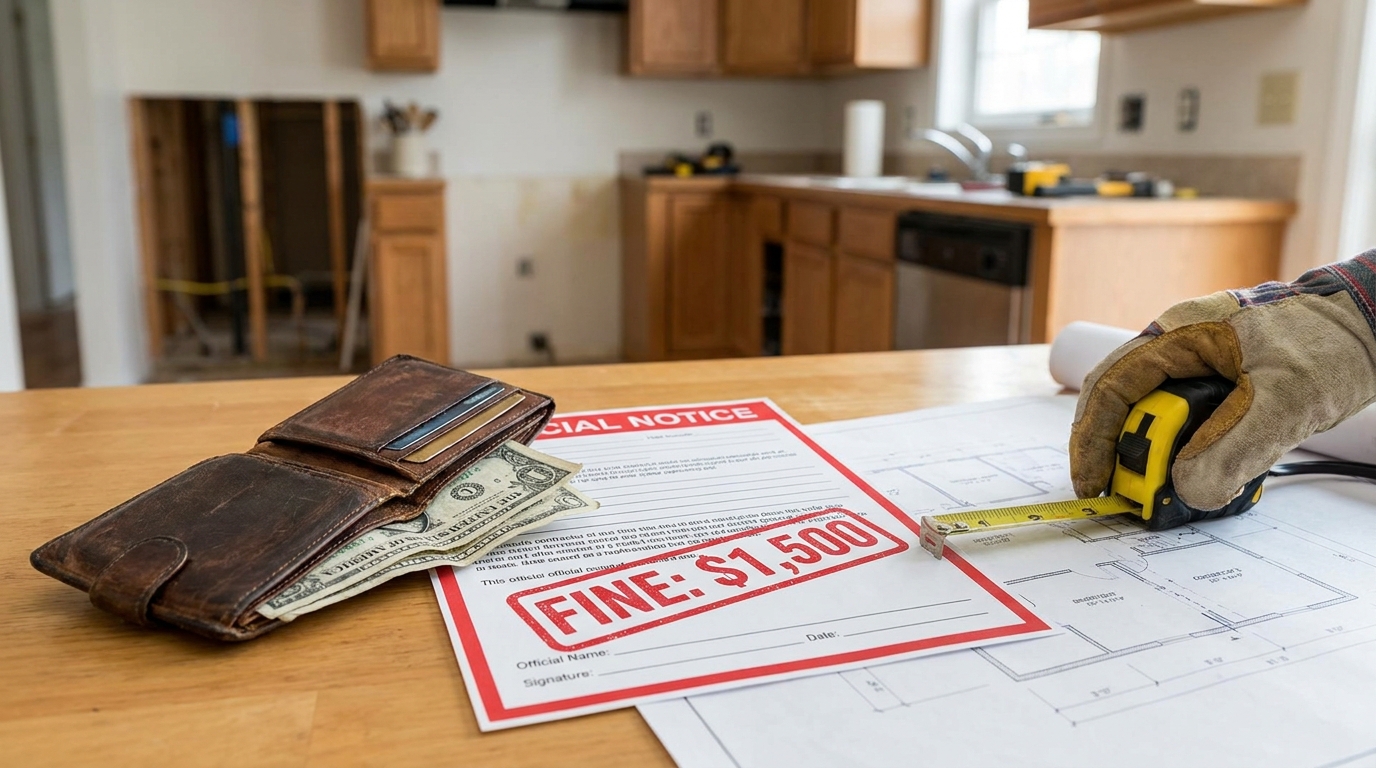
Starting July 1, 2026, the minimum fine California can hand an unlicensed contractor jumps from $200 to $1,500. That is a 7.5 times increase, and it is easy to read as a contractor problem. It is not. When you hire someone who cannot legally pull a permit or stand behind their work, you are the one left holding the bag when the job goes sideways. The fine lands on them. The failed inspection, the voided insurance claim, and the lien on your house land on you.
Three states made news heading into 2026 for cracking down on unlicensed work: California, New Jersey, and Florida. But the stories are very different, and one of the most repeated claims about Florida is simply wrong. Here is what actually changed, what did not, and how to protect yourself in about the time it takes to microwave a cup of coffee.
California: the $200 minimum fine becomes $1,500 (this one is real)
California's Senate Bill 779 is the cleanest, fully confirmed change of the three. It amends the state's Business and Professions Code so that the minimum civil penalty for an unlicensed contractor citation goes from "not less than $200" to "not less than $1,500." The maximum stays at $15,000. The official bill text sets the operative date plainly: this section becomes operative on July 1, 2026.
The bill also lets the Contractors State License Board (CSLB) adjust that minimum for inflation using the Consumer Price Index every five years, so the floor is designed to keep climbing over time. If you want the broader picture, the Press Democrat has a rundown of seven contractor law changes taking effect in California for 2026.
Why should a homeowner care about a fine that someone else pays? Because a bigger penalty is meant to price unlicensed operators out of the market, and because it is a signal: the state is treating no license as a serious problem, not a paperwork technicality. The homeowner takeaway is not the dollar figure. It is that the person cutting your "deal" is now doing something the state fines at four figures minimum.
New Jersey: a real overhaul, phasing in through February 2026
New Jersey's change is substantial but staged, not a single flip of a switch. The Home Improvement and Home Elevation Contractor Licensing Act, enacted in January 2024, created a new State Board of Home Improvement and Home Elevation Contractors and moves the state from simple registration to actual licensing.
Two pieces matter most for homeowners:
-
Financial protection (effective April 2025): Contractors now must carry tiered surety bonds and real liability coverage. Bonds run $10,000 for smaller operations (contracts under $10k or annual volume under $150k), $25,000 in the middle tier (contracts $10k to $120k or annual $150k to $750k), and $50,000 for larger jobs (a single contract over $120k or annual volume of $750k or more). On top of that, contractors must carry commercial general liability insurance of at least $500,000 per occurrence.
-
Licensing and permits (effective February 1, 2026): New applicants must pass a state competency exam and show qualifying background, such as an accredited apprenticeship, trade school, or at least two years of supervised experience. Just as important for you, municipalities are barred from issuing construction permits to unlicensed or lapsed contractors. Contractors who have been licensed five or more years are grandfathered from the new exam requirement.
That permit rule is the quiet game changer. If your contractor cannot get licensed, your town cannot legally issue the permit for your project. No permit means no inspection, and no inspection can mean trouble when you sell or file an insurance claim. New Jersey publishes the details in an official notice on the new requirements.
Florida: the part everyone gets wrong
Here is where you need to be careful, because a lot of coverage frames Florida's tough penalty as a brand new 2026 law. It is not.
In Florida, doing unlicensed contracting work during a declared state of emergency is already a third-degree felony under existing state law, punishable by up to five years in prison and a $5,000 fine. That has been on the books. It applies to repeat offenders and to anyone doing unlicensed work during a declared emergency, which is exactly the post-hurricane window when scammers flood damaged neighborhoods. The Florida Bar has a clear summary of how these penalties work.
For a first offense outside of an emergency, unlicensed contracting in Florida is a first-degree misdemeanor, up to one year in jail and a $1,000 fine. A repeat offense, or any offense during a declared emergency, is what escalates to the felony.
What about the 2026 bills? Two of them that got attention, House Bill 1341 and its companion Senate Bill 1394, did not become law. HB 1341, an omnibus enforcement bill covering the Department of Business and Professional Regulation, died in a subcommittee on March 13, 2026. A separate bill, SB 492, was filed to add a mandatory 15-day jail sentence or one year of probation for unlicensed contractors, but you should confirm its final status before treating it as settled law.
The bottom line for Florida homeowners: the felony risk for unlicensed emergency work is real and serious, but it comes from existing law, not a new July 1, 2026 enactment. The rules protecting you after a storm are already there.
Why homeowners pay when the low bidder has no license number
A cheaper bid from an unlicensed contractor almost never accounts for the risk you are quietly taking on. Here is what a missing license number can cost you, regardless of which state you live in:
-
No bond or recovery fund to claim against. Licensed contractors are typically bonded, and some states run recovery funds for wronged homeowners. Hire unlicensed, and that backstop usually disappears. If the work is botched or abandoned, there is no fund and no bond to make you whole.
-
Voided insurance claims. If unpermitted or unlicensed work later causes damage, your homeowner's insurance may deny the claim tied to that work.
-
Failed inspections and permit problems. Unlicensed contractors often skip permits. Unpermitted work can force expensive rework, complicate a future sale, and trigger fines.
-
Lien exposure with no one to pursue. A mechanic's lien can land on your property from unpaid subs or suppliers, and if the contractor was operating illegally, you may have no licensed party to hold accountable.
The pattern is consistent: the savings are up front and small, and the exposure is on the back end and large.
How to verify a license in about 60 seconds
Every one of these states offers a free, official lookup portal. You do not need to call anyone. Grab the contractor's license number off their bid or business card and check it yourself before you sign.
California
Use the CSLB Check A License tool. Search by license number, business name, or personal name. A healthy record shows an active status, a bond on file, and workers' compensation coverage or a valid exemption. The tool also discloses any complaint history.
Florida
Use the Florida Department of Business and Professional Regulation portal at MyFloridaLicense.com. Florida license prefixes tell you what the person is actually allowed to do: CGC, CBC, and CRC are certified general, building, and residential contractors; CCC is roofing; CFC is plumbing; CAC is air conditioning; CPC is pools. A leading R means registered at the local level. Match the prefix to the trade you are hiring for.
New Jersey
Use the Division of Consumer Affairs contractor verification portal. Confirm the license is active and that the name matches the person standing in your driveway.
In every case, a valid record should show three things: an active status, a name that matches the person or business you are dealing with, and a classification that covers the actual work being done.
Red flags that separate a real license from a borrowed one
Scammers know homeowners rarely check, so a favorite trick is to borrow, fake, or misrepresent a license. Watch for these:
-
No license number printed on the bid or contract at all.
-
A license number that does not match the person's name or business name when you look it up.
-
A status that reads expired, inactive, or suspended.
-
A classification that does not cover the trade being performed, for example a general classification for what is really specialized roofing or electrical work.
-
Cash-only demands or large upfront deposits before any work begins.
Any one of these is a reason to pause. Two or more, and you should walk.
What to do if you already hired someone unlicensed
If you suspect the person you hired is not licensed, or you are looking at a job that went wrong, do this:
-
Document everything. Save contracts, texts, invoices, photos of the work, and proof of payments. This is your record if you need to file a complaint or pursue recovery.
-
File a complaint with the state board. In California that is the CSLB, in Florida the DBPR, and in New Jersey the Division of Consumer Affairs. These agencies investigate unlicensed activity and can point you toward recovery options.
-
Understand your recovery path early. If a bond or state recovery fund applies, there are usually deadlines. The sooner you engage the state, the better your options.
Bottom line
Verifying a license takes about a minute and costs nothing. Skipping it can cost thousands and leave you with no bond, no insurance backstop, and no licensed party to pursue. California is raising the stakes with a $1,500 minimum fine, New Jersey is phasing in real licensing and permit rules through February 2026, and Florida's tough emergency-work felony has been there all along. The rules exist to protect you. Use the free lookup tool, match the name and the classification, and get everything in writing before anyone touches your home.
Related reading
-
[The Viral '2026 Water Heater Rule Will Double Your Bill' Warning Is Mostly Wrong: What the DOE Standard Actually Changes at Home](/guides/2026-water-heater-rule-doe-standard-what-changes-at-home)
-
[Free Roof in Exchange for Solar Panels? A $275 Million Fraud Case and 7,000 FTC Complaints Say Read the Contract First](/guides/free-roof-solar-panels-fraud-case-read-contract-first)
Sources
-
California SB 779, Contractors: civil penalties (official bill text)
-
California contractors: key law changes for 2026 (The Press Democrat)
-
Unlicensed contractors could face jail time (The Florida Bar News)
-
Florida House Bill 1341 (2026), bill page and status (The Florida Senate)
-
Florida Senate Bill 1394 (2026), bill page (The Florida Senate)
-
NJ Consumer Affairs, notice on new licensing requirements (official PDF)
-
How to Verify a License, MyFloridaLicense.com (Florida DBPR)
Note: This article contains AI-assisted content and has been reviewed by our editorial team.
ABOUT THIS SERVICE: CallTheLocal.com is a directory and lead generation service, not a contractor or service provider. Submitting this form does not obligate you to hire anyone or purchase any service. Your information will be shared with licensed, insured home service professionals in your area who may provide quotes for your project. CallTheLocal.com does not guarantee the quality, timeliness, or outcome of any work performed by service providers you connect with through this service. Always verify licensing, insurance, and references before hiring. Get everything in writing before work begins.