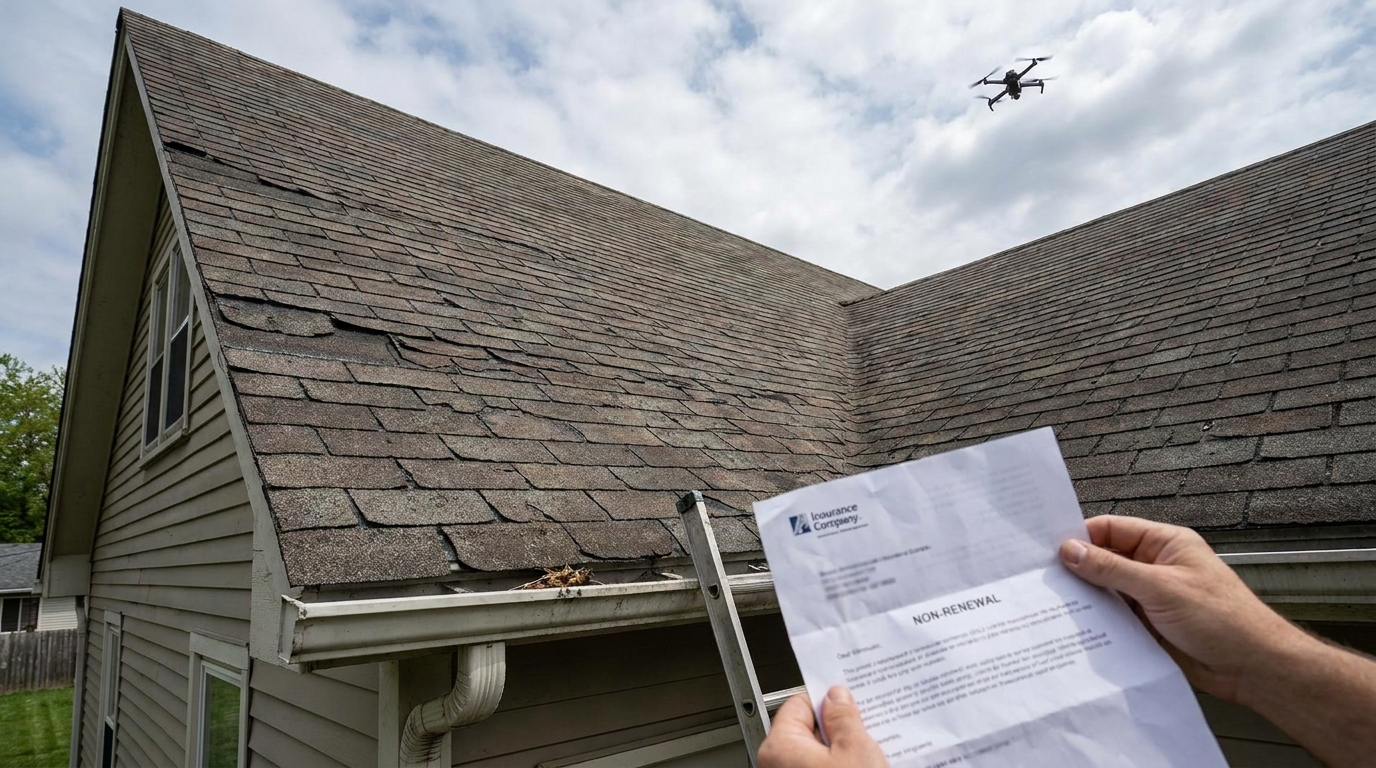
The letter does not mention a leak, a claim, or a storm. It mentions your roof. And the only thing your insurer looked at was a photo taken from above, sometimes without telling you and often without ever showing you the image. In 2026 this is a common way to lose a homeowners policy: not because something failed, but because software scored your roof as old or worn from the sky.
If you have gotten one of these notices, or you are worried you might, here is the practical picture. What insurers are actually doing, where the technology gets it wrong, the real age cutoffs by roofing material, the hidden payout trap on an older roof, and the state rules that are starting to force insurers to prove their case before they drop you.
How carriers are scanning roofs without knocking on your door
Instead of sending an inspector out, many carriers now buy aerial and satellite imagery from third-party firms such as CAPE Analytics and Nearmap, then run AI condition scoring across entire books of business at once. State Farm, Allstate, and Farmers are among the carriers cited as using aerial or AI-assisted underwriting. State Farm has said it does not fly its own drones and instead contracts imaging vendors.
This is a portfolio-wide audit, not a one-off inspection. As NPR reported, aerial imagery is increasingly the basis for non-renewal decisions. The economics explain the momentum: the aerial imaging market was worth roughly $3.41 billion in 2024 and is projected to reach about $8.24 billion by 2030. Remote roof auditing is cheaper and faster than boots on a ladder, so it is spreading fast, especially in storm-exposed states where non-renewal pressure is rising. In Texas, non-renewal rates roughly doubled between 2020 and 2023.
The catch for homeowners: in most states, insurers can use aerial imagery in underwriting with no requirement to notify you first, and many never share the image that triggered the decision. Consumer advocates at United Policyholders have documented exactly this pattern.
Where the AI gets it wrong
Do not assume a flag is accurate. Documented errors from aerial and AI roof assessments include:
-
Skylights and solar panels read as roof damage.
-
Moss or algae on a neighboring property attributed to the wrong home.
-
A Texas insurer that assessed the wrong house entirely.
-
Algae streaks and shadows interpreted as deterioration.
-
Outdated imagery that does not reflect a roof's current condition, for example after a repair or replacement.
Cosmetic surface staining is one of the biggest sources of bad calls. Dark algae streaks are common on asphalt shingles and often have nothing to do with the roof's structural life. If your notice is vague about what was found, that is a red flag worth challenging, not a verdict to accept.
The real age thresholds by material
Underwriting scrutiny tracks closely with roof age and material. These are typical ranges, not guarantees, and cutoffs vary by carrier and by state:
-
Asphalt shingles: inspections are commonly triggered around 15 years. Serious coverage restrictions and non-renewal risk concentrate at 20 years, the most common hard cutoff for both 3-tab and architectural shingles. At 25 years and up, many carriers move to actual-cash-value terms only or decline coverage.
-
3-tab asphalt lifespan: roughly 15 to 20 years.
-
Architectural asphalt lifespan: roughly 20 to 30 years.
-
Metal: roughly 40 to 70 years, often not flagged until 30-plus.
-
Tile and slate: 50-plus years, rarely flagged before 40 to 50.
The takeaway: if you have an asphalt roof approaching 15 years, you are entering the window where a photo from above can put your policy at risk, even if the roof is doing its job.
AI workflows for revenue teams
Placeholder house ad for Conservus.ai. Swap with final creative when brand assets are ready.
Partner with Conservus.aiThe hidden cost: ACV versus RCV
Sometimes an aging roof does not get you dropped. It gets you quietly downgraded. This is the difference between replacement-cost-value coverage and actual-cash-value coverage, and it can cost you thousands after a loss.
With replacement-cost-value coverage, a covered loss pays out what it costs to replace the roof today. With actual-cash-value coverage, the payout is depreciated for age and wear, so it can land far below the real cost to replace. An older roof kept on ACV-only terms may still be "covered," but a claim can leave you paying a large share of a new roof out of pocket. If your renewal quietly shifts your roof to ACV, treat that as a real financial change, not fine print.
The 'useful life' inspection that can preserve coverage
An older roof is not automatically a lost cause. A licensed or authorized inspector can produce a roof condition and useful-life report, and that document can be the difference between keeping and losing a policy.
Florida is the clearest example of how this works in law, and it is worth understanding because the details are widely misreported. Under existing [Florida Statute 627.7011](https://www.flsenate.gov/Laws/Statutes/2024/627.7011), an insurer may not refuse or non-renew a policy solely because of roof age if the roof is under 15 years old. For a roof 15 years or older, the homeowner has the right to a roof inspection by an authorized inspector, generally at the homeowner's expense, before the insurer can require replacement. And if that inspection shows the roof has 5 or more years of useful life remaining, the insurer cannot refuse or non-renew based on roof age alone.
One important correction, because it has circulated widely: this 5-year protection is existing Florida law. It was not created by a new 2026 bill. Florida House Bill 815 would have expanded Statute 627.7011 to more residential policy types, such as condo association and landlord policies, and would have created a separate standard for low-slope versus steep-slope roofs. But HB 815 died in the House Insurance and Banking Subcommittee on March 13, 2026, and its Senate companion, SB 808, also died. See the official House record. Nothing about the law changed. The protection you can rely on is the one already on the books.
The laws that are actually fighting back
The genuine push against aerial-imagery non-renewals is coming from state insurance regulators, not from that Florida bill. Several states have moved to make insurers show their work:
-
Michigan: DIFS Bulletin 2025-12-INS says insurers using aerial imagery for cancellation or non-renewal must notify the homeowner, provide copies of the imagery, and allow the homeowner to challenge it or correct the record. Cosmetic issues like discoloration or streaking cannot be the sole basis for an adverse action, a physical inspection should be sought before acting, and state law (MCL 500.2123) requires at least 30 days' notice for non-renewals unrelated to non-payment.
-
Massachusetts: Division of Insurance Bulletin 2025-02, issued April 30, 2025, addresses underwriting actions based on aerial imaging and homeowner rights to see the images and appeal.
-
Pennsylvania: regulators have taken the position that drone or aerial footage of a roof alone is not sufficient justification to drop a home policy.
-
California: introduced 2025 legislation to require homeowner notification before an insurer uses aerial data, and a Massachusetts bill would grant rights to view images, know their capture dates, and appeal.
The direction is clear, but coverage is uneven. Most U.S. states still permit aerial imagery in underwriting with no prior-notification requirement, so what protection you have depends heavily on where you live.
AI workflows for revenue teams
Placeholder house ad for Conservus.ai. Swap with final creative when brand assets are ready.
Partner with Conservus.aiThe paperwork that saves a policy
If your roof is flagged, documentation is your strongest tool. Keep and be ready to produce:
-
A licensed inspector's roof condition and useful-life report.
-
Dated photos of the roof's current condition.
-
Receipts and permits for prior repairs or re-roofs.
-
Manufacturer warranty documentation.
If you are dropped or restricted based on an aerial image, request the image, check whether your state gives you the right to see it and challenge it, and escalate to your state insurance department if the decision rests on cosmetic issues or an obvious error like the wrong house. NerdWallet and U.S. News both outline these consumer steps in more detail.
Deciding when to replace and what it costs you not to
The money question is whether to replace proactively or fight to keep coverage on the roof you have. A useful way to frame it:
-
When an inspection buys you years: if a licensed inspector documents solid remaining useful life, that report can preserve coverage and let you defer a large replacement expense. The inspection is a modest, homeowner-paid cost compared with a full re-roof.
-
When replacement is genuinely needed: if the roof is at or past its material lifespan and an inspection confirms real deterioration, replacing it proactively protects both your home and your insurability.
-
The cost of losing coverage: a non-renewal can push you into high-cost or last-resort insurance pools, which often means paying more for less. Weigh a planned re-roof against that ongoing premium hit, not just against zero.
Get any inspection or replacement quote in writing, and get more than one, so you can tell the difference between a roof that truly needs work and a photo that was misread.
Your 2026 action checklist
-
Find out your roof's actual age and material so you know which scrutiny window you are in.
-
If you are near a 15- or 20-year mark, order a useful-life inspection from a licensed inspector before your renewal date.
-
If you are flagged, request the aerial image and the specific reason for the decision in writing.
-
Learn your state's disclosure and challenge rules, since they vary widely.
-
Gather your inspection report, dated photos, permits, receipts, and warranty documents.
-
Escalate to your state insurance department if the decision relies on cosmetic issues, outdated imagery, or an outright error.
AI workflows for revenue teams
Placeholder house ad for Conservus.ai. Swap with final creative when brand assets are ready.
Partner with Conservus.aiRelated reading
-
[New 2026 Tariffs Just Reached Your Floors and Cabinets: Why That Vinyl Plank and Imported Tile Quote Jumped 10 to 25%](/article/2026-tariffs-flooring-cabinet-quotes-vinyl-tile-price-increase)
-
[The 30% Solar Tax Credit Is Gone for 2026 Buyers: Why a Cash or Loan Install Now Costs Thousands More](/article/solar-tax-credit-gone-2026-cash-loan-cost-more)
Sources
-
House Bill 815 (2026), Bill status page (The Florida Senate)
-
HB 815 (2026) Roofing Requirements for Property Insurance (Florida House of Representatives)
-
Chapter 627 Section 7011, 2024 Florida Statutes (The Florida Senate)
-
Dropped via Drone: Why Your Insurer is Scanning Your Roof Without Notice (United Policyholders)
-
Insurance companies using aerial imagery to determine if they'll renew home coverage (NPR)
-
Bulletin 2025-12-INS, Use of Aerial Imagery by Personal Lines Insurers (Michigan DIFS)
-
Is AI Spying on Your Roof? How Insurers Use Tech to Raise Rates (U.S. News & World Report)
-
Home Insurance Companies May Use Aerial Images to Drop Policies (NerdWallet)
Note: This article contains AI-assisted content and has been reviewed by our editorial team.
ABOUT THIS SERVICE: CallTheLocal.com is a directory and lead generation service, not a contractor or service provider. Submitting this form does not obligate you to hire anyone or purchase any service. Your information will be shared with licensed, insured home service professionals in your area who may provide quotes for your project. CallTheLocal.com does not guarantee the quality, timeliness, or outcome of any work performed by service providers you connect with through this service. Always verify licensing, insurance, and references before hiring. Get everything in writing before work begins.