If you own a home in Florida, you may have seen a claim making the rounds: that a new law takes effect July 1, 2026, and finally stops insurers from dropping you just because of your roof's age. The protection itself is real and worth understanding. The timing and the bill attached to it are not.
Here is the short version before we get into the details. The rule that keeps an insurer from refusing or non-renewing your policy solely because your roof is under 15 years old has been Florida law since the 2022 reforms. It is already on the books. The 2026 bill many people are pointing to, HB 815, did not pass. It died in the House Insurance and Banking Subcommittee on March 13, 2026, and it will not take effect July 1 or any other date. (Florida House of Representatives, HB 815 bill detail)
This matters because acting on the wrong information can cost you. If you think a brand new protection kicks in this summer, you might wait to push back on a non-renewal notice that you could actually challenge right now. So let's walk through what the law really says, what the failed bills tried to change, and what you can do today.
What Florida law actually says about roof age today
The relevant statute is Fla. Stat. 627.7011, which governs homeowners' policies and replacement cost coverage. Two parts of it deal directly with roof age, and both are current law in the 2025 statutes, not a 2026 change.
First, for newer roofs. Under 627.7011(5)(b), an insurer may not refuse to issue or refuse to renew a homeowner's policy on a residential structure with a roof that is less than 15 years old solely because of the age of the roof. In plain terms: if your roof is under 15 years old, its age alone is not a legal reason for a carrier to drop you. (Fla. Stat. 627.7011, The Florida Senate)
Florida's own consumer guidance from the Department of Financial Services confirms this is an existing homeowner protection, not a pending development. (Florida Department of Financial Services, Property Insurance Changes)
What changes when your roof crosses 15 years old
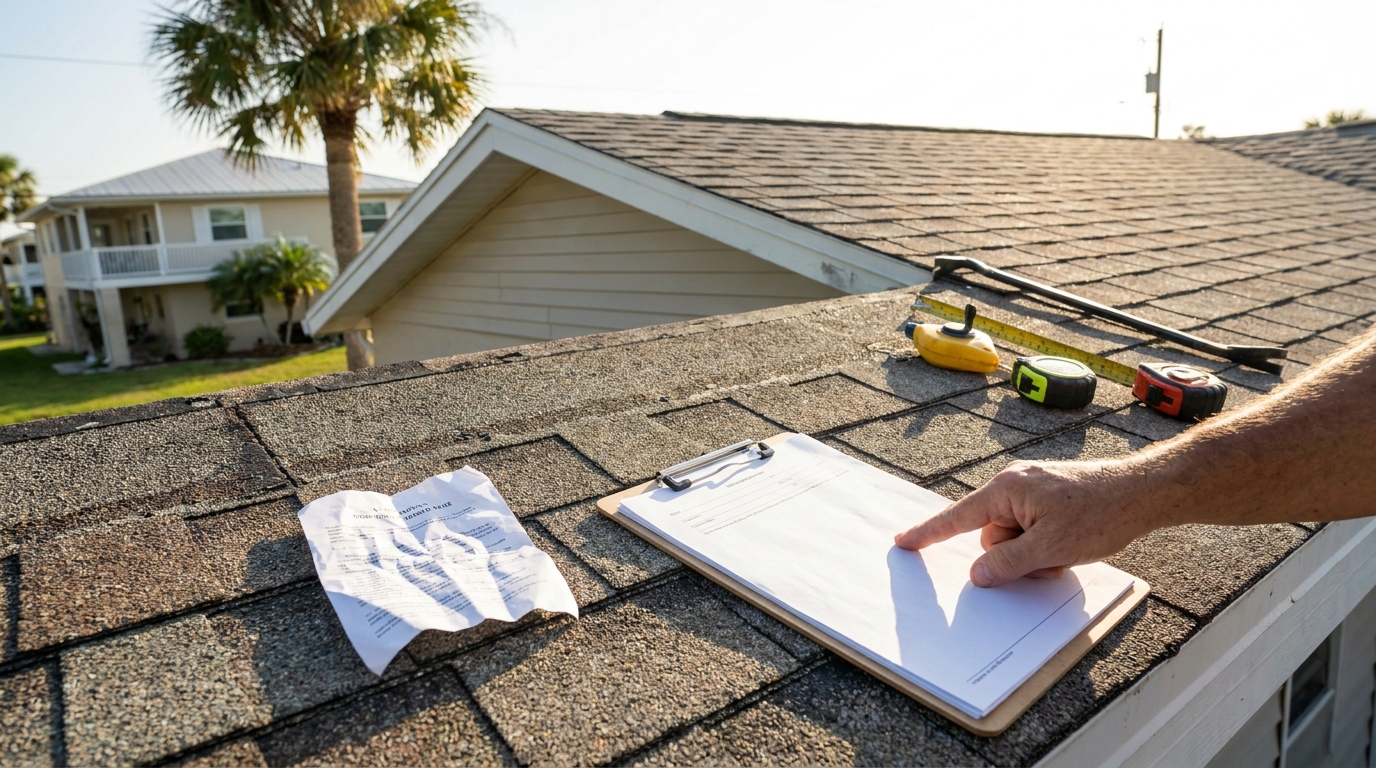
Once a roof reaches 15 years or older, the protection does not simply disappear. Under 627.7011(5)(c), before an insurer can require you to replace the roof as a condition of issuing or renewing coverage, it must let you get an inspection. That inspection is paid for by you, the homeowner, and performed by an authorized inspector.
Here is the key standard: if the inspection shows the roof has 5 years or more of useful life remaining, the insurer may not refuse to issue or renew your policy solely because of the roof's age. So an older roof in good shape can keep your coverage in force, as long as a qualified inspector documents that remaining useful life. (Fla. Stat. 627.7011, The Florida Senate)
One detail that trips people up is how roof age is even measured. Under the statute, the roof's age is based on the last date that 100 percent of the roof's surface area was built or replaced to the building code in effect at that time, with a rule for cumulative partial replacements that eventually add up to the full surface. If you re-roofed a section at a time, that can affect how the age is calculated, so keep your paperwork.
What HB 815 and SB 808 tried to do in 2026
So if the protections already exist, what were the 2026 bills about? HB 815 and its Senate companion, SB 808, were attempts to clarify and extend the existing framework. According to the Senate analysis of SB 808, the proposals carried the same familiar pieces: the 15-year threshold, the 5-years-of-useful-life inspection standard, and a provision to allow low-slope roof coating as an alternative to full replacement in some cases. The bills aimed to differentiate low-slope from steep-slope roofs and to broaden coverage of the protections. (SB 808 bill analysis, The Florida Senate)
Importantly, that same analysis confirms the under-15-year protection the bill would have extended was already in 627.7011. In other words, the legislation was meant to build on existing law, not create the core protection from scratch.
Neither bill became law. HB 815 was introduced December 18, 2025, went to committee in early January, and died in the Insurance and Banking Subcommittee on March 13, 2026. (BillTrack50, HB 815 status) SB 808 likewise did not pass. So when you see a headline saying a new roof-age law takes effect July 1, 2026, treat it as a red flag. The dependable source is the statute that is already in force.
Actual cash value vs. replacement cost on older roofs
A lot of homeowner anxiety around roof age is really about a different issue: whether the insurer pays full replacement cost or only actual cash value when an older roof is damaged. Replacement cost pays to replace the roof at today's prices. Actual cash value subtracts depreciation for age and wear, which can leave you with a much smaller check.
You may have heard that roofs flip to actual cash value at 20 years, or sometimes 25. It is important to be clear here: no Florida statute sets a 20-year or 25-year actual-cash-value trigger. That age threshold is a carrier underwriting and market practice, not a legal requirement, and the exact age varies from one insurer to the next.
What the law did change came from the 2022 reforms. SB 2-D allowed insurers to offer a separate roof deductible, up to 2 percent of the dwelling coverage or 50 percent of the roof replacement cost, whichever is lower, as an opt-out endorsement you have to consent to. Separately, federally backed mortgage guidance from Fannie Mae and Freddie Mac now permits actual cash value coverage on the roof while the rest of the dwelling stays on replacement cost. Together these shifts are why actual-cash-value roof coverage became more common, but again, the specific age cutoff is the carrier's call, not a statute. (Florida Department of Financial Services, Property Insurance Changes)
One more piece of 2022 context that often gets confused with roof-age underwriting: SB 4-D ended the old 25 percent rule for roofs built after 2007. If less than 25 percent of such a roof is damaged, only the repaired section has to meet current code, rather than the damage triggering a full tear-off. That is a building-code rule, separate from how carriers price coverage by roof age.
What you can do as a homeowner right now
Here is the practical playbook, based on the protections that are actually in force.
-
Know your roof's real age. Find the date the roof was last fully replaced and keep the permit, the contractor invoice, and any inspection reports. Because age is measured from the last full replacement to code, good documentation can be the difference in a coverage decision.
-
If your roof is under 15 years, push back on age-only non-renewals. An insurer cannot drop you solely because of roof age in that window. If a non-renewal notice cites only roof age, that is your cue to ask the carrier to point to the actual reason and to reference 627.7011(5)(b).
-
If your roof is 15 years or older, use the inspection route. Before a carrier can require replacement, you have the right to a homeowner-paid inspection by an authorized inspector. If that inspection shows 5 or more years of useful life, the insurer cannot refuse coverage on age alone.
-
Read the notice carefully. A non-renewal is not the same as a cancellation, and the stated reason matters. If the reason is age only and your situation is protected, gather your documentation and respond promptly rather than waiting for a law that is not coming.
What a roof certification inspection costs
If you need an authorized inspector to document remaining useful life, expect to pay out of pocket. A commonly cited range for a roof certification or insurance inspection is roughly $400 to $600, but treat that as a rough market estimate, not a fixed or regulated price. Costs vary by region, roof size, slope, and how detailed the report needs to be, and prices in higher-cost metro areas like Miami or Tampa can run above smaller markets. Before you book, call two or three licensed inspectors in your area for a firm quote and confirm they qualify as an authorized inspector for insurance purposes. Get the scope and fee in writing.
Where Florida homeowners can get help
If you receive a non-renewal notice you believe is improper, or you are not sure whether a protection applies to you, the Florida Department of Financial Services and the Chief Financial Officer's consumer resources can help you understand your rights and file a complaint if needed. Their property insurance guidance also lays out the current rules in plain language. (Florida Department of Financial Services, Property Insurance Changes)
The bottom line: the roof-age protection is real, but it has been law since 2022. The July 1, 2026 new-law story tied to HB 815 is not accurate, because that bill died in committee. Lean on the statute that is actually in force, keep your roof documentation in order, and use the inspection option if your roof has crossed the 15-year mark.
Related reading
Sources
-
HB 815 (2026) bill detail, Florida House of Representatives (confirms HB 815 died in the Insurance and Banking Subcommittee on March 13, 2026)
-
Fla. Stat. 627.7011 (2025), The Florida Senate (current under-15-year protection, 15-plus-year inspection rule, and how roof age is measured)
-
Property Insurance Changes, Florida Department of Financial Services
-
SB 808 (2026) Banking and Insurance committee bill analysis, The Florida Senate
This article contains AI-assisted content and has been reviewed by our editorial team.
ABOUT THIS SERVICE: CallTheLocal.com is a directory and lead generation service, not a contractor or service provider. Submitting this form does not obligate you to hire anyone or purchase any service. Your information will be shared with licensed, insured home service professionals in your area who may provide quotes for your project. CallTheLocal.com does not guarantee the quality, timeliness, or outcome of any work performed by service providers you connect with through this service. Always verify licensing, insurance, and references before hiring. Get everything in writing before work begins.
Related reading
- Spring 2026 Hail Alley Damage Has Roofers Booked Through November: What a $400 Adjuster Meeting Decides About a $25,000 Roof
- Hurricane Season 2026 Is Already Stress-Testing Florida Roofs: Why a $400 Pre-Storm Inspection Beats a $45,000 Replacement Claim
- Insurance Carriers Are Refusing to Renew Roofs Over 15 Years in 2026: How a $500 Roof Inspection Can Save a $35,000 Replacement Surprise