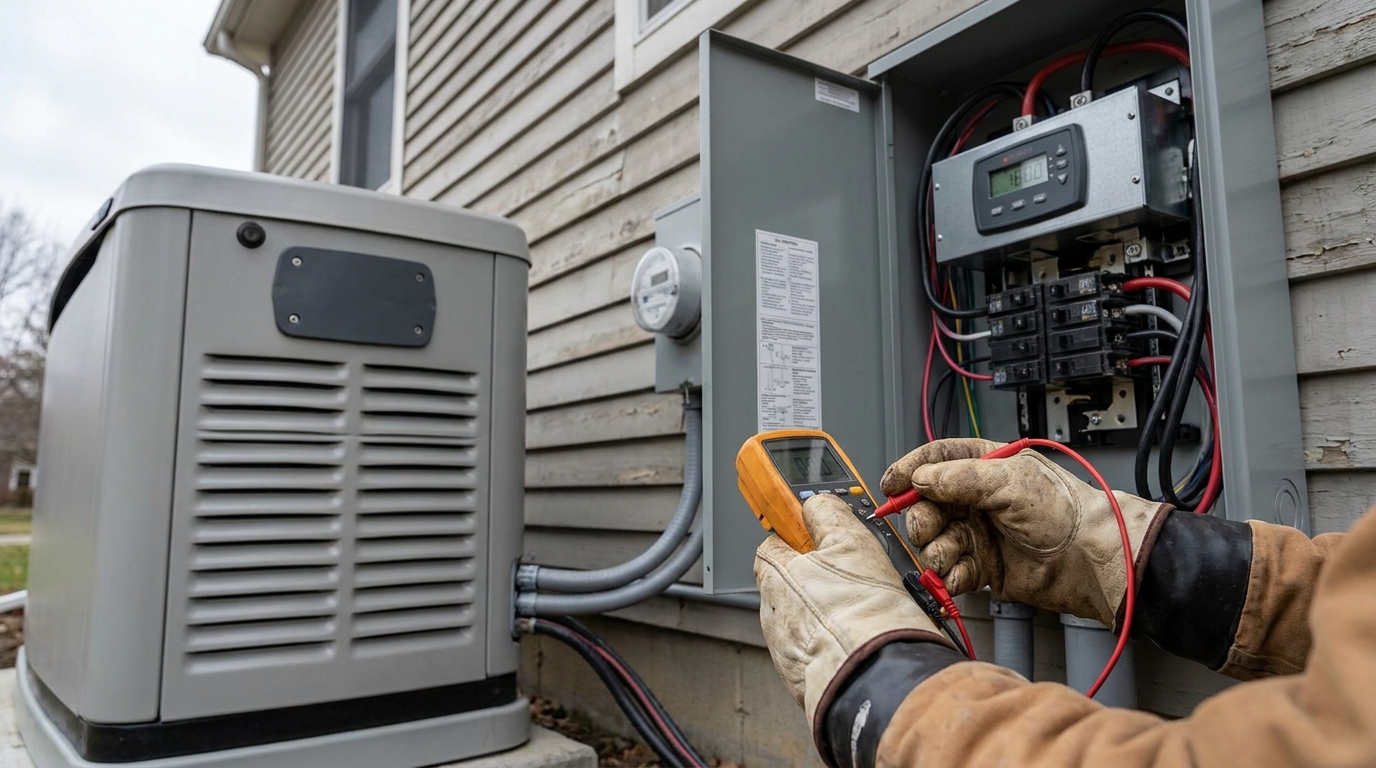
If your electrician has been busier than usual, there is a reason. In January 2026, the North American Electric Reliability Corporation (NERC) released its 2025 Long-Term Reliability Assessment, and the headline is hard to ignore: 13 of the 23 assessment areas across North America now face elevated or high risk of not having enough power to meet demand over the next five years. That is more than half the continent. Homeowners have noticed, and quotes for whole-home standby generators have been climbing as a result.
This is a practical guide to what the warning actually means, what backup power costs in 2026, and how to buy the right size without overpaying. We will keep it grounded in real numbers.
What the grid warning actually says
NERC is the organization responsible for tracking the reliability of the bulk power system across the United States, Canada, and part of Mexico. Its annual assessment looks out over a ten-year horizon and flags regions where projected demand could outrun available supply during peak conditions.
The 2025 report, summarized by POWER Magazine, found 13 of 23 areas at elevated or high risk. Five regions are projected to reach the more serious "high risk" category: MISO (the Midwest, starting around winter 2028), PJM (the mid-Atlantic and parts of the Midwest), Texas RE-ERCOT (most of Texas), and two western subregions, WECC-Basin and WECC-Northwest, beginning around 2029.
It helps to be clear on the terms. "Elevated risk" means a region could fall short of power under above-normal conditions, such as an extreme heat wave or a deep cold snap paired with unexpected generator outages. "High risk" is more serious: the region may face shortfalls even under normal peak conditions. Neither term means blackouts are guaranteed. It means the safety margin between supply and demand has gotten thin enough that unusual stress could force controlled outages.
The driver, in plain terms
The core problem is not that the grid is falling apart. It is that demand is growing faster than new power plants and transmission lines are being built. After roughly two decades of flat electricity use, demand is surging, and the biggest single reason is the buildout of data centers and artificial intelligence computing.
The numbers are striking. MISO alone projects roughly 18 gigawatts of data center load by 2035, and ERCOT in Texas projects about 23 gigawatts by mid-decade. For scale, a single gigawatt is roughly enough to power a mid-size city. NERC's projected summer peak demand growth of 224 gigawatts is 69 percent higher than the prior year's forecast, and winter growth of 245 gigawatts is up 65 percent. Those are the highest compound annual growth rates NERC has recorded since it began tracking this in 1995.
Federal energy forecasters see the same trend. The U.S. Energy Information Administration (EIA) forecasts record electricity demand of about 4,199 billion kilowatt-hours in 2025 and about 4,267 billion in 2026, both surpassing the previous 2024 record of 4,110 billion. Summer 2026 generation is forecast to run about 3 percent above summer 2025. The EIA has already noted that peak demand set new records during recent summers.
The takeaway for a homeowner is simple. Grid stress is most likely to show up during the hottest and coldest stretches, exactly when you most want your air conditioning or heat to keep running. That is why interest in backup power is climbing.
What backup power costs in 2026
There are three broad tiers, and the price gap between them is large. Here is what current 2026 pricing looks like.
Portable inverter generators: roughly $250 to $2,500 and up
These are the entry point. A small inverter unit around $250 can run a refrigerator and a few essentials during a short outage. Premium enclosed models cost two to three times what budget open-frame units do, and larger portable inverters push past $2,500. They are affordable and flexible, but you have to run them manually, keep fuel on hand, and place them safely outdoors away from the house. They do not power your whole home.
Whole-home standby generators: typically $8,000 to $15,000 installed
This is the category most homeowners are asking about. According to 2026 cost data from HomeGuide and Angi, a fully installed standby generator generally runs $8,000 to $15,000. A popular 22 kW Generac Guardian is commonly $11,000 to $14,000 installed.
That installed price is not just the machine. A typical quote bundles several line items:
-
The generator unit itself: $3,500 to $8,000
-
Automatic transfer switch: $500 to $1,500
-
Concrete pad: $300 to $600
-
Electrical work: $1,500 to $3,000
-
Gas-line connection: $500 to $1,500
-
Permits: $200 to $500
-
Labor: $1,000 to $2,000
When you see those pieces broken out, a $12,000 all-in quote starts to make sense. When you do not see them broken out, that is worth a second look, and we will come back to why.
Whole-home battery backup: roughly $12,000 to $50,000 and up
Battery systems, often paired with solar, are the premium option. Based on 2026 pricing from HomeGuide and EnergySage, expect roughly $12,000 to $18,000 for an essential-loads system (around 13 kWh), $22,000 to $32,000 for partial whole-home coverage (20 to 27 kWh), and $35,000 to $50,000 or more for full whole-home coverage (40 kWh and up). Installed cost commonly lands around $500 to $1,300 per kWh.
AI workflows for revenue teams
Placeholder house ad for Conservus.ai. Swap with final creative when brand assets are ready.
Partner with Conservus.aiRight-sizing: how many kW you actually need
This is where homeowners either save money or waste it. Bigger is not automatically better. An oversized generator costs more upfront and can run inefficiently. Undersized, it trips or fails to start your heaviest appliances.
Here is the general rule of thumb reputable installers work from:
-
13 kW covers essentials: refrigerator, some lights, a few outlets, and basic circuits.
-
17 to 20 kW covers most homes running one major appliance at a time, such as central air or an electric range.
-
25 kW and up is for running several large loads simultaneously.
Most homes land in the 14 to 24 kW range, which matches the guidance behind manufacturer tools like the Generac sizing reference. On top of the base figure, a good installer adds roughly 20 to 25 percent margin and accounts for motor surge. That last part matters: an air conditioner that draws 3,500 watts while running can spike to around 7,000 watts at the moment it starts up. Ignore surge, and a technically "big enough" generator can stall the first time the AC kicks on.
How a real load calculation works
The single most important step in buying a generator is the load calculation, and it is the step people forget to ask about. As explained by RC Generators & Electric, there are two common methods.
The first adds up the wattage of everything you want to power, divides by 1,000 to get kilowatts, then adds a safety margin. The second, more accurate method uses a recording ammeter left on your panel for about 30 days to capture your actual peak kilowatt draw, then multiplies that peak by 125 percent to build in headroom.
A reputable installer performs one of these before quoting a size. If a salesperson names a generator size without ever looking at your panel, your appliances, or your usage, they are guessing, and you are the one who pays for a wrong guess.
The steps people forget
A standby generator is a permitted electrical and fuel project, not a plug-in appliance. The parts that surprise homeowners are usually these:
-
Permits. Most jurisdictions require electrical and sometimes gas permits. Budget $200 to $500.
-
Gas line. The unit needs a fuel supply, usually natural gas or propane, sized to feed the generator at full load. That connection runs $500 to $1,500.
-
Transfer switch. The automatic transfer switch is what safely disconnects your home from the grid and switches to generator power. It is not optional, and it is a real cost, $500 to $1,500.
-
Concrete pad. The generator needs a stable, level base, typically $300 to $600.
-
Startup and testing. A proper install ends with a commissioning test to confirm the automatic transfer, the load handling, and the exercise schedule all work.
AI workflows for revenue teams
Placeholder house ad for Conservus.ai. Swap with final creative when brand assets are ready.
Partner with Conservus.aiPlan ahead of peak season
Timing matters. In storm-prone and heat-stressed states, demand for installers spikes right when you need them, and backlogs stretch out. The worst time to start shopping is during an active outage or the week a heat wave or hurricane is forecast. If grid reliability is your concern, the smart move is to get load calculations and quotes during a quiet stretch, well ahead of peak summer or winter season, so you are not waiting in a queue behind everyone else.
Battery-plus-solar vs. gas generator
Both keep the lights on, but they win in different situations.
A gas standby generator costs less upfront, generally $8,000 to $15,000 installed, and can run indefinitely as long as fuel keeps flowing, which makes it strong for long multi-day outages. The tradeoffs are fuel dependence, noise, and routine maintenance.
A battery-plus-solar system costs more, from around $12,000 for essentials to $50,000 or more for full-home coverage. It runs silently, needs no fuel deliveries, and can lower your everyday electricity bill by storing solar power. Its limit is runtime: a battery only holds so many kilowatt-hours, so during a long outage without enough sun to recharge, it can run dry. Batteries tend to win for homeowners who want daily energy savings, quiet operation, and coverage for shorter outages. Gas tends to win for whole-home coverage through extended outages at a lower entry price.
Red flags to watch for
-
A quote with no load calculation. If nobody measured or added up your actual electrical needs, the recommended size is a guess.
-
A single lump-sum price that hides the scope. A good quote itemizes the unit, transfer switch, gas line, pad, permits, electrical, and labor. A one-number price can quietly leave out the transfer switch or gas work, then reappear as a change order later.
-
Pressure to buy the biggest unit "to be safe." Oversizing costs you money upfront and does not make the system more reliable.
-
No permit talk. Skipping permits is a shortcut that can void insurance and fail an inspection at resale.
AI workflows for revenue teams
Placeholder house ad for Conservus.ai. Swap with final creative when brand assets are ready.
Partner with Conservus.aiBuyer checklist and next steps
-
Decide your goal: cover essentials only, or the whole home.
-
Get at least two or three itemized quotes, each including a load calculation.
-
Confirm the recommended kW size matches your real loads plus surge and a 20 to 25 percent margin.
-
Make sure the quote spells out the transfer switch, gas line, pad, permits, and startup testing.
-
Verify licensing and insurance, and get the full scope in writing before any work starts.
-
Shop before peak season, not during an outage.
Half of North America sitting at elevated or high grid risk does not mean the lights are about to go out everywhere. It means the margin has narrowed, especially during extreme heat and cold, and that is a reasonable prompt to plan your backup power calmly rather than in a panic. Get a real load calculation, an itemized quote, and the right size, and you will spend your money where it counts.
Related reading
-
[Your Local Plumber Just Got Bought by Wall Street: How the $50 Billion Home-Services Buying Spree Is Quietly Reaching Your Service Call](/article/local-plumber-bought-by-wall-street-private-equity-home-services)
-
[Home Insurance Is Now 9% of the Average Mortgage Payment: The Five Home-Service Upgrades That Actually Lower Your Premium in 2026](/article/home-insurance-9-percent-mortgage-five-upgrades-lower-premium-2026)
Sources
-
POWER Magazine: NERC Warns Long-Term Grid Reliability Risks Mounting
-
EIA Today in Energy: U.S. electricity peak demand set new records
-
HomeGuide: How Much Does a Whole House Generator Cost (2026)
-
RC Generators & Electric: How to Calculate Electrical Load for Home Generator Sizing
Note: This article contains AI-assisted content and has been reviewed by our editorial team.
ABOUT THIS SERVICE: CallTheLocal.com is a directory and lead generation service, not a contractor or service provider. Submitting this form does not obligate you to hire anyone or purchase any service. Your information will be shared with licensed, insured home service professionals in your area who may provide quotes for your project. CallTheLocal.com does not guarantee the quality, timeliness, or outcome of any work performed by service providers you connect with through this service. Always verify licensing, insurance, and references before hiring. Get everything in writing before work begins.
AI workflows for revenue teams
Placeholder house ad for Conservus.ai. Swap with final creative when brand assets are ready.
Partner with Conservus.ai