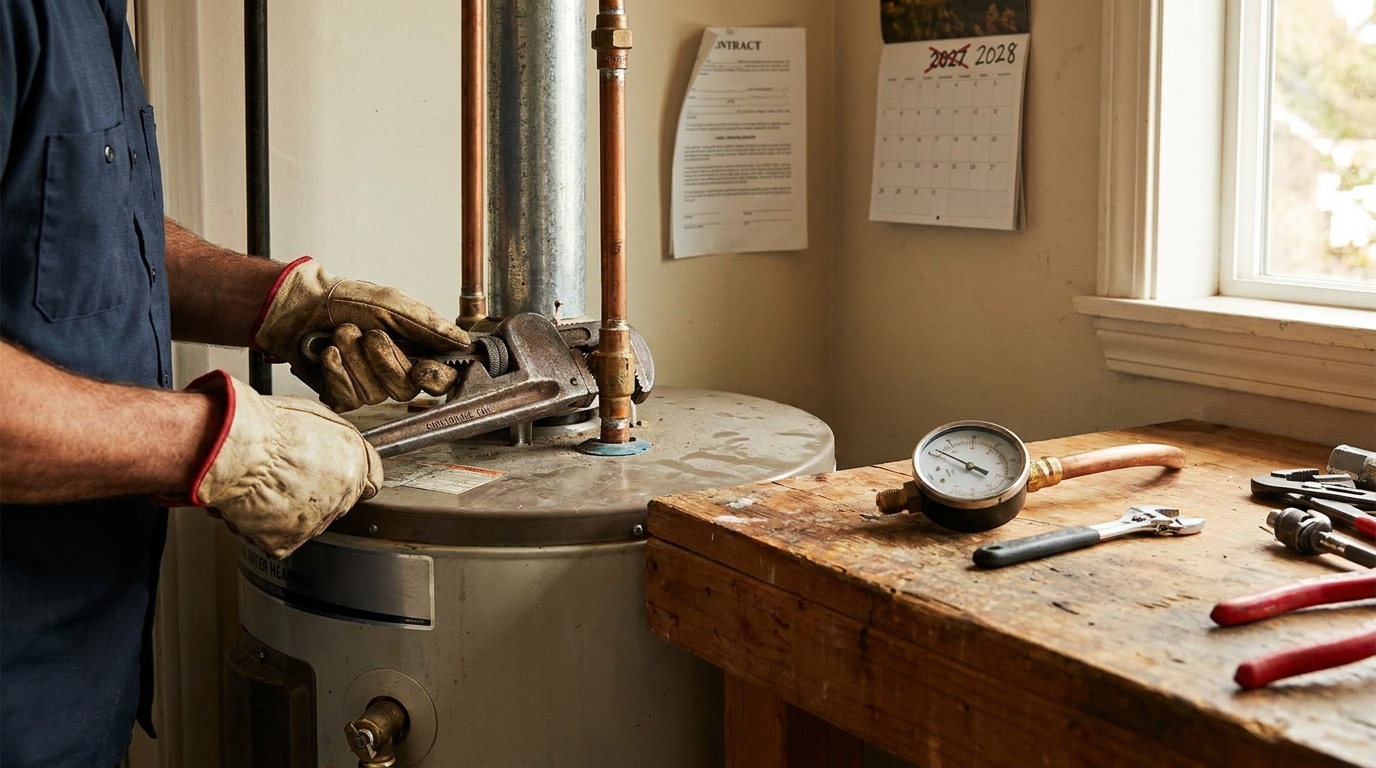
If a contractor has told you that your gas water heater becomes illegal in January 2027, you are being quoted against a date that the regulator who wrote it has formally proposed to move.
On July 14, 2026, the Bay Area Air District published draft amendments that would delay the zero-NOx compliance date for small residential water heaters by a full year, from January 1, 2027 to January 1, 2028, and carve out one-time exemptions for households that cannot realistically comply. The public comment period on that draft closed on August 13, 2026 at 6 p.m. The Board of Directors' decision is tentatively scheduled for November 2026.
That timing matters for anyone shopping a water heater right now, because the sales pressure is running ahead of the law in both directions.
What is actually adopted, and what is only proposed
The rule in effect today is Regulation 9, Rule 6, as last amended on March 15, 2023. That version sets a zero-NOx standard with a January 1, 2027 compliance date for water heaters rated under 75,000 BTU per hour, which covers the great majority of single-family tanks.
So the 2027 date is still the law. It has not been repealed, delayed, or softened yet.
The July 2026 draft is exactly that: a draft. It is not adopted, and you cannot plan around 2028 as settled either. The honest read as of today is that the adopted date is 2027, the District has proposed 2028, and the Board has not voted. The Air District's rule development page for Rules 9-4 and 9-6 is the place to check for the real, current status. Not a flyer, not a text message from a sales rep.
Worth knowing that the July draft already replaced an earlier concept. In May 2026, staff discussed a shorter nine-month delay to October 2027, with a vote in October 2026. The July 14 draft supersedes that with a full year and a November vote. If you read coverage from the spring, it describes a version that is no longer on the table.
What the rule restricts, and what it does not
This is the part that gets misrepresented most often, so here it is plainly.
Rule 9-6 is a point-of-sale standard on newly installed equipment. It does not require you to remove a working gas water heater. The District's own implementation page is explicit that existing appliances are unaffected, and it frames the trigger around equipment manufactured on or after the compliance date. Your current tank stays legal until it fails.
What the rule does is change what you are allowed to install once you do replace. In practice, meeting a zero-NOx standard means a heat pump water heater, since there is no gas unit on the market that hits zero.
The difference between "you must replace your water heater by 2027" and "when your water heater dies after the compliance date, the replacement has to be electric" is the difference between an emergency and a plan.
The proposed exemptions, in plain terms
The July draft would add one-time exemptions in four buckets:
-
Low-income owners. Enrollment in Medi-Cal or CalFresh, or spending more than 28% of income on mortgage and property taxes.
-
No room or ventilation. Properties that lack adequate space or ventilation for a compliant unit.
-
Electrical limitations. A panel below 100 amps, insufficient capacity, or a required electrical run longer than 50 feet.
-
Certain commercial high hot-water uses. Restaurants, laundries, healthcare, and assisted living, per CBS San Francisco's reporting on the proposal.
District staff estimate these exemptions could reach roughly 38% of water heater installations, with about 18% qualifying as low-income and about 20% on building or electrical constraints, according to the Palo Alto Daily Post and Canary Media.
Read that number again. If the draft is adopted as written, close to four in ten installations may not be subject to the standard at all. A 50-foot run from the panel to a garage or a side-yard closet is not exotic in Bay Area housing stock, and neither is a 100-amp panel in a house built before the 1980s.
What a swap actually costs
Two credible sets of numbers are in circulation, and they do not agree. You should see both.
The Air District's own estimate, as reported by the Daily Post, puts a standard electric water heater install at about $3,500 against $1,900 to $2,900 for gas. That is a gap of roughly $600 to $1,600.
Canary Media reported a higher real-world figure: heat pump water heater installs averaging around $7,000, roughly double the cost of gas, with a typical gap near $3,500. The same reporting puts electrical service upgrades on difficult properties anywhere from $2,000 to $30,000.
Both can be true. The District is estimating across a large population, including easy installs in newer homes with capacity already in the panel. The higher figures reflect what a specific house with a specific closet and a specific panel actually costs. When you collect quotes, treat the District's number as a floor and the Canary figure as a realistic middle, and get at least three bids.
The rebate money that is not there anymore
This is where a lot of otherwise reasonable cost math falls apart, and where you should be most skeptical of a quote.
The federal 25C Energy Efficient Home Improvement Credit, worth up to $2,000 for a heat pump water heater and $600 for a qualifying panel upgrade, applies only to property placed in service before December 31, 2025. It is not available for a 2026, 2027, or 2028 installation. Any quote or article that describes a heat pump water heater price as "before rebates" while pointing at the federal credit is describing money you cannot claim.
On the state side, TECH Clean California's single-family heat pump water heater incentives were reported nearly reserved statewide as of November 14, 2025. HEEHRA single-family rebates were fully reserved, and new Northern California reservations were waitlisted as of February 24, 2026.
There may still be utility or local programs that apply to you, and TECH points homeowners to switchison.org for live amounts. But do not let a rebate be a line item in your decision until you have confirmed in writing that the specific program is open, that your project qualifies, and who is responsible for filing. A rebate that gets applied as an instant discount on the invoice is real. A rebate described verbally as "you'll get that back" is not.
The 120-volt plug-in path, and its honest limits
If your obstacle is electrical, the retrofit worth asking about is a 120-volt plug-in heat pump water heater. Rheem's ProTerra plug-in line is built specifically to replace a gas unit without running a 240-volt circuit, which in a lot of homes also means skipping a panel upgrade. Rheem offers the line in multiple tank sizes from 40 up to 80 gallons, and in two flavors: a dedicated-circuit version and a shared-circuit version. The dedicated-circuit model has the faster recovery of the two, which matters if your household draws hot water in back-to-back bursts.
Confirm the exact gallon size and recovery rate against the current spec sheet for the model you are quoted, not against a general description.
Now the caveats, because "plug-in" gets oversold as "drop-in." A 120-volt heat pump water heater still needs condensate drainage, and it still needs clearance and air volume around the unit to work. A tight interior closet that was fine for a sealed gas unit is not automatically fine for a heat pump. Recovery on any heat pump water heater is slower than a gas burner, which is usually a non-issue with the right tank size and a bad surprise with the wrong one. Ask your installer to walk the actual location with you and point to where the condensate goes.
Panel upgrade reality check
If you do need electrical work, Bay Area numbers run higher than the figures that circulate online.
A full 100-amp to 200-amp service upgrade generally lands around $3,500 to $6,500 from contractor sources. Replacing the service mast and meter adds roughly $1,500 to $3,000 on top. And if PG&E has to touch the transformer or service drop on their side, add another $2,000 to $4,000, plus a timeline that is not under your contractor's control.
Lighter work is much cheaper. Adding a 120-volt outlet, installing a circuit-sharing device, or dropping in a small sub-panel to make a heat pump water heater workable runs closer to $500 to $2,500. Ask specifically which of these your house needs before you accept a full service upgrade as a given.
Red flags in a water heater quote right now
A quote that uses "the 2027 ban" as the reason to replace a functioning tank today is leaning on a date the regulator has formally proposed to move, and one that may not apply to your property at all if you land in the roughly 38% of installations the draft would exempt.
Questions to ask, in this order:
-
What is the manufacture date on the unit you are proposing, and how does the rule's manufacture-date trigger apply to it?
-
Is my installation actually subject to Rule 9-6? What is the BTU rating of my current unit and of the replacement?
-
Do I appear to fall into one of the proposed exemption categories? What is my panel amperage, and how long is the run from the panel to the water heater location?
-
What is the remaining life on my current tank? What specifically are you seeing that says it needs to go now?
-
If you are quoting a rebate, which program, is it currently open, and will it come off this invoice?
A good contractor will answer all five without getting defensive. Get the answers in writing.
Don't let a furnace quote borrow the water heater date
Different appliances, different rules, different years. Under the same rule family, residential and commercial furnaces fall under Rule 9-4 with a January 1, 2029 compliance date, and water heaters from 75,000 BTU per hour up to 2 million BTU per hour, which covers commercial and many multifamily and tankless applications, are set at January 1, 2031. Residential fan-type furnaces already had an ultra-low-NOx date of January 1, 2024.
If someone is quoting you a furnace and citing 2027, they are citing the wrong rule.
Why the standard is not simply going away
It is worth understanding the shape of the fight, because it tells you what is likely to survive the November vote. The District attributes roughly 85 premature deaths per year in the Bay Area to gas appliance emissions, which is the health basis for amending the rule rather than repealing it.
Board Chair Lynda Hopkins has defended the standard on those grounds, saying, "Let's talk about the affordability of asthma." At the same time, eight of eighteen directors present sought further delay or a voluntary program, per Canary Media. Air District CEO Philip Fine framed the amendments around cost, saying the goal is that "A broken water heater will never become a financial crisis."
Read together, that suggests a Board more likely to delay and exempt than to scrap the standard. Which is another way of saying: an electric replacement is probably in your future eventually, just not necessarily on the schedule you are being sold.
What to watch, and what to do
Mark the November 2026 Board meeting. Check the Air District's building appliances rule development page for the adopted text after that vote, and treat that page as the authority over anything a sales flyer says.
In the meantime, the practical call is straightforward. If your tank is under about eight years old and working fine, the case for replacing it against a deadline that regulators have proposed to move, and that may exempt you anyway, is weak. Use the time to find out your panel amperage and measure the run to your water heater, because those two facts determine your options and your cost more than any date will.
If your tank is at or near end of life, replace it on its own merits. Get three quotes, price both the 120-volt plug-in path and the conventional one, confirm any rebate in writing, and make the decision on electrical capacity and space. Not on the calendar.
Related reading
-
[The Crew That Didn't Show Up: 349,000 Missing Workers and Why Your Start Date Keeps Sliding](/guides/construction-labor-shortage-contractor-delays-what-homeowners-should-know)
-
[The Local Plumber You Just Called May Answer to Wall Street: Inside the Private Equity Buyout of Neighborhood Trades](/guides/local-plumber-private-equity-buyout-neighborhood-trades)
Sources
-
Bay Area Air District: Rules 9-4 and 9-6 Building Appliances (rule development status)
-
Bay Area Air District: Building Appliances Rule Implementation
-
Bay Area Air District: Regulation 9, Rule 6 (adopted March 15, 2023)
-
CBS San Francisco: Bay Area Air District mulls delays, changes to ban on natural gas water heaters
-
Palo Alto Daily Post: Air district will likely delay ban on gas water heaters (July 15, 2026)
-
Canary Media: Bay Area looks to exempt some households from gas water-heater rule
-
Rheem: 120-Volt ProTerra Plug-in Heat Pump Water Heaters Designed for Easy Gas Unit Replacement
Note: This article contains AI-assisted content and has been reviewed by our editorial team.
ABOUT THIS SERVICE: CallTheLocal.com is a directory and lead generation service, not a contractor or service provider. Submitting this form does not obligate you to hire anyone or purchase any service. Your information will be shared with licensed, insured home service professionals in your area who may provide quotes for your project. CallTheLocal.com does not guarantee the quality, timeliness, or outcome of any work performed by service providers you connect with through this service. Always verify licensing, insurance, and references before hiring. Get everything in writing before work begins.