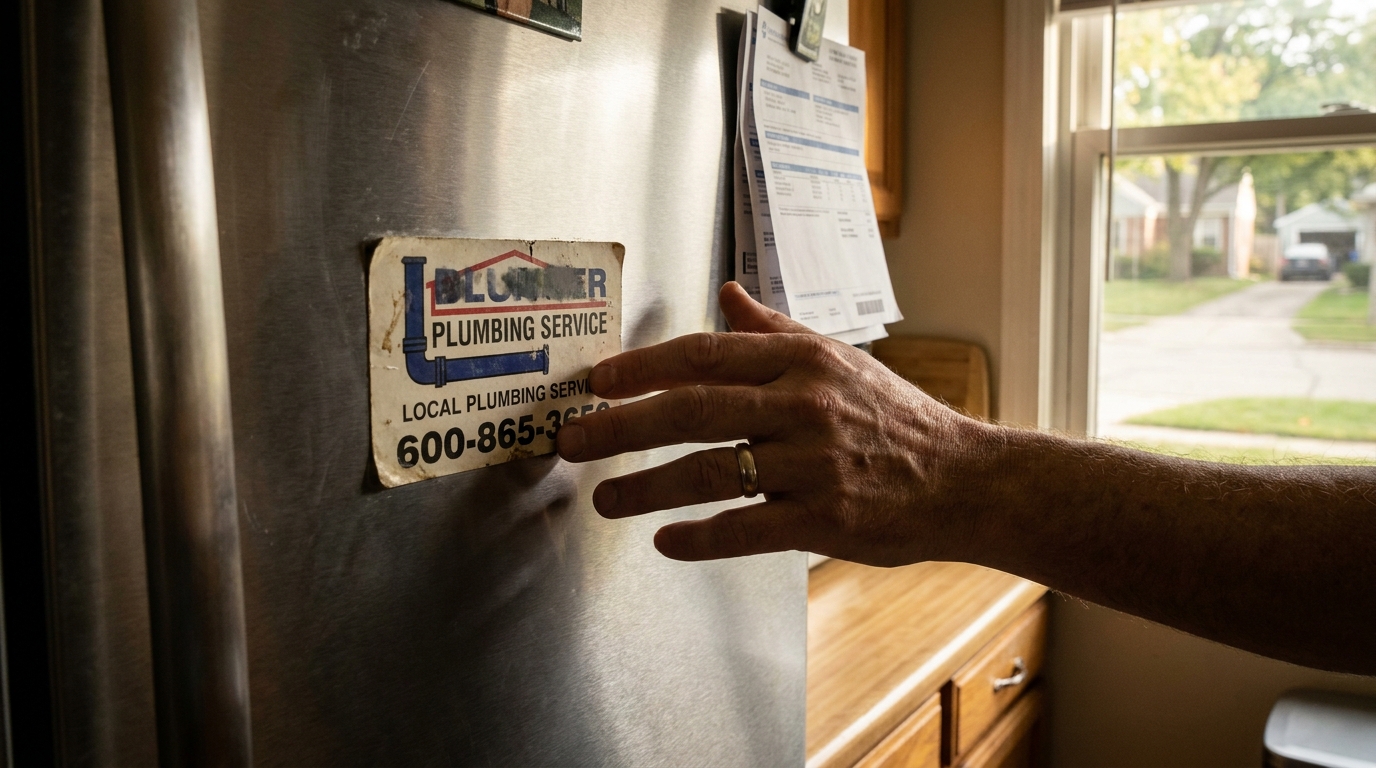
You call the plumbing company your neighbor recommended. Same name on the van. Same logo. Same phone number you have had on the fridge for six years. The tech who shows up is friendly and local, because he is local. Nothing about the visit tells you that the company changed hands eighteen months ago and now reports to an investment firm several states away.
That is not sloppy branding. It is the strategy. When a private equity backed platform buys a residential trades business, it usually keeps the local name, the trucks, and the phone number exactly as they were, because the name is most of what it paid for. Trust in home services is hyper local, and rebranding a 40 year old family plumbing shop into a national logo would burn the asset. So the sign stays up, and homeowners have no obvious way to know.
This article is not an argument that consolidated shops do bad work. Plenty do fine work. It is a practical guide to figuring out who you are actually dealing with, what commonly shifts on the invoice after a sale, and how to protect yourself on the quotes that matter.
How big the buyers actually are
You will see a lot of loose numbers on this topic. Here are the ones that come straight from the companies involved.
Apex Service Partners. In its May 28, 2026 announcement of a strategic minority investment from Apollo Funds alongside existing sponsor Alpine Investors, Apex described itself as operating 75 local brands across 46 states, with more than 13,000 employees, more than 16 million homes served, and roughly $3 billion in annual revenue. If you have seen the figure of $1.3 billion and close to 300 businesses floating around, that number is stale and does not match what the company says about itself.
Sila Services. Goldman Sachs Alternatives' private equity business announced on November 12, 2024 that it had agreed to acquire a majority stake in Sila from affiliates of Morgan Stanley Capital Partners, with Sila management retaining a significant minority position. Sila operates more than 30 brands across the Northeast, Mid Atlantic, and Midwest. The release did not disclose a purchase price, so treat any dollar figure you see attached to that deal as unconfirmed.
Wrench Group. Backed by Leonard Green & Partners, Wrench runs roughly 35 regional brands concentrated in the Sun Belt, including names like Coolray, Parker & Sons, Abacus, and Berkeys. Revenue estimates for Wrench vary so wildly across third party sources that none of them is worth repeating.
Add up just those three and you get roughly 140 local brand names under three owners. There are dozens of similar platforms buying HVAC, plumbing, electrical, and roofing companies. You may see claims of more than 200 such platforms. That number does not trace back to any credible source, and deal trackers put the realistic count much lower. The point does not depend on the exaggeration. Dozens of platforms buying steadily is enough to change what the market looks like in a given metro within a few years.
What the industry's own data says about your bill
The most useful read on what homeowners are feeling right now comes from inside the industry. Jobber, which makes software for home service businesses, published its Home Service Economic Report for Q2 2026 on August 20, 2026, built on its dataset covering more than 100,000 home and commercial service businesses and more than 400,000 professionals, with year over year comparisons drawn from a cohort of businesses active since January 2023.
Jobber's own headline finding for the quarter: fewer new jobs booked, made up by charging more per job.
That single line is the consumer facing symptom in plain language. Revenue kept growing in June, up 7.5% year over year in green services, 7.6% in cleaning, 6.4% in contracting, and 9.1% in construction. But average invoice size climbed through the quarter. Green services went from 3.5% year over year invoice growth in April to 8.4% in June. Cleaning went from 3.4% to 5.8%. Contracting swung from negative 3.5% in April to positive 2.6% in June. Volume softened while tickets rose.
The backdrop matters too. Jobber's report notes inflation spiking to 4.2% in May, its highest since 2023, before cooling to 3.5% in June, and consumer confidence falling to 44.8 in May before recovering to 49.5 in June. Jobber CEO Sam Pillar summarized it in the company's announcement: "Gas prices spiked and confidence took a hit in May, and home service still finished the quarter growing revenue." Chief strategy officer Abheek Dhawan added, "What we're seeing is a category becoming more durable, not just resilient for one quarter."
One more number from that report deserves your attention before you sit at the kitchen table with a salesperson: home equity line of credit balances hit a record $459 billion by June. Financing is a bigger part of the home services conversation than it used to be, and a monthly payment is a very effective way to make a large number feel small.
Five things you can check to see who owns the shop
None of these is proof on its own. Think of them as signals. Two or three together usually tell you what you need to know.
-
Your state licensing board. Search your own state's contractor licensing portal by company name. Look at the entity name behind the license and the qualifying individual, and note any recent change. Licensing lookups are run state by state, the interfaces differ, and some go offline for stretches, so go directly to your state's board rather than trusting a national aggregator site.
-
The website footer and privacy policy. Parent company names tend to survive in the fine print even when they never appear on the homepage. The privacy policy is often the most honest page on a contractor's website because a lawyer wrote it.
-
A sudden push toward membership plans. If a shop that never sold a maintenance plan is now leading every visit with one, something changed in how it is being run.
-
Flat rate price books replacing hourly billing. Flat rate pricing is not inherently worse for you, and some independents use it well. But a switch away from time plus materials is a common operational change after a sale.
-
Technicians selling on commission. Ask the tech directly whether any part of their pay depends on what you approve today. Most will tell you straight.
To be clear about the evidence here: these are patterns that contractors and trade observers describe, not documented corporate policies published by any of the companies named above. Use them as prompts to look closer, not as a verdict.
What tends to change after a sale
The three areas homeowners most often notice, again as a described pattern rather than a documented policy, are the diagnostic fee structure, the availability of financing offered on the spot, and where the repair versus replace line gets drawn. A system that a family owned shop would have patched for a few hundred dollars is more likely to come back as a replacement recommendation with a financing option attached.
Sometimes replacement really is the right call. A 19 year old furnace with a cracked heat exchanger is not a repair candidate. The problem is that you generally cannot tell the difference from inside the conversation, which brings us to the cheapest tool you have.
The second opinion math
Homeowners tend to decide fast off a very small comparison set. In an April 2022 Service Direct survey of 559 US homeowners aged 30 and older, 85% said they contact three or fewer contractors, and 60% make a hiring decision within 72 hours. The same survey found that being licensed and insured was the single most important research factor, named first by 25% of respondents, and that 84% considered membership in a professional organization such as the BBB important.
Meanwhile, the FTC's baseline guidance is to get three written estimates and never to automatically take the lowest bid.
So run the arithmetic on your own job. If you have a $5,000 quote in hand and a second company charges $89 for a diagnostic visit, that second opinion costs about 1.8% of the job. On a $12,000 system replacement, the same $89 is about 0.7%. There is no other decision in home ownership where you can buy that much certainty for that little. Diagnostic fees vary by trade and metro, and many companies waive them if you proceed with the work, so ask when you book.
The one exception is genuine emergencies. Water actively coming through the ceiling or no heat in a hard freeze is not the moment to shop. Stop the damage first, then get a second opinion on the permanent repair.
The FTC checklist, worth keeping
From the FTC's consumer guidance on avoiding home improvement scams:
-
Get three written estimates.
-
A written estimate should list the scope of work, materials, completion date, and price.
-
Do not automatically take the lowest bid.
-
Verify license and insurance before hiring, not after.
-
Require a written contract with the contractor's name, address, phone number, and license number, plus any promise that was made to you verbally.
-
Never pay by cash or wire transfer.
-
A deposit of about one third is standard. A demand for full payment up front is a red flag.
The FTC also publishes a plain language home repair scams resource that is worth passing along to older relatives, who are targeted disproportionately for driveway, roofing, and tree work pitches.
How to actually find an independent
Independents are still out there in large numbers. For scale, the three largest platforms named above account for roughly 140 brand names combined, while Jobber's software dataset alone covers more than 100,000 home and commercial service businesses. Consolidation is real and it is accelerating, but it has not replaced the field.
Three practical moves:
-
Search your state licensing board by county or city rather than starting with a search engine. Paid search results are dominated by whoever has the biggest marketing budget, which is usually not the two truck shop.
-
Ask on the first call who owns the company. It is a completely normal question and the answer, including how it is answered, tells you a lot.
-
Notice who picks up. If the number reaches a regional call center that schedules for several markets, you are probably talking to a platform. If it reaches a dispatcher who knows which tech is closest to your street, you are probably talking to a local shop.
And when you get the quote, whoever it comes from, hold it to the same standard: in writing, itemized, with a license number on it, and compared against at least one other bid before you sign.
Looking locally: Call The Local maintains directory listings of home service professionals by metro. Use them as a starting point for building your short list, then verify licensing and insurance with your state board before you hire anyone.
Related reading
-
DIY EV Charger Installs Are Ending, But Not Everywhere and Not on the Date You Were Told
-
[The Grid Browned Out Before Your AC Died: What Record Summer Demand Actually Does to a Compressor, and the $300 Part That Prevents It](/guides/grid-brownout-ac-compressor-damage-surge-protector-cost)
Sources
-
Apex Service Partners and Alpine Investors Announce Strategic Minority Investment from Apollo Funds, Apollo Global Management, May 28, 2026.
-
Jobber Home Service Economic Report: Q2 2026, published August 20, 2026.
-
Home Service Delivers Steady Revenue Growth in Q2 2026, Jobber press release, August 20, 2026.
-
Sila Services Announces Equity Investment from Goldman Sachs Alternatives' Private Equity Business, November 12, 2024.
-
Survey: What Matters to Homeowners When Choosing a Contractor, Service Direct, April 2022 (n=559 US homeowners aged 30 and older).
-
How To Avoid a Home Improvement Scam, FTC Consumer Advice.
-
Home Repair Scams, FTC Consumer Advice (Pass It On).
Note: This article contains AI-assisted content and has been reviewed by our editorial team.
ABOUT THIS SERVICE: CallTheLocal.com is a directory and lead generation service, not a contractor or service provider. Submitting this form does not obligate you to hire anyone or purchase any service. Your information will be shared with licensed, insured home service professionals in your area who may provide quotes for your project. CallTheLocal.com does not guarantee the quality, timeliness, or outcome of any work performed by service providers you connect with through this service. Always verify licensing, insurance, and references before hiring. Get everything in writing before work begins.
Related reading
- No, You Can't Be Blocked From Selling Your California Home in 2026 Over Old Toilets. Here's the Real Rule.
- Millions of Homeowners Are Getting a 'Your Water Line May Be Lead' Letter in 2026: What the Notice Means and Who Actually Pays the Bill
- Your Local Plumber Just Got Bought by Wall Street: How the $50 Billion Home-Services Buying Spree Is Quietly Reaching Your Service Call
- The Bay Area's Gas Water Heater Ban Was Set for January 2027. Regulators May Push It to 2028, and Quotes Are Already Using the Old Date.
- Your Water Utility's Letter Probably Says 'Unknown.' That One Word Decides Who Pays.