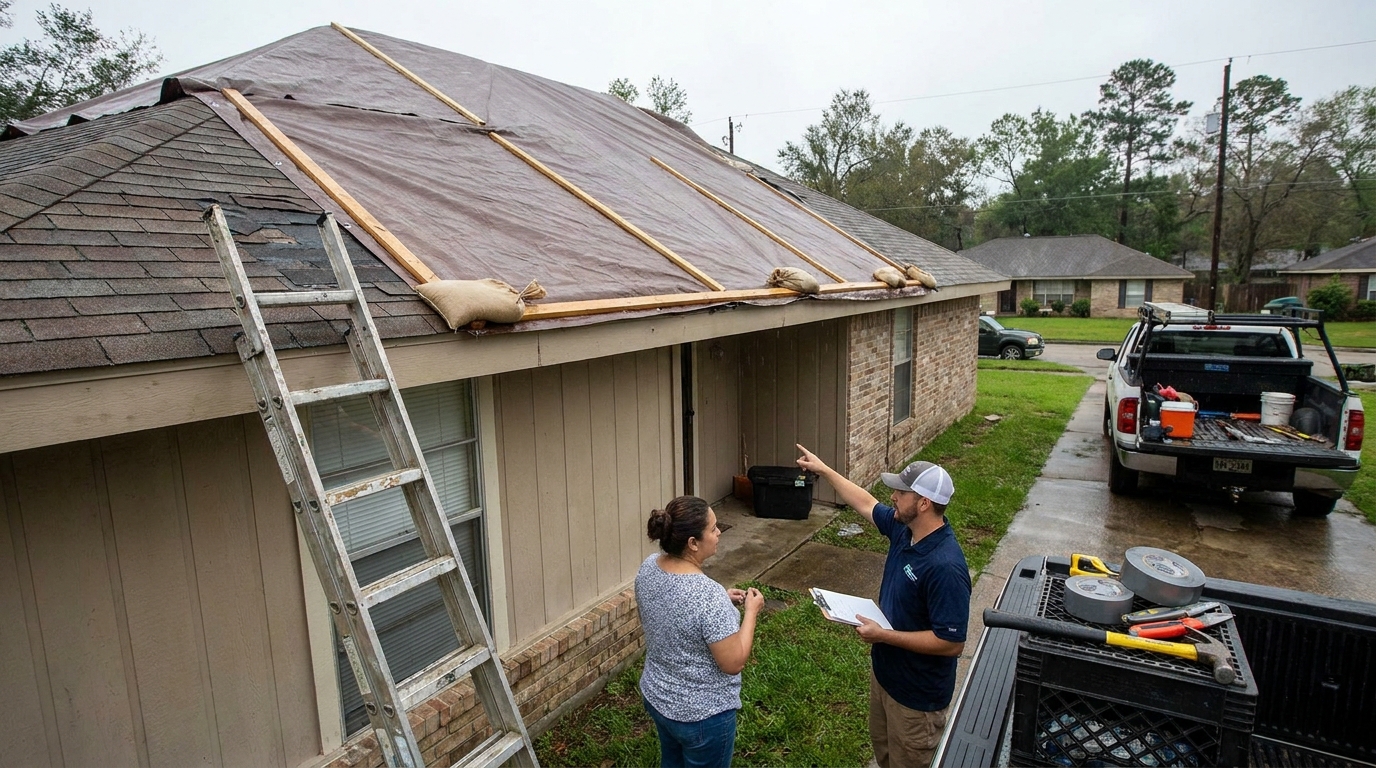
Tarps went up fast across Beaumont, Port Arthur and Lumberton this week after Tropical Storm Edouard came ashore near Johnson Bayou, Louisiana, on the afternoon of Sept. 1. Look at them from the street and you will notice something: they are gray, brown, silver, whatever the crew had on the truck. Almost none of them are blue. That is the tell. The blue tarps people remember from past storms come from a federal program that is not running in Southeast Texas, which means the emergency roof tarp cost on your house right now is a bill somebody has to pay, and the only real question is who.
The timeline, and the gap in it
Edouard formed Aug. 31 and made landfall the following afternoon with 60 mph sustained winds. Port Arthur recorded a 90 mph gust. Rainfall topped 20 inches in spots, with a flash flood emergency declared for Hardin, Polk and Tyler counties. More than 82,000 customers lost power, and Entergy reported 198 damaged poles and 81 damaged transformers, according to the storm summary compiled from local reporting.
Local government moved the same day. Jefferson County Judge Jeff Branick and Port Arthur Mayor Charlotte Moses each signed disaster declarations on Sept. 1, per the Port Arthur News. Hardin and Polk counties declared for flooding.
The federal government has not. As of Sept. 5, there is no federal major disaster declaration for Edouard. That single fact drives most of what follows.
Why the free tarp is not coming
Operation Blue Roof is not a standing service you can call. It is a FEMA mission assignment carried out by the U.S. Army Corps of Engineers, and the sequence is fixed: an initial damage assessment, then a governor's request for assistance, then a federal declaration and a mission assignment. Only after all of that can the Corps call center start signing homeowners up. FEMA's own announcement of a past Blue Roof activation lays out the order plainly. No declaration, no program. Waiting on a blue tarp in Beaumont right now means waiting on something that legally cannot start.
Worth knowing the rules anyway, in case a declaration lands later. When Blue Roof does run, it is free to eligible residents. It covers primary residences and permanently occupied rentals with less than 50% structural damage. It excludes metal roofs, and mobile homes are excluded or handled case by case at best. You have to sign a Right of Entry form before a crew touches the house.
The mechanism that makes a declaration more likely is the damage report. The City of Beaumont's Sept. 2 notice asks residents to complete the State of Texas iSTAT survey at damage.tdem.texas.gov, one survey per affected address. The city is explicit that completing the survey does not replace filing an insurance claim and does not guarantee assistance. True, and also beside the point. iSTAT totals are the raw material a federal declaration request is built from. It takes about ten minutes. Do it.
The declaration you saw in the news was a different storm
This trips up a lot of people. On Sept. 3, Gov. Abbott announced federal disaster declaration approval for Texas. Read the fine print. That approval covers July's Hill Country storms and flooding. It is Public Assistance only, meaning money for governments and certain nonprofits, not checks to homeowners. It names 19 counties including Kerr, Kendall, Uvalde, Val Verde and Bandera. Jefferson County is not on the list. Individual Assistance for 30 counties was still pending when the announcement went out.
Different storm, different half of the state, different kind of aid. If a contractor tells you federal help just got approved for your roof, that is either confusion or a sales pitch.
What a tarp actually costs here
Two numbers matter: price per square foot, and price per roofing square (100 square feet).
-
Standard, scheduled tarping: $0.70 to $2.00 per square foot, or roughly $70 to $200 per square, per Angi's 2026 cost data.
-
Emergency tarping: $1.00 to $2.80 per square foot, or roughly $100 to $280 per square.
-
After-hours premium: 25% to 40% on top, or a flat call-out fee of $200 to $500.
-
Tarp material alone: about $0.10 to $0.30 per square foot, which tells you most of what you are paying for is labor and risk.
HomeGuide puts the national average around $450, with a full range of $150 to $3,300. Most homeowners who call a professional out for an emergency tarp land somewhere around $800 to $1,000.
Run the math on a typical job. An 8 to 12 square area covered on an emergency call comes out around $800 to $2,800 depending on pitch, height and how much debris the crew has to strip before anything gets fastened. Steeper roofs cost more because the crew slows down. Two-story costs more than one. A crew that battens the tarp down with wood strips is doing more work, and doing it better, than one that weights it with sandbags and leaves.
So a $2,500 quote to tarp a small section over one bedroom is a signal to call somebody else. It is not, by itself, proof of a crime. More on that below.
Who pays, part one: the tarp is mitigation, not repair
Your policy almost certainly asks you to prevent further damage, and it generally pays for what that costs. The Texas Department of Insurance says it directly in its storm recovery guidance: "Make temporary repairs to prevent more damage," "Cover broken windows and holes to keep rain out," "Keep a list of the repairs and save receipts," and "Take pictures and video of the damage." TDI's disaster claims FAQ adds that your policy should pay for the materials and labor you used to make those repairs. TDI's consumer help line is 800-252-3439.
Four things to get right, in this order:
-
Photograph before anyone climbs up. Wide shots of the house, then close shots of the damage, then video walking the interior ceilings. Once a tarp is on, the tarp is all the adjuster sees.
-
Get an itemized invoice, not a total. Squares covered, hourly labor, after-hours fee broken out, materials listed. A one-line "emergency tarp, $1,400" invoice is harder to get reimbursed than the same amount itemized.
-
Keep every receipt, including the hardware store run you made yourself at midnight.
-
Do not let the crew start permanent work before the adjuster sees the damage. TDI says this outright. The tarp is fine. The tear-off is not.
Who pays, part two: the clock your insurer is on
Texas Insurance Code Chapter 542 puts hard deadlines on carriers, summarized well by the Independent Insurance Agents of Texas:
-
15 business days to acknowledge your claim and request the information it needs.
-
15 business days after receiving all requested information to accept or reject the claim, with a possible 45-day extension if the carrier notifies you.
-
5 business days to pay after accepting.
If TDI designates a weather-related catastrophe, every one of those deadlines stretches an additional 15 days. Whether TDI has made that designation for Edouard is worth confirming at tdi.texas.gov before you start counting days, because it changes when your carrier is actually late. Chapter 542A also attaches penalty interest to weather claims that blow the deadlines, at a rate that floats rather than sitting at a fixed number, so ask your agent or an attorney for the current figure rather than trusting a number you read on a contractor's flyer.
Then there is the second policy. Plenty of homeowners in Jefferson County carry windstorm coverage through the Texas Windstorm Insurance Association and a separate policy for everything else. That determines who you call first, so check your declarations page before you dial. TWIA's claims process runs on its own clock: you have one year from the date of damage to report, TWIA assigns a state-licensed field adjuster, and a claims examiner issues a decision within 60 days of receiving all requested information. TWIA also tells policyholders to make temporary repairs and keep receipts, and not to make permanent repairs before consulting the examiner.
Permits: the tarp is not the problem, the new roof is
Nobody is going to cite you for a tarp. The permanent roof is where this gets expensive if you skip a step.
Beaumont routes permits and inspections through its CityWorks online portal. Inspections cannot be scheduled by phone. Building Codes is at 801 Main Street, Suite 201, and the number is 409-880-3100. The city publishes a Roofing Bond Form and a separate Contractor's Bond Form along with its residential, commercial and MEP fee schedules on its permit resources page. The roofing contractor bond is commonly reported at $15,000, with $25,000 for building contractors, but call 409-880-3100 and confirm the current amount and the reroof permit fee before you rely on either figure.
Here is the paragraph that saves someone a second tear-off. Jefferson County is one of 14 counties inside TDI's designated catastrophe area, alongside Aransas, Brazoria, Calhoun, Cameron, Chambers, Galveston, Kenedy, Kleberg, Matagorda, Nueces, Refugio, San Patricio and Willacy. Under the Windstorm Inspection Program, re-roofs and roof repairs in those counties must be built and inspected to TDI specifications to be eligible for TWIA wind coverage. That is the WPI-8 certificate. If your roofer finishes the job without the inspection, the wind coverage on your brand new roof is at risk, and the fix is doing it again. Ask about WPI-8 before you sign, not after the shingles are on.
Vetting a roofer in a week when everyone is a roofer
Texas does not license roofers. The Roofing Contractors Association of Texas says so plainly on its consumer page. TDLR does not regulate the trade, and RCAT's licensing program is voluntary industry self-regulation run by a trade association, not a state credential. You may see blog posts claiming a Texas roofing license takes effect in 2026. It does not. HB 3344 in the 2025 session would have created TDLR licensing for reroofing contractors and it died in the Calendars Committee after May 8, 2025.
So skip "are you licensed" and check the things that actually exist:
-
The city bond. Beaumont has a roofing bond form for a reason. Ask for the bond and verify it with Building Codes.
-
A certificate of insurance sent directly from the agent, not a PDF forwarded from the contractor's phone. General liability and workers' comp.
-
A physical Southeast Texas address. Not a P.O. box, not a hotel, not an out-of-state plate and a promise.
-
Contract language on the deductible, spelled out before you sign.
Two offers should end the conversation on the spot, because both are against the law. TDI's roofing law page is clear: a contractor cannot waive, rebate or absorb your insurance deductible. That is Insurance Code Chapter 707 and Business and Commerce Code Section 27.02. Any repair contract of $1,000 or more paid through an insurance settlement has to carry a notice saying you are responsible for the deductible, and your insurer may demand proof you paid it. Second, a roofer doing the work on your house cannot also negotiate your claim or act as your public adjuster. TDI specifically flags offers to negotiate settlements or file the claim for you as prohibited. Report either one to the Texas Attorney General at 800-621-0508.
Price gouging, framed honestly
High prices during a surge are not automatically illegal. The Attorney General's guidance is careful about this, and so should you be. The prohibition under the Deceptive Trade Practices Act, Section 17.46(b)(27), covers repair work and building materials sold at an exorbitant price, but it attaches to a disaster declared by the governor or the president. A county judge's or a mayor's declaration may not be enough to trigger it. Before you assume the statute applies to your quote, check gov.texas.gov for a state proclamation naming Jefferson County for Edouard.
If you do file a complaint, what helps is evidence: the written quote with a date on it, photos of the damage, and two or three competing quotes for the same scope. "It felt like a lot" is not a case. "Three crews quoted $900 to $1,200 and this one quoted $4,000 on the same night for the same 10 squares" is.
What to ask before you say yes on the phone at 9 p.m.
-
What is the price per square foot, and how many squares are you covering?
-
Is there an after-hours or call-out fee, and how much is it?
-
Will I get an itemized invoice tonight, before you leave?
-
Are you tarping only, or are you asking me to sign anything about the permanent roof?
-
What is your Beaumont bond number, and can your insurance agent email me the certificate directly?
-
What is your physical address here?
-
Does anything you are handing me mention my deductible, and what does it say?
If the answer to number four is a contract for the full roof, put it down. Tarping is a two-hour decision. A re-roof is not, and you do not have the adjuster's scope yet.
The decision
Pay for the tarp now. Waiting on a free one that cannot legally be dispatched costs you more in water damage than the tarp costs. Photograph everything before the crew climbs up, get the invoice itemized, and file both the insurance claim and the iSTAT survey the same day. Then hold. Do not authorize the permanent roof until you have the adjuster's scope in hand, a bonded contractor with a real local address, WPI-8 inspection written into the scope of work, and your deductible spelled out in the contract as yours to pay.
The tarp is the emergency. The roof is the decision, and you have time to make it right.
Related reading
-
Roofers Have Open Calendars in the Quietest Season Since 1941
-
How to Find a Licensed Roofer on Kauai When the Whole Island Needs One
Sources
-
Residents Encouraged to Report Storm Damage, City of Beaumont (Sept. 2, 2026)
-
Jefferson County, Port Arthur issue Disaster Declarations, Port Arthur News
-
Governor Abbott Announces Federal Disaster Declaration Approval (Sept. 3, 2026)
-
Prompt Payment of Claims, Independent Insurance Agents of Texas
-
How to Spot and Report Price Gouging, Texas Attorney General
Note: This article contains AI-assisted content and has been reviewed by our editorial team.
ABOUT THIS SERVICE: CallTheLocal.com is a directory and lead generation service, not a contractor or service provider. Submitting this form does not obligate you to hire anyone or purchase any service. Your information will be shared with licensed, insured home service professionals in your area who may provide quotes for your project. CallTheLocal.com does not guarantee the quality, timeliness, or outcome of any work performed by service providers you connect with through this service. Always verify licensing, insurance, and references before hiring. Get everything in writing before work begins.