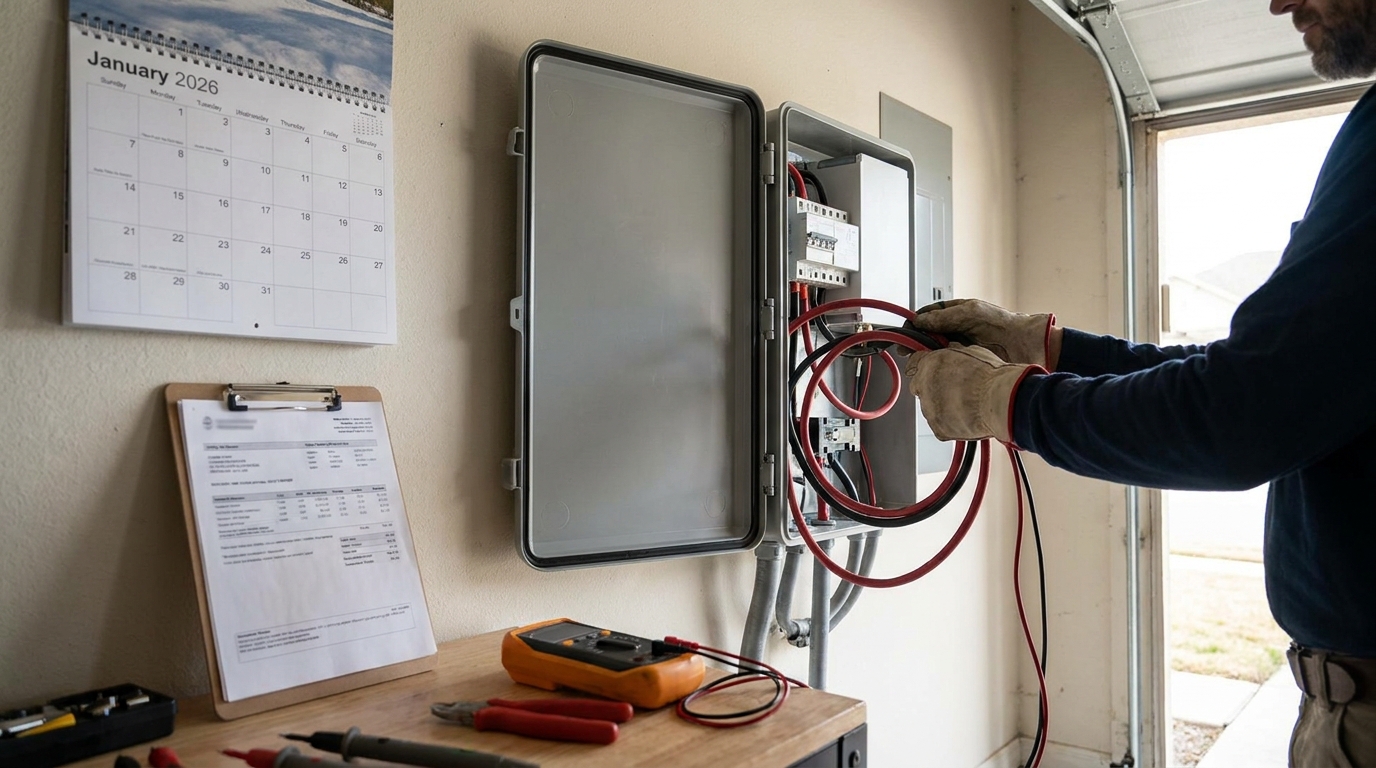
Something odd happened in the first three months of 2026. The 30% federal tax credit that had covered home battery installations since 2023 expired on December 31, 2025. Rooftop solar installations promptly fell about 10% year over year. And home batteries set an all-time record anyway: 673 MW installed in Q1 2026, according to U.S. Energy Information Administration data reported in early July 2026.
Measured in energy rather than power, the Wood Mackenzie and American Clean Power U.S. Energy Storage Monitor, released June 23, 2026, clocked residential storage at a record 1.3 GWh for the quarter, up 86% from a year earlier and 5% from the prior quarter.
The asterisk you should hear before anything else
That record is real, and it is also partly an accounting artifact of the deadline that killed the credit.
Wood Mackenzie and ACP say plainly that residential volumes were "buoyed by an overflow of installations initiated at the end of 2025 to capture the expiring Section 25D tax credit." In other words, a large share of what got counted as a Q1 2026 installation was a job sold and started in late 2025 by a homeowner racing the December 31 cutoff. The equipment went on the wall in January or February. The decision was made in November.
The same forecast calls for residential storage to contract roughly 5% for full-year 2026, citing tax equity constraints and updated permitting rules, before returning to about 12% average annual growth over the following four years. Utility Dive characterized it as a shallow contraction after the rush.
So the honest version of the headline is this: a record quarter, inflated by a backlog, followed by an expected dip. What makes it interesting is not that the number was big. It is that demand did not fall off a cliff the way rooftop solar did once the same subsidy disappeared for both. Batteries kept selling because their value comes from your electricity bill and your utility's rate structure, and neither of those went away on January 1.
What actually expired on December 31, 2025
The Residential Clean Energy Credit, Section 25D, ended with no phase-down. The IRS states that the credit "is not available for any property placed in service after December 31, 2025."
-
The rate was 30% of qualified costs, including installation labor.
-
Battery storage of at least 3 kWh capacity had been eligible since 2023, including standalone batteries with no solar attached.
-
"Placed in service" is the trigger, not the contract date and not the payment date. A system paid for in 2025 but energized in 2026 does not qualify.
-
Carryforward still applies to qualifying 2025 systems. The credit is nonrefundable, so if it exceeded your 2025 tax liability, the unused portion carries forward to future years on returns you are filing now. Ask your tax preparer rather than your installer.
The Congressional Research Service has published an explainer on the termination timing and carryforward mechanics if you want the congressional version.
Practical translation for anyone shopping in 2026: on a $15,000 system, the credit was worth about $4,500. That is gone. Any quote you receive today that shows a 30% federal credit line item is either out of date or misleading, and we will come back to that under red flags.
Why demand did not collapse, driver one: your bill went up
A battery's economic value is a function of what a kilowatt-hour costs. Every kWh the battery lets you avoid buying at peak price is the product. Raise the price of electricity and you raise the value of the battery, credit or no credit.
EIA's August 2026 Short-Term Energy Outlook puts the U.S. residential average at 17.3 cents per kWh in 2025, 18.3 cents in 2026 (up 5.8%), and 18.6 cents in 2027. EIA separately reported residential electricity costs up more than 7% in April 2026 compared with April 2025.
That is the national average, which almost nobody actually pays. If you are in California, Hawaii, or the Northeast, your number is well above it. If you are in parts of the South or the Pacific Northwest with cheap hydro or gas generation, you are below it. This single variable does more to determine whether a battery makes sense for you than any policy in Washington.
Why demand did not collapse, driver two: rate design
The bigger structural story is what utilities pay you for exported power versus what they charge you to buy it back.
California is the clearest case. Under the old net energy metering rules, exported solar was credited at roughly retail rates, so a battery added little: the grid was already acting as a free battery. Under the Net Billing Tariff, also called the Solar Billing Plan, which has been mandatory for interconnection applications submitted after April 14, 2023, exports are credited at time-varying avoided-cost values rather than retail. PG&E's own page says the prior program "lacked incentives for battery adoption" and that the current plan rewards storing power and using it on site.
Strip out the acronyms and here is what changed for a homeowner. Midday solar you send to the grid is now worth relatively little. Electricity you buy during the 4 to 9 p.m. residential peak is expensive. A battery moves energy from the cheap side of that gap to the expensive side. The wider your peak-to-off-peak spread, the more a battery is worth, and that arithmetic did not require a tax credit to work.
Before you assume this applies to you, pull up your last bill and find out whether you are on a time-of-use rate at all. If your utility charges one flat price around the clock, the arbitrage value described above is zero for you.
Why demand did not collapse, driver three: state and utility programs
California, Texas, Hawaii, and Arizona posted the largest quarter-over-quarter increases in Q1 2026, with California and Hawaii accounting for the majority of new residential capacity. Two of those states have specific programs worth understanding, and the other two are mostly a story about bills and heat.
Hawaii
Hawaii's Battery Bonus program is closed to new participants. Its successor, BYOD Plus (Bring Your Own Device Plus), is open on Oahu, Maui County, and Hawaii Island. Hawaiian Electric describes it as paying "$400 upfront for each kW committed," plus an export credit at the retail rate, in exchange for grid services including Capacity Reduction and Fast Frequency Response. Pairing with new or existing rooftop solar is required.
Commit 5 kW and that is $2,000 up front against your installed cost. Some installers publish additional terms, including a five-year commitment and a 6 to 8 p.m. export window credited near retail (in the neighborhood of 42 cents per kWh). Those specifics come from installer marketing rather than the utility's own program page, so confirm them against your actual agreement before you build them into a budget.
California
This is where a lot of 2026 quotes get sloppy. The Self-Generation Incentive Program still exists, but the money that is actually flowing to residential storage is the Residential Solar and Storage Equity budget: $1,100 per kWh, $280 million authorized, reservations open since June 2, 2025. It is income-qualified. General-market residential SGIP is effectively exhausted and waitlisted, which means most California buyers should plan on no meaningful state rebate at all.
If an installer quotes you an SGIP number, ask which budget category, and ask whether it is currently funded or waitlisted. Then verify with the program administrator for your utility territory yourself. A rebate that exists on paper and a rebate you will actually receive are different things.
Texas and Arizona
Both grew sharply. Neither is being driven by a headline consumer rebate. Treat growth in those states as a signal about outage risk, summer peak pricing, and utility-specific programs that vary by service territory, and check what your own utility offers rather than assuming a statewide program exists.
What a battery actually costs in 2026
The working benchmark: EnergySage marketplace data updated July 13, 2026 puts a 13.5 kWh installed system at $15,647 before incentives. That is roughly $1,159 per kWh installed.
The spread around that number is enormous, and you should expect your quotes to reflect it:
-
By brand: Tesla lands near $967 per kWh, while the full brand range runs from roughly $342 to $3,505 per kWh.
-
By state: from about $563 per kWh in Alabama to about $1,586 per kWh in Louisiana. Labor markets, permitting burden, and installer density all move this.
The retrofit premium nobody mentions in the sales call
If you already have solar and you are adding storage, expect to pay more than a new-construction bundle. EnergySage explicitly notes that retrofitting to an existing array costs extra in labor, wiring, and sometimes equipment.
The reason is inverter architecture. A DC-coupled battery ties into the solar array on the DC side and is generally more efficient, but it usually requires a hybrid inverter, which may mean replacing the inverter you already own. An AC-coupled battery bolts on alongside your existing system without touching it, which is simpler but adds a conversion step and its own efficiency loss. Which one your installer proposes changes both the price and the performance, so make them tell you which they are quoting and why.
How to build a payback number now that the credit is gone
Without 25D, the math has three revenue lines and one cost line. Write them down in this order.
1. Annual time-of-use arbitrage. Take the number of kWh your battery realistically shifts from off-peak to peak each day, multiply by 365, and multiply by your peak-minus-off-peak spread in dollars. Here is an illustration using assumed numbers, not quoted rates: 10 kWh shifted per day is 3,650 kWh a year. At a 20 cent spread that is about $730 a year. Shave a bit off for round-trip efficiency losses, because you do not get back everything you put in.
2. Any state or utility rebate you have confirmed is open. In Hawaii under BYOD Plus, that is $400 per kW committed. In California for most general-market buyers in 2026, that is $0. Use the number you verified, not the number on the brochure.
3. Any grid-services income, discounted heavily. See the next section.
Against installed cost. Using the $15,647 benchmark and $730 a year of arbitrage with no rebate, simple payback is more than 20 years, which is longer than most battery warranties. That is not a reason to give up on the idea. It is a reason to notice which lever actually matters: your rate spread and your rebate, not the equipment brand.
Keep resilience out of the ratio. Backup power during outages is genuinely valuable, but it is not a return on investment, and folding a made-up dollar value for it into a payback calculation is how people talk themselves into bad purchases. Put it in a separate column and answer a separate question: what is it worth to you to keep the refrigerator, the well pump, the medical equipment, or the home office running, and how many hours per year do you actually lose power? If your utility drops service twice a year for 40 minutes, that column is thin. If you are in a wildfire shutoff zone or on a rural line that goes down for days, it may be the whole reason to buy.
Virtual power plant income is a variable, not a promise
Grid-services programs, where your utility pays you to discharge your battery during system peaks, are real money and a favorite of installer proposals. They are also less dependable than those proposals suggest.
Event-based California programs headline at $2.00 per kWh discharged, which sounds transformative until you count how many event hours actually occur. Meanwhile California's statewide Demand Side Grid Support program has its per-event option suspended for 2026, and its storage virtual power plant option is largely closed to new enrollment. SMUD's My Energy Optimizer Partner+ in Sacramento is the outlier, with substantial one-time enrollment incentives.
The rule to carry into a sales conversation: verify each program's 2026 enrollment status directly with the administrator before you let a dollar figure into your spreadsheet. If a quote's payback depends on VPP revenue, ask the installer to show you the program is open to new enrollments today. A payback model built on a closed program is not a payback model.
Where a battery still does not pencil
Plainly, because the industry rarely says it: if all four of these are true for you, a battery is not an investment.
-
Your utility charges a flat rate, or your peak-to-off-peak spread is narrow. No spread, no arbitrage.
-
You export little or nothing, so export repricing does not affect you.
-
Outages are rare and short where you live.
-
Your state has no open rebate and no open virtual power plant program.
Under those conditions the only remaining value is resilience, which is a preference purchase, like a generator or a nicer kitchen. That is a completely legitimate reason to buy one. Just buy it knowing that is what you are doing, and do not accept a payback chart that pretends otherwise.
What to ask an installer before you sign
-
Usable versus nameplate capacity. A 13.5 kWh nameplate battery does not give you 13.5 kWh. Get the usable figure in writing, and make sure any per-kWh price comparison uses the same basis across quotes.
-
Backup scope, and what it costs. Whole-home backup usually requires more equipment and often a service panel upgrade. A critical-loads subpanel is cheaper and covers a defined list of circuits. Ask for the price difference as a separate line item, and get the circuit list on paper.
-
Warranty throughput, not just years. Most battery warranties cap total energy cycled (in cycles or MWh) as well as duration. If you plan to cycle daily for arbitrage, the throughput cap is the one that will actually expire first.
-
Inverter compatibility with your existing array. AC-coupled or DC-coupled, and does the quote include replacing your current inverter?
-
Permitting and interconnection timeline, in writing. Interconnection approval is the step most likely to add months, and it is outside the installer's control, which is exactly why you want their estimate committed to paper.
-
Which specific incentive, and is it open. Program name, budget category, and current status.
Red flags in a 2026 quote
-
Any line item for a 30% federal tax credit. It does not exist for systems placed in service after December 31, 2025. This one is disqualifying on its own.
-
Per-kWh pricing quoted on nameplate capacity while a competitor quotes usable. It makes the more expensive system look cheaper.
-
Virtual power plant revenue baked into the payback without proof the program is accepting new enrollments in 2026.
-
A rebate cited without naming the specific budget category. "You'll get SGIP" is not an incentive, it is a hope.
-
No written interconnection or permitting timeline. Vagueness here reliably becomes delay later.
-
Pressure to sign before a deadline that is not a real deadline. The one genuine deadline already passed in December 2025.
The bigger read
Batteries and rooftop solar lost the same subsidy at the same moment. Solar fell about 10% year over year. Batteries set a record, even accounting for the backlog that padded it, and the battery attach rate on new residential solar rose to roughly 45% in Q1 2026 from 38% a year earlier, according to Rewiring America, with Utility Dive citing SEIA data closer to 50%.
The reason for the divergence is that the value of a solar panel was heavily tied to a federal percentage, while the value of a battery is tied to the price of your kilowatt-hour and the shape of your utility's rate. Bills are rising. Rate structures are shifting toward rewarding self-consumption. Those trends kept working on January 1, 2026.
Expect a softer 2026 as the backlog clears, roughly a 5% residential contraction by the Wood Mackenzie and ACP forecast, then a return to growth. For you personally, none of that matters as much as three numbers you can find on your own bill and your own utility's website: your rate, your peak-to-off-peak spread, and whether there is an open incentive in your service territory. Get those three, then start collecting quotes.
Related reading
-
[The Grid Browned Out Before Your AC Died: What Record Summer Demand Actually Does to a Compressor, and the $300 Part That Prevents It](/guides/grid-brownout-ac-compressor-damage-surge-protector-cost)
Sources
-
Residential Clean Energy Credit, Internal Revenue Service
-
Expiration and Carryforward Rules for the Residential Clean Energy Credit, Congressional Research Service
-
U.S. Energy Storage Market Q1 2026 Sets Records Across Sectors, American Clean Power Association and Wood Mackenzie, June 23, 2026
-
US energy storage installations break all the records in Q1, Solar Power World
-
US sees record Q1 2026 energy storage installations amid rosy outlook, Utility Dive
-
The household battery boom points to a Homegrown Energy future, Rewiring America, July 2, 2026
-
US homeowners installed a record amount of battery storage this year, TechSpot, July 3, 2026 (reporting on EIA data, via Ars Technica)
-
Customer Incentive Programs, Hawaiian Electric
-
Self-Generation Incentive Program, California Public Utilities Commission
-
[Solar Battery Cost: Are They Actually Worth It In 2026?](https://www.energysage.com/energy-storage/how-much-do-batteries-cost/), EnergySage, updated July 13, 2026
-
Short-Term Energy Outlook, August 2026, U.S. Energy Information Administration
Note: This article contains AI-assisted content and has been reviewed by our editorial team.
ABOUT THIS SERVICE: CallTheLocal.com is a directory and lead generation service, not a contractor or service provider. Submitting this form does not obligate you to hire anyone or purchase any service. Your information will be shared with licensed, insured home service professionals in your area who may provide quotes for your project. CallTheLocal.com does not guarantee the quality, timeliness, or outcome of any work performed by service providers you connect with through this service. Always verify licensing, insurance, and references before hiring. Get everything in writing before work begins.