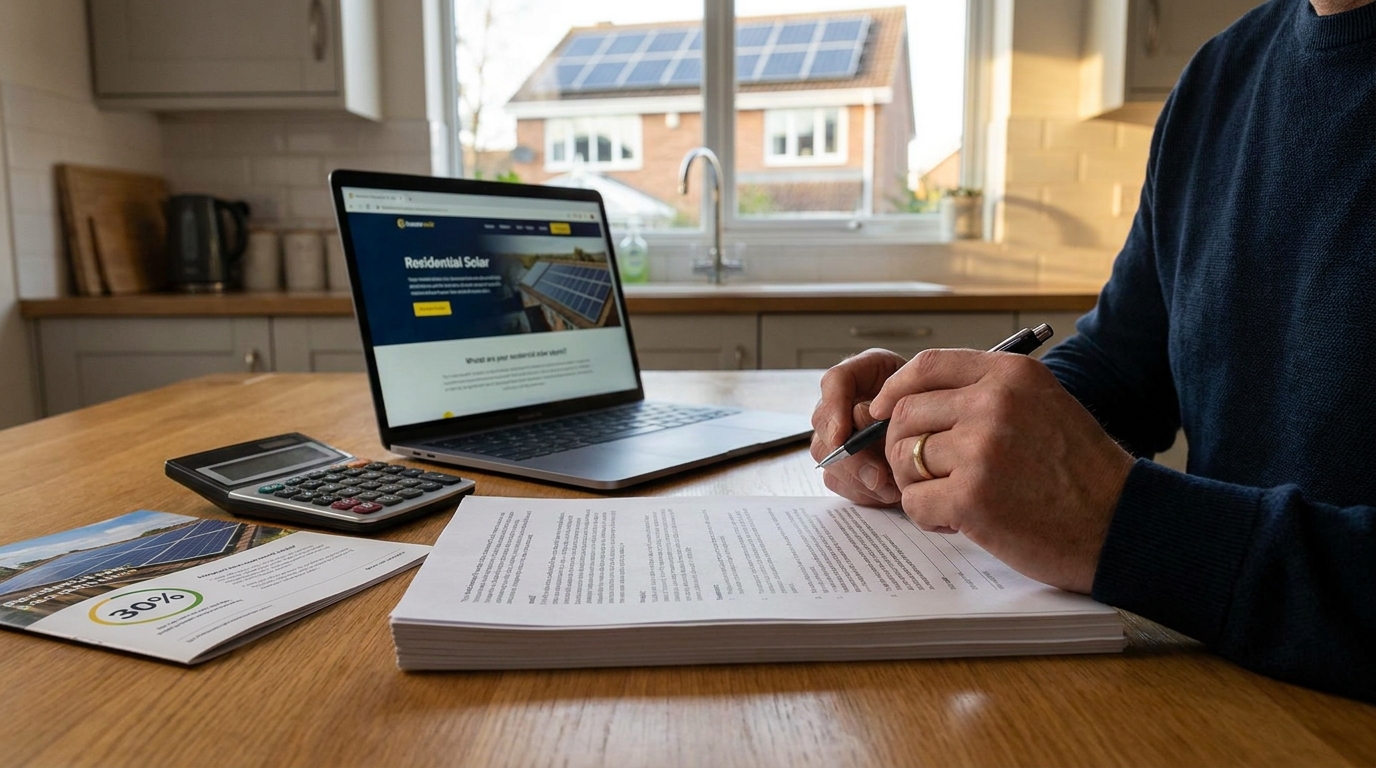
The quote sitting on your kitchen table probably still says something close to 30% federal tax credit. The rep who left it there is not necessarily lying to you. But if that quote is for a lease or a power purchase agreement, the 30% is not yours. It belongs to whoever owns the panels, and under that contract, that is not going to be you.
Here is the short version. The homeowner credit, Section 25D, ended for good on January 1, 2026. The credit still being claimed on residential rooftops is Section 48E, a business credit. In a lease or a PPA, the business claiming it is the solar company. There is no line on your tax return where that money shows up, because it never touches your return at all.
That does not automatically make a lease a bad deal. Plenty of them pencil out fine. It just makes it a different deal than the number on the page implies. Here is what changed, why the pitch is still perfectly legal, and the specific things to nail down before you sign something that runs 25 years.
What actually changed on January 1
The One Big Beautiful Bill Act (Public Law 119-21), signed July 4, 2025, terminated the Residential Clean Energy Credit. Per the IRS guidance on the law, Section 25D is unavailable for any expenditure made after December 31, 2025.
Two things about that are worth sitting with.
First, there was no step-down. Solar incentives have historically wound down in stages, 30% to 26% to 22%, giving people a year or two of warning. This one did not do that. It went from 30% to zero on a single date.
Second, and this one caught real people: the IRS treats an expenditure as "made" when the original installation is completed, not when you signed the contract and not when you paid. Homeowners who signed in the fall of 2025, put down deposits, and then hit a permitting delay or an interconnection backlog that pushed completion into January 2026 received nothing. The contract date did not save them. If you are talking to a company that is still gesturing vaguely at "the federal credit" on a purchase, that credit is gone, full stop.
Why the lease pitch is still legal
This is the load-bearing fact of the whole story, and almost nobody explains it.
OBBBA did add a restriction to Section 48E denying the credit for residential property that is rented or leased to a third party. If you stopped reading there, you would conclude that leased rooftop solar lost its credit too. But that restriction is narrower than it sounds. It applies only to qualified solar water heating property and small wind energy property.
Leased solar electric generating property, meaning ordinary rooftop photovoltaic panels, was expressly carved out. It remains 48E-eligible. Law firm analysis of the amendments walks through the provision in detail.
So the sequence is: Congress killed the credit you could claim, kept the credit a solar company can claim on the panels it owns on your roof, and the industry responded exactly as you would expect. Trade coverage of the pivot describes third-party ownership as the sector's answer to 25D going away, with TPO running around 45% of U.S. residential installs and one investment bank projecting 25% TPO growth in 2026.
Aurora Solar's 2026 Solar Snapshot, released March 24, 2026, found that 65% of solar salespeople expect more than half their 2026 projects to be third-party owned, up from 44% who reported that a year earlier. Salespeople selling no TPO at all dropped from 9% to 1%. Read that carefully: it is a survey of what reps expect, not a measure of market share, and Aurora does not disclose sample size or methodology. Treat it as a vendor survey. But the direction is unmistakable. Almost everyone is selling this now.
Meanwhile the overall market is shrinking. The SEIA and Wood Mackenzie U.S. Solar Market Insight report published June 10, 2026 forecasts a 21% decline in residential solar for 2026, with growth resuming from 2027 through 2031. Fewer customers, more pressure per customer. That is the room you are sitting in.
Follow the money
Under a lease or PPA, the third-party owner claims the 48E credit. It reduces that company's federal tax bill. Whether any portion of that value shows up in your monthly payment is a pricing decision the company makes, not a legal requirement, and not something you can verify from any document you will ever receive.
This is the practical difference that matters. When you bought a system in 2024 and claimed 25D, you could look at your own Form 5695 and see the number. It was auditable, by you. Now, if a rep tells you the 30% is "built into your rate," there is no line anywhere that confirms it. You are being asked to take pricing on faith.
The honest way to handle this is to stop treating the 30% as a discount you are receiving and start treating the monthly payment as the only number that exists. Compare that payment against your current utility bill and against a cash purchase. Ignore the credit entirely in your math, because it is not yours.
The deadline that already passed
If a rep tells you to hurry because of a July 4, 2026 deadline, that deadline is behind us.
July 4, 2026 was the begin-construction cutoff under 48E, twelve months after OBBBA was enacted. Projects that began construction on or before that date can be placed in service through 2030 under normal continuity rules. Projects that begin construction after it must be placed in service by December 31, 2027 or receive no credit at all.
So the live pressure lever in late 2026 is not the deadline itself. It is safe-harbored equipment. Companies that stockpiled inventory or started qualifying work before the cutoff are selling out of that position, and "we safe-harbored your system" is the sentence you will hear.
It may be completely true. It may also be sales language. The move is simple: ask the rep to put the safe-harbor basis in writing. Which method, which date, and what happens to your price if the claim does not hold up. A company that genuinely safe-harbored equipment can answer that in a sentence. One that cannot answer it in writing has told you something useful.
The guidance is genuinely unsettled, and that is not a reason to hurry
In August 2025 the IRS issued Notice 2025-42, which eliminated the 5% cost safe harbor for wind and solar and left only the Physical Work Test, with a Section 6 exception for low-output solar facilities of 1.5 MW (AC) or less. That exception covers essentially every residential rooftop system in the country. Technical explanations of the notice lay out the difference between the two tests.
Then, on June 6, 2026, the U.S. District Court for the District of Columbia vacated the notice nationwide as arbitrary and capricious, restoring the 5% safe harbor and remanding the matter to the IRS. An appeal or replacement guidance could change the picture again.
Here is what a homeowner should take from that: nothing you can act on, and nothing anyone should be able to use on you. You cannot resolve federal tax litigation from your kitchen table, and neither can the person across from you. If a rep uses legal uncertainty as a reason to sign tonight, they have inverted it. Uncertainty is a reason to slow down and get commitments in writing, not to speed up.
How to read an escalator
Most leases and PPAs carry an annual escalator, commonly 2% to 3%, over a 20 to 25 year term. The rep will describe it as modest. Compounding is not modest.
Run the arithmetic yourself. On a $150 monthly payment with a 25-year term:
-
Flat, no escalator: $150 in year 25. Roughly $45,000 total.
-
2% escalator: about $241 in year 25. Roughly $57,700 total.
-
3% escalator: about $305 in year 25. Roughly $65,600 total.
Those are illustrative figures using simple compounding, not quotes. Plug in your own starting payment and term. The point is the spread: one percentage point of escalator is worth about $8,000 over the life of the agreement on a modest system.
And then there is the comparison that actually decides whether the escalator is a good bet. Reps will justify a 2.9% bump by showing you a chart of projected utility rate increases. Projections are marketing. Ask instead for your own utility's actual historical rate increases over the last ten years, which is public information you can pull yourself from your utility's tariff filings or your state commission. If your utility has averaged 2% and the escalator is 2.9%, the escalator is not tracking your bill. It is outrunning it.
Prepaid PPA versus paying cash
Prepaid third-party ownership has become a real product. Aurora found 45% of salespeople now offer it and 11% call it their most popular financing option. You pay a lump sum up front, the company still owns the system and still claims 48E, and you get power at a fixed rate with no escalator.
What you get: a lower upfront number than a cash purchase, no escalating payment, and the owner carries maintenance and warranty obligations.
What you give up: ownership, the simplicity of selling your house without a contract attached to it, and any state incentive that flows to the system owner rather than the resident.
Prepaid is generally the cleanest of the TPO structures because it removes the escalator, which is where most of the long-run pain lives. It is still not ownership.
Running the numbers on a typical 8 kW system
Say the price basis out loud, because the two common sources disagree meaningfully.
EnergySage marketplace quotes averaged roughly $2.58 to $2.60 per watt in early 2026. On that basis an 8 kW system lands near $20,600 to $20,800, and across the wider quoted band of $2.55 to $3.45 per watt, roughly $20,400 to $27,600. Those are competitive-bid marketplace numbers. Lawrence Berkeley National Laboratory's installed-price data runs materially higher, with a 2024 cash-purchase median near $3.50 per watt, which would put the same system closer to $28,000.
This article uses the marketplace basis, and you should know why the gap exists: marketplace quotes come from installers competing against each other in a bidding environment. A single rep at your kitchen table is not in that environment. If you only get one quote, expect to land closer to the LBNL end.
Critically, none of those figures get reduced by 25D anymore. In 2024 an $8 kW system at $24,000 netted out around $16,800 after the federal credit. In 2026 it is $24,000. That is the real reason leases got easier to sell, and it is worth naming plainly rather than pretending the cash option looks the way it used to.
The comparison you actually want is total 25-year cost of the lease, escalator included, against the cash price plus expected inverter replacement, against 25 years of doing nothing and just paying your utility. Three columns. Get all three on one page before deciding.
One more variable: storage. The SEIA and Wood Mackenzie report found a record 45% of first-quarter 2026 residential installs were paired with a battery. In some states, particularly California, the battery is what makes the economics work at all. Price the system you would actually want, not the panels-only version that quotes cheapest.
What happens if you sell in year 8
This is where leases most often go sideways, and it goes sideways at the worst possible moment: during a closing.
When you sell a house with a lease or PPA on it, the agreement generally has to be either assumed by the buyer or bought out by you. Assumption requires the buyer to qualify with the solar company and to want the contract. A buyer who is already stretching on a down payment may not want to inherit a payment that escalates for another 17 years. If they will not assume it, you are buying it out, at a price set by a schedule you agreed to years earlier.
Buyout terms vary enormously between companies. Some are reasonable. Some are punitive. Title companies routinely flag these agreements, and resolving one late can delay or kill a closing.
The fix costs you nothing and takes ten minutes: get the full buyout schedule in writing before you sign, showing the dollar figure for every year of the term. Not a formula. Not a sentence saying it will be determined at the time. A table. If a company will not produce one, that is your answer.
Counterparty risk over 25 years
A 25-year agreement is a 25-year bet that the company on the other side of it still exists and still answers the phone. Recent enforcement activity suggests that is not a safe assumption.
In Connecticut, Attorney General William Tong announced on March 17, 2026 an investigation into SunStrong Management LLC over warranty failures, unresponsiveness, and a $10 monthly fee charged to customers who wanted to see their own system's production data. The same announcement covered a $100,000 settlement with Spruce Power 3, LLC over billing and warranty problems on contracts the company had acquired from NRG between 2021 and 2023. Note that phrase: contracts get sold. The company that services your agreement in year 15 may not be the company that signed it. Connecticut's prior actions in the sector include a $5 million judgment against Vision Solar that went unfunded when the company entered bankruptcy, a suit against Sunrun, and settlements with Dividend Finance and EnergyBillCruncher.com.
In Texas, Attorney General Ken Paxton issued civil investigative demands on April 6, 2026 to Sunrun, Freedom Forever, Lone Star Solar Services, and CAM Solar under the Texas Deceptive Trade Practices-Consumer Protection Act, citing more than 100 formal complaints alleging misrepresentation of energy bill savings and system efficacy. Trade press covered the initiative as it developed. Nine days later, on April 15, 2026, Freedom Forever filed for Chapter 11.
To be fair and specific about where things stand as of August 2026: a civil investigative demand is an information request, not a finding of wrongdoing. Sunrun has not been sued under the Texas initiative and is not in bankruptcy. The point is not that any one of these companies is bad. The point is that in a five-month window, one attorney general opened an investigation and collected a settlement, another issued demands to four companies, and one of those four filed for bankruptcy protection. Your 25-year warranty is only as good as the entity still standing to honor it.
Practical version: ask how long the company has been operating, whether it services its own contracts or sells them, and who performs warranty work. Then look up your own state attorney general's consumer protection page and search the company name before you sign.
Your state changes the answer
The federal money does not reach you. State money sometimes does, and in one state it clearly does.
New York. This is the real exception. The state's Solar Energy System Equipment Credit is worth 25% of qualifying costs, capped at $5,000, and it applies to leases and PPAs with a written term of at least ten years. It is computed as 25% of that year's lease payments, with a five-year carryforward. If you are in New York and leasing, there is genuinely a credit on your own return. Confirm the term length in your agreement meets the ten-year threshold.
California. No state solar income tax credit. New systems go on NEM 3.0 net billing, mandatory since April 15, 2023, where exported power is valued near $0.08 per kWh against the roughly $0.30 to $0.35 retail rates that NEM 2.0 customers received. That single change is why storage matters so much in California: power you store and use yourself is worth far more than power you export. SGIP storage rebates run roughly $150 to $1,000 per kWh, weighted heavily toward income-qualified households and those in high fire threat districts. Separately, the property tax new construction exclusion for solar is set to sunset January 1, 2027 absent legislative extension, which is worth confirming before you commit to a 2026 or 2027 installation date.
Massachusetts. The SMART 3.0 base incentive for 2026 is $0.03 per kWh, or $0.06 per kWh for low-income customers. Under a lease or PPA, that payment goes to the third-party owner, not to you. State guidance is explicit that lease and PPA customers need to ask the owner how, or whether, the SMART payment is reflected in the monthly payment. Ask it in writing and get the answer in writing.
Illinois. Illinois Shines pays renewable energy credits to Approved Vendors, who may pass some value through. For the 2026 to 2027 program year, customer-owned projects get a new REC adder, reported as roughly a 36% increase for Ameren Illinois territory and eligible rural cooperatives (installer analysis here, worth verifying against the official program site). Under a TPO agreement the vendor receives the SREC. Illinois is the clearest case in the country where ownership is specifically rewarded over leasing.
Everywhere else, check your state energy office and your utility's own program page rather than relying on the incentive sheet a salesperson prints for you.
The three questions
If you take nothing else from this, take these. Ask them out loud, and get written answers before signing.
1. Who owns the panels at year 26? Do you get the system, is there a purchase option, does the company remove it, or does the agreement renew? What is the removal cost if you want them gone, and who repairs the roof penetrations? A vague answer here is common and unacceptable.
2. What is the escalator, in dollars, in year 25? Not the percentage. The dollar figure. Then the total of all payments across the full term. Compare that total against your utility's actual historical rate increases, not its projected ones.
3. What exactly happens at closing if I sell in year 8? Assumption process, buyout schedule as a year-by-year table, and what happens if the buyer will not or cannot assume. This is the question that most often turns a fine agreement into a problem, and it is the easiest one to answer before you sign and the hardest one to answer after.
Two more worth adding in 2026: what is the safe-harbor basis for the 48E credit on my system, in writing? and does your company service its own contracts, or do you sell them?
The bottom line
Solar leases are not a scam. For a homeowner without the cash or the tax appetite for a purchase, a well-priced prepaid PPA or a low-escalator lease can be a perfectly reasonable way to lower a power bill, and with 25D gone, third-party ownership is the only route to that federal credit value for a lot of households.
But price it honestly. This is a 25-year utility contract with a title complication attached, sold by an industry facing a 21% down year and under active investigation in at least two states. It is not a 30% discount, because the 30% is not yours.
Get three quotes. Read the escalator. Get the buyout schedule as a table. Look up the company with your state attorney general. And do not let anyone use unsettled federal tax guidance as a reason to sign tonight.
Related reading
Sources
-
IRS Notice 2025-42: Sections 45Y and 48E Beginning of Construction (PDF)
-
Foley Hoag: Federal Court Vacates IRS Notice 2025-42, Restoring Five Percent Safe Harbor
-
Utility Dive: Solar industry looks to third-party ownership as 25D tax credit winds down
-
[Aurora Solar: Solar financing in 2026, more options, more closes (2026 Solar Snapshot)](https://aurorasolar.com/tpo-solar-financing-trends-2026/)
-
Connecticut Attorney General: New Developments to Hold Solar Industry Accountable (March 17, 2026)
-
EnergySage: New York Solar Incentives, Tax Credits & Rebates 2026
-
MassCEC: Unlocking Solar Incentives, Your Guide to Massachusetts SMART 3.0
-
Straight Up Solar: Illinois SREC Incentives Increase in 2026
Tax and legal guidance in this area is actively changing. The vacatur of Notice 2025-42 has been remanded to the IRS and could be appealed or superseded. Confirm current federal and state rules with a qualified tax professional before making a decision based on them.
Note: This article contains AI-assisted content and has been reviewed by our editorial team.
ABOUT THIS SERVICE: CallTheLocal.com is a directory and lead generation service, not a contractor or service provider. Submitting this form does not obligate you to hire anyone or purchase any service. Your information will be shared with licensed, insured home service professionals in your area who may provide quotes for your project. CallTheLocal.com does not guarantee the quality, timeliness, or outcome of any work performed by service providers you connect with through this service. Always verify licensing, insurance, and references before hiring. Get everything in writing before work begins.