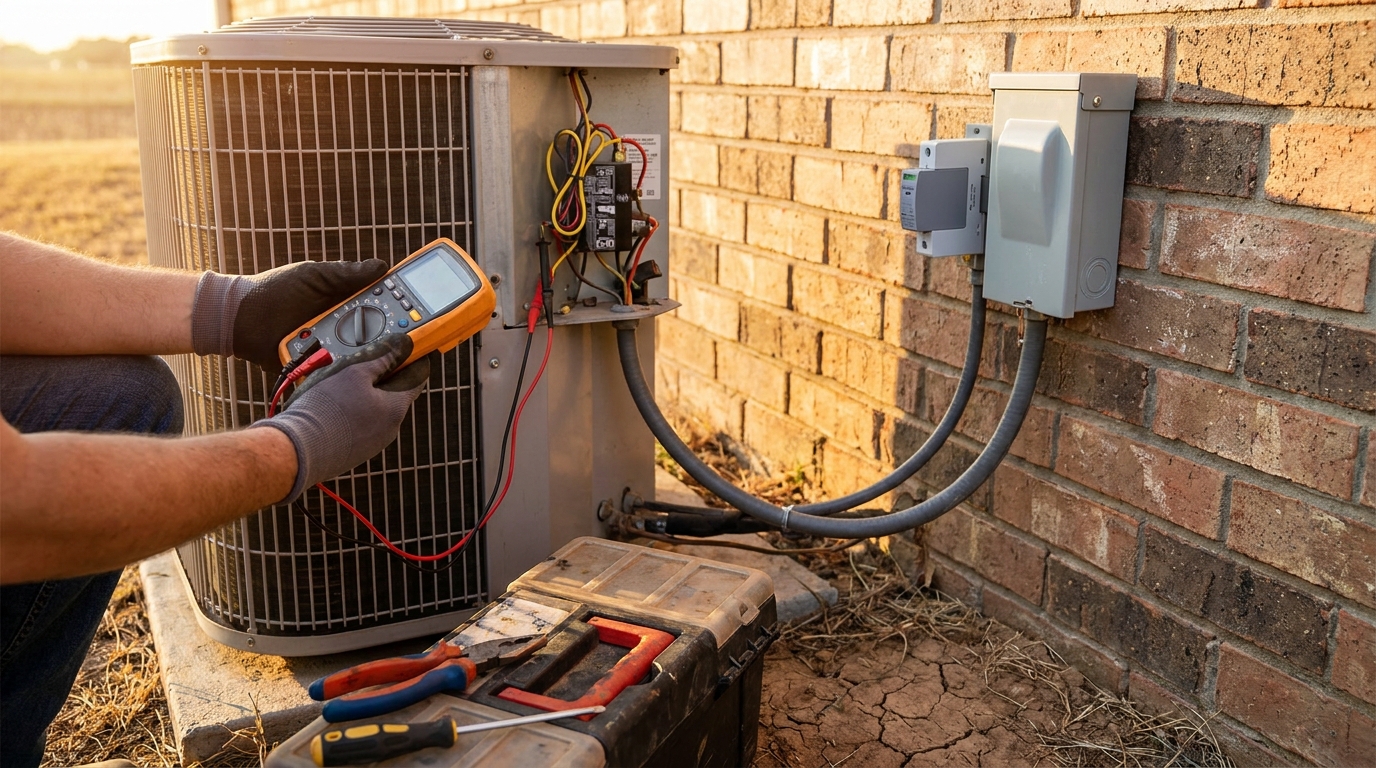
If your air conditioner quit within a day or two of a heat wave this summer, there is a decent chance it did not simply wear out. It got hurt by the electricity coming into your house. And the moment it most likely got hurt was not while the lights were dim. It was the second the power came back.
That distinction matters, because it changes what you should do the next time your neighborhood browns out. It also happens to be the thing most homeowner advice gets backwards.
What actually happened on the grid this summer
Start with the facts, because the internet version of this summer is more dramatic than the real one, and the real one is bad enough.
On July 2, 2026, between 5 and 6 p.m. Eastern, PJM Interconnection (the grid operator covering 13 states and Washington, D.C., from Illinois to New Jersey) recorded a preliminary unrestricted peak demand of about 168,158 MW. That beat the previous all-time summer record of 165,563 MW, which had stood since August 2, 2006. Twenty years, gone in one afternoon.
One important nuance: the grid did not physically deliver 168 GW. Actual metered load topped out closer to 162.7 GW, because PJM leaned on roughly 6 GW of demand response, meaning large customers who agree in advance to cut usage when things get tight. The unrestricted number is what demand would have been without that intervention. Both figures are preliminary pending a roughly 60 day settlement review.
Here is the part that should get your attention as a homeowner: PJM's own Summer 2026 Outlook had forecast a peak of about 156,400 MW against roughly 180,200 MW of generation capacity plus about 7,800 MW of contracted demand response. Real demand blew past the forecast by roughly 12 GW. PJM has said publicly that data center load growth is outpacing new generation and tightening reserve margins.
The federal government stepped in, and you can look the orders up by number. On June 30, 2026, the Department of Energy issued Federal Power Act Section 202(c) emergency orders No. 202-26-32 and No. 202-26-33 to PJM, directing it to maximize output including fossil and dual gas and fuel oil units, waiving certain emissions limits, and authorizing the curtailment of data centers with backup generation before resorting to voltage reduction or load shed. Order 202-26-32 ran from 11:59 p.m. ET June 30 through 11:59 p.m. ET July 3.
It was not just PJM. A separate order covering MISO and CenterPoint (No. 202-26-30, issued June 18, 2026) runs from June 22 through September 19, 2026. And on July 26, DOE issued Order No. 202-26-37 to the Southwest Power Pool, covering its 17 state footprint from North Dakota to Louisiana, effective through August 3 and later extended. You can see the full 2026 list on DOE's own order index.
Neighboring grids ran hot too. During the early July event, NYISO peaked around 32,410 MW and ISO-NE around 25,850 MW under conditions described as exceptionally tight, with National Weather Service heat indices reaching up to 115 degrees. Roughly 160 million people across 30 states were under extreme temperature alerts, and NWS HeatRisk coverage at the major or extreme tiers peaked near 180 million. Those two numbers measure different things, so be skeptical of anyone quoting one as the other.
Now the correction that keeps this article honest: there were no rolling blackouts in Texas or California this summer. ERCOT issued a voluntary conservation appeal on July 13, 2026, for 2 to 8 p.m., and its summer forecast peak of about 92,000 MW is 7.6% above the all-time record of 85,508 MW set on August 10, 2023, according to Houston Public Media's coverage. California's last actual rolling blackouts were in August 2020. This summer was a series of near misses and conservation appeals, not a collapse. That is still exactly the condition that damages home equipment, because near misses come with sagging voltage, momentary outages, and hard restorations.
The part everyone gets wrong about brownouts and your compressor
Search this topic and you will read, over and over, that low voltage makes your air conditioner "draw more amps" and cook itself. For a standard single phase compressor motor that is already running, that is backwards. HVAC School, a training resource for the trade, is direct about it: a running single phase PSC motor under sustained low voltage draws less current, not more.
So what actually breaks things? Three paths, and they are worth knowing by name because they lead to different repairs.
1. The stall. Danger arrives when the compressor tries to start into a sagging grid. Starting takes far more torque than running. If voltage is too low to get the rotor turning, the motor sits in what is called locked rotor condition, and there it does draw dramatically more current. That current becomes heat, and heat is what damages windings or burns the motor out entirely. This is why the killer moment is a start attempt during a brownout, not the brownout itself.
2. The inverter board. Modern variable speed and ECM equipment fails the opposite way, and more expensively. The electronics actively pull more current during low voltage in an attempt to hold the horsepower they were told to produce, which overstresses and overheats the inverter components. Industry cost guides put replacement of inverter boards, IGBT modules, and communication interfaces in the range of $800 to $2,500. If you paid extra for a high efficiency variable speed system, you have more to lose here, not less.
3. The restoration spike. This is the pivot point of the whole article. Control boards are most often killed by the voltage spike when power comes back, not by the sag. Utilities restoring a circuit are re-energizing a lot of load at once, and the transient that follows is what fries electronics. Your equipment can ride out twenty dim minutes and then die in the first half second of normal service.
Two secondary failure modes round out the picture. Capacitors, which provide the phase shift and current boost a motor needs to start, cannot do that job at reduced voltage, which produces the classic hum with no spin. And contactors and relays chatter during fluctuating voltage, pulling in weakly and arcing, which pits the contacts and shortens their life. Latching contactors with built in brownout protection are a real fix for this, not an upsell.
What a brownout looks like from inside your house
You will usually notice this before any equipment fails. Watch for:
-
Lights dimming and recovering on a cycle. Not one flicker, but a rhythm. That is voltage sagging under load and partially recovering.
-
A condenser that hums for three to five seconds, then trips. That is a start attempt failing. The internal overload is protecting the motor. It will keep trying.
-
Audible chatter at the outdoor disconnect or inside the electrical panel. A rapid clicking or buzzing is a contactor pulling in and dropping out.
-
The unit starts, runs briefly, then drops out. Voltage sufficient to start but not to sustain, or an overload cutting in on heat.
-
Incandescent flicker timed to the compressor's start attempts. If the lights dip in sync with the outdoor unit clunking, your service voltage has very little headroom.
Any of these during a heat event is your cue to act, and acting is simple.
The 15 minutes that can save you $2,000
Because the danger is concentrated at start attempts and at restoration, the protective move is to make sure your system does neither one during unstable power.
-
Turn the system off at the thermostat. Set it to Off, not just up a few degrees. This stops the compressor from attempting starts into a sagging grid.
-
Turn the AC breaker off at the panel. Now the restoration spike has nothing to travel into.
-
Wait 15 to 30 minutes after power returns. Utility voltage is often still unstable in the minutes right after restoration, as load comes back on the circuit.
-
Breaker back on, then thermostat back on. In that order.
One clarification, because nearly every consumer article on this topic mixes it up. Your system already has a built in anti short cycle delay, commonly three to five minutes, sometimes called the three minute rule. That delay exists to stop the compressor from restarting against unequalized refrigerant head pressure. It is a completely different mechanism from the 15 to 30 minute wait above, which is about letting utility voltage settle. Three minutes is not enough after a grid event. Do not let the built in delay talk you out of the longer wait.
Is it the utility's problem or your capacitor? Check before you pay a diagnostic fee
An HVAC diagnostic visit typically runs $100 to $200. A call to your utility about low voltage is free. There is a published standard that tells you which one to make.
ANSI C84.1 (current edition 2020) sets acceptable service voltage for a 120V nominal system. Range A, the normal operating range, is 114 to 126 volts. Range B, an infrequent and temporary allowance, is 110 to 127 volts. Service voltage is measured at the point of delivery and is the utility's responsibility. Utilization voltage, measured at the equipment terminals, is yours, since it includes losses in your own wiring. The Range A and Range B framework is the same one your utility's engineers use.
What that means in practice:
-
Persistently below 114V on a 120V leg? That points to a utility or service problem. Call the utility, report low voltage, and ask them to log it. This is not something an HVAC contractor can fix.
-
Normal voltage, but the outdoor unit hums and will not spin? That points at the run capacitor. Other tells include slow starts, a unit that will not start at all, and a burning smell.
Safety, and this one is not boilerplate: do not open the condenser cabinet to look. Capacitors store high voltage even after the power is disconnected, and This Old House flags this explicitly. You can safely take a voltage reading at an ordinary outlet or have an electrician read the panel. Leave the sealed equipment to someone with a meter and a discharge tool.
The good news on capacitors: they are cheap. Total installed cost runs $80 to $400, averaging around $175. The part itself is only $8 to $45, with labor at $60 to $150 per hour doing most of the damage. By type, run capacitors go for $98 to $230 installed, dual run $105 to $245, and start capacitors $99 to $225. They typically last 10 to 20 years.
Compare that to the failure you are trying to avoid. Installed compressor replacement averages roughly $1,800 to $2,800, with a typical 3 ton system commonly landing between $1,500 and $3,400, and out of warranty jobs spanning $1,100 to $4,650 once you include the part, four to eight hours of labor, refrigerant recovery and recharge, and ancillary parts. Out of warranty is the expensive case, and heat waves are very good at finding out of warranty equipment. These are national ranges, not quotes, so expect variation. Labor heavy metros in the Northeast and West Coast tend to sit at the high end; much of the Midwest and South runs lower.
The $300 part
A whole home surge protective device (SPD) installed at your electrical panel runs about $250 to $700, with $300 to $700 typical in 2026 and a broader range up to about $1,100 for larger jobs. The device alone is $60 to $300 for a Type 2, or $400 to $800 for higher capacity 80 to 100 amp units. Labor runs $200 to $450, with electricians at $50 to $130 per hour plus a $100 to $200 service call, per HomeGuide's 2026 cost data. One caveat worth knowing before you call: an old or full panel can force a panel upgrade, which adds $1,000 to $3,000 or more.
Then add the second, smaller one. A Type 2 SPD mounted at the outdoor disconnect next to your condenser runs roughly $150 to $400 installed, and the parts are only $15 to $80. It is cheapest bundled with a new disconnect at $150 to $300, so if you are replacing a disconnect anyway, do it then.
Why both? They do different jobs. The panel unit clamps the large transient arriving on the service side, which is the one that comes in on restoration. The condenser unit sits a few feet from the control board it is protecting, catching what makes it past the panel and what gets induced in the run of wire between them. Together they are under $1,100 against a $1,500 to $4,650 compressor and an $800 to $2,500 inverter board.
The code angle most homeowners have never heard: NEC 230.67 has required a Type 1 or Type 2 SPD on all dwelling unit services since the 2020 code, located integral to or immediately adjacent to the service equipment. The 2023 edition extended the requirement to dormitory units, hotel and motel guest rooms, and nursing home patient sleeping rooms. Critically for existing homes, the requirement is triggered again when existing service equipment is replaced. You can read the 230.67(A) code text here.
So here is a concrete thing to do: if your panel or service equipment was replaced after your jurisdiction adopted the 2020 NEC, go look at your panel. There should be a small module either built into it or mounted right beside it, usually with a green indicator light. If there is not one, you may have paid for work that was supposed to include it. Adoption dates vary by state and sometimes by county, so check with your local building department before you make an accusation, but do check.
When a hard start kit is legitimate, and when it is an upsell
A hard start kit gives the compressor a temporary boost of starting torque. The part costs $15 to $75 for a common 5-2-1 style compressor saver, or $150 to $250 for a premium kit. Installed totals reach $400 to $500 at some shops.
It is a legitimate recommendation when there is a documented history of hard starting, a long lineset run between the condenser and the air handler, or operation on a generator or chronically low voltage service. All three are real conditions with real fixes.
The tell that you are being sold rather than served: a hard start kit offered as the remedy for a failed run capacitor. Those are different components solving different problems, and a hard start kit does not fix a bad run capacitor. If a technician diagnoses a capacitor failure and quotes you a hard start kit, that is the classic swap.
The question to ask, word for word: "What were the locked rotor amps and the start time you measured?" A technician recommending this legitimately took a reading with a clamp meter and can tell you the number. One who cannot produce a measurement is guessing, or selling.
Who pays when it dies anyway
Short answer, and it is not a happy one: probably you.
Utilities operate under state filed tariffs that broadly disclaim liability for outage related damage. When a surge takes out your equipment, the utility typically points to that tariff and denies the claim. Houston's KPRC ran a useful local walkthrough of exactly this dynamic with a named utility and a real claimant. The escalation path, if you want to contest it, is a complaint with your state public utilities commission.
Homeowners insurance compounds the problem in two specific ways. Standard policies commonly exclude power failure that originates off premises at utility facilities, which describes essentially every neighborhood outage. They also exclude mechanical and electrical breakdown as a non covered peril. Insure.com's independent rundown lands in the same place from a non carrier perspective.
The fix exists and it is called an equipment breakdown endorsement. It is an add on, it is usually inexpensive relative to the coverage, and most people have never been offered it. Call your agent and ask by name.
Put it all together and the logic of the surge protector gets clearer. The utility disclaims. Your policy excludes. Nobody is legally obligated to make you whole. The $250 to $700 device at your panel is the only protection you actually control.
Your pre heat wave checklist
-
Look for an SPD at your panel. If your service equipment was replaced after your area adopted the 2020 NEC, one should be there. If it is missing, get a quote.
-
Get a voltage reading logged now, not during the emergency. Knowing your normal makes an abnormal reading meaningful. Anything persistently under 114V is a utility conversation.
-
Save your utility's outage line and voltage complaint number in your phone. Not their general customer service number. Utilities usually have a separate line for power quality issues.
-
Call your insurance agent and ask about an equipment breakdown endorsement. Ask specifically whether your policy excludes off premises power failure. Most do.
-
Learn the shut off sequence before you need it. Thermostat off, breaker off, wait 15 to 30 minutes after power returns, breaker on, thermostat on.
-
If you have variable speed equipment, prioritize the condenser SPD. Your boards cost more to replace than a conventional system's.
Grid demand is not going back down. PJM has said plainly that new load is arriving faster than new generation. That means more summers like this one, with more conservation appeals, more emergency orders, and more restoration spikes running into the wire that feeds your condenser. Spending a few hundred dollars on the boring part in the spring is a much better trade than paying four figures for a compressor in August, when every HVAC company in your zip code is booked three weeks out.
Related reading
Sources
-
Summer Outlook 2026: PJM Prepared To Meet Growing Summer Demand With Adequate Resources, PJM Inside Lines
-
PJM Hot Weather Operations Update, July 2, 2026, PJM Inside Lines
-
PJM anticipates new peak demand record as heat wave tests power grid, Utility Dive
-
PJM Interconnection Surpasses All-Time Demand Record During Summer Heat Wave, energynews.pro
-
2026 DOE 202(c) Orders, U.S. Department of Energy, CESER
-
Federal Power Act Section 202(c): PJM Order No. 202-26-32, U.S. Department of Energy
-
Federal Power Act Section 202(c): SPP Order No. 202-26-37, U.S. Department of Energy
-
Brownouts and How They're Killing HVAC Equipment, HVAC School
-
Voltage Tolerance Boundary (ANSI C84.1 service voltage limits), Pacific Gas and Electric Company
-
ANSI C84.1-2020: Electric Power Systems and Equipment, Voltage Ratings (60 Hz), The ANSI Blog
-
NEC 230.67 Surge Protection (code text), Electrical License Renewal
-
NEC Code Requirements for Surge Protection (230.67 / 215.18), Leviton
-
How Much Does an AC Capacitor Replacement Cost? (2026 Prices), This Old House
-
How Much Does an AC Compressor Cost? (2026), HomeGuide
-
How Much Does a Whole-House Surge Protector Cost? (2026), HomeGuide
-
HVAC Surge Protector: 2026 Installation Cost and Guide, Trilpeak
-
ERCOT prepares for record demand during Texas heat wave, Houston Public Media
-
California scrambles to prevent rolling blackouts amid heat wave, Utility Dive
-
What Is the 3-Minute Rule for Air Conditioners?, Berkeys
-
Does Homeowners Insurance Cover Power Surges?, Progressive
-
Does homeowners insurance cover power surges and outages?, Insure.com
-
Does CenterPoint have to pay if a power surge damages your appliances?, KPRC Click2Houston
Cost figures in this article are national ranges drawn from consumer cost aggregators and should be treated as ballparks, not quotes for your market. Grid, code, and standards facts are cited to primary sources (PJM, DOE, ANSI, NEC).
Note: This article contains AI-assisted content and has been reviewed by our editorial team.
ABOUT THIS SERVICE: CallTheLocal.com is a directory and lead generation service, not a contractor or service provider. Submitting this form does not obligate you to hire anyone or purchase any service. Your information will be shared with licensed, insured home service professionals in your area who may provide quotes for your project. CallTheLocal.com does not guarantee the quality, timeliness, or outcome of any work performed by service providers you connect with through this service. Always verify licensing, insurance, and references before hiring. Get everything in writing before work begins.
Related reading
- The Rebate That Replaced Your Lost Heat Pump Credit Now Refuses to Pay for a Heat Pump If You're Switching Off Gas
- Colorado's New Furnace and Water Heater Rules Took Effect January 1. Here Is What Actually Changed (and What Some Quotes Get Wrong)
- Your Old AC Still Runs, but a 2026 R-410A Recharge Now Runs $100 to $400: The Refrigerant Squeeze Nobody Warned You About