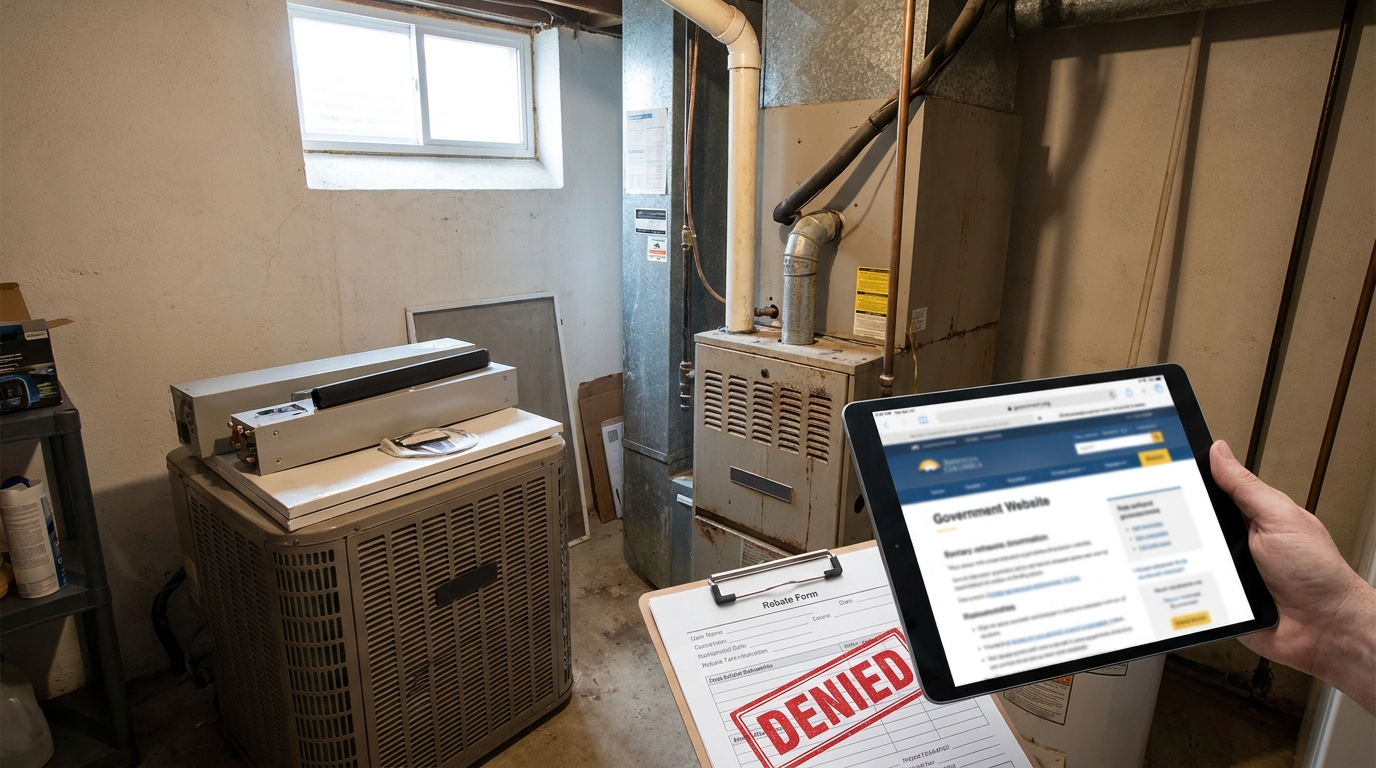
Here is the situation a lot of homeowners walked into this summer. You looked at a heat pump in late 2025, the timing did not work out, and you missed the federal tax credit by a few weeks. A contractor or a state website told you not to worry, because the big rebate program would cover it. Then you went back to that state page in June or July and the fuel-switching option was gone.
That was not a website glitch. The U.S. Department of Energy changed the rules on the largest pot of home electrification rebate money in the country, and the change specifically targets the upgrade most people were planning: swapping a gas, oil, or propane heating system for a heat pump.
If your house currently burns a fossil fuel for heat, you need to read this before you sign anything.
What changed, and exactly when
On May 29, 2026, DOE issued two Home Energy Rebates program notices, Program Notice 26-1 and Program Notice 26-2. The agency announced them publicly on June 1. Together they unfroze the $8.8 billion in Inflation Reduction Act rebate money that had been sitting paused, and at the same time rewrote what that money can buy.
Those dates matter, because state pages and contractor emails keep referring vaguely to "mid-2026" changes. When you call your state energy office, ask which program notice they are operating under. If they say 26-1 or 26-2, you are talking to someone who is current.
One naming problem trips up almost everyone. There are two separate programs, and states market them under different names than DOE uses:
-
HEEHR (High-Efficiency Electric Home Rebates), which most states advertise as HEAR. Roughly $4.5 billion nationally, up to $14,000 per household, paid per piece of equipment. This is the one that changed.
-
HOMES (Home Efficiency Rebates), which many states call HER. Roughly $4.3 billion, up to $8,000 per household, and it pays based on whole-home energy savings of at least 20 percent rather than on which appliance you bought. Details are on DOE's Home Energy Rebates page.
Same federal money, four acronyms. If you only remember one thing from this section, remember that HEAR and HEEHR are the same program, and that is the program with the new restriction.
The rule, in one sentence
Under the new guidance, HEEHR rebates are allowed only for upgrading HVAC equipment and appliances from existing electric equipment to more efficient electric equipment, or for new construction. Gas-to-electric conversions are out, as Utility Dive reported when the notices landed.
Atlas Public Policy's Atlas Buildings Hub analysis puts the scale of that at roughly 73 million U.S. households that heat with gas, oil, or propane and are therefore shut out of the HEEHR path. Atlas does note those households may still be able to reach rebate money through HOMES, and we will come back to that, because it is the single most important thing to ask your state about.
There is a second change buried in the guidance that will affect your project schedule and your budget. Per Canary Media's reporting, the new HEEHR rules require insulation and air sealing upgrades before heat pump funding gets approved. So even homeowners who still qualify are looking at an envelope job first, then the equipment. Plan for two phases, not one.
Which upgrade paths still draw money
Not everything is closed. Depending on your house and your state, these are still live:
-
Electric resistance to heat pump. If you heat with baseboard electric, electric furnace, or a similar resistance system, you are exactly the customer HEEHR now serves. This path is intact.
-
Old heat pump to new, more efficient heat pump. Also electric-to-electric, also still in.
-
Efficiency-only gas work. Replacing an aging gas furnace with a higher-efficiency gas furnace is an efficiency upgrade rather than a fuel switch. Availability varies by state program.
-
Envelope work. Insulation, air sealing, and duct sealing continue to be supported, and under the new sequencing rule they are now a prerequisite for a lot of equipment money anyway.
-
New construction. The guidance carves this out explicitly.
-
A heat pump inside a HOMES savings package. This is the open question. HOMES pays on modeled or measured whole-home savings, not on what fuel you started with, so in principle a heat pump could be part of a qualifying package in a gas home. Reporting differs on how much room that actually leaves in practice.
We are not going to tell you your gas-heated house definitely can or definitely cannot get HOMES money for a heat pump, because that answer is being set state by state right now, not by DOE. That uncertainty is the whole reason for the next section.
How to read your state's page before you sign
Rebate calculators from last year are actively misleading at this point. Go to your state energy office's own page and look for four things.
-
A program notice date. If the page still describes fuel switching without referencing the May 29, 2026 guidance, it may simply be stale. Call.
-
A fuel-switching cutoff date. Many states set a hard submission deadline for gas-to-electric scopes of work.
-
Whether HEAR is open at all. Some states have paused new applications entirely while they rework the program.
-
Whether the HER or HOMES side is still taking applications. This is often the surviving door.
Georgia is the cleanest worked example available. Per the Georgia Environmental Finance Authority's HEAR program update, fuel-switching scopes of work had to be submitted by 10:00 a.m. ET on August 10, 2026. Georgia then stopped accepting new single-family and multifamily HEAR applications at 1:00 p.m. on August 14, 2026. Its Home Efficiency Rebates program is still accepting applications.
Georgia was not unusual, just early and clear about it. States with already-launched programs had three months, until August 31, 2026, to bring their programs into compliance. So if you are reading this now, every live state program has already been through that deadline. The same guidance also opened a path for the roughly 43 states and territories that never had a live program, which is its own reason to re-check a state you wrote off a year ago. Canary Media notes South Dakota declined participation and Idaho was blocked from participating.
What this actually does to a quote
Real numbers help here. Rewiring America's national median installed costs for a ducted whole-home heat pump:
-
1,500 to 2,500 sq ft home: $19,500 median, typical range $17,000 to $23,000
-
2,500 to 5,500 sq ft: $25,000 median
-
5,500+ sq ft: $29,000 median
-
Single-zone ductless (one room): $6,600 median, range $5,400 to $8,500
Take the $19,500 median. In 2025, a homeowner doing that job could claim $2,000 from the federal 25C credit. An income-qualified household in a participating state could also draw up to $8,000 in HEEHR money toward the heat pump itself. Best case, that stacked to roughly $10,000 off, putting the out-of-pocket near $9,500.
Be honest with yourself about that best case. Stacking depended on your income tier and your state's specific rules, and plenty of households never got the full amount. Treat $10,000 as the optimistic end of a range, not a number you were promised.
Today, for a household heating with gas, both of those doors are shut. The credit expired and the HEEHR path excludes you. You are looking at the $19,500 quote, minus whatever your utility offers, minus whatever HOMES money your state can route to you. That is a meaningful swing on a single project.
Two changes, same homeowner, same twelve months
The rebate restriction did not arrive in a vacuum. The [Energy Efficient Home Improvement Credit](https://www.irs.gov/credits-deductions/energy-efficient-home-improvement-credit), known as 25C, was terminated by the 2025 reconciliation law. It applies only to qualifying property placed in service before December 31, 2025. The annual caps were $1,200 for general improvements and $2,000 for heat pumps, heat pump water heaters, and biomass stoves and boilers.
You will still see posts claiming a 30 percent federal heat pump tax credit is available. It is not. Do not build a budget around it, and be skeptical of any contractor who quotes you a "net after federal credit" price for a 2026 installation.
One exception worth checking. If you installed a qualifying system in 2025 and have not filed, that credit is still claimable on your 2025 return using IRS Form 5695. The extended filing deadline is October 15, 2026. If that is you, this is a real $2,000 sitting on the table, and it is worth an hour with your tax preparer this week.
The ENERGY STAR wrinkle
Two things happened to the blue label, and they point in different directions.
First, EPA and DOE signed a memorandum of agreement on March 3, 2026 making DOE the lead agency for ENERGY STAR. Program activities, partnership agreements, trademarks, and IT systems and databases transfer within 90 days. The agreement runs 10 years and either agency can exit with one year's notice. Facilities Dive reported that Congress appropriated $33 million for ENERGY STAR in FY2026 and, for the first time, added language barring the administration from cutting that amount. Industry groups read that as stability.
Second, and quieter: the new HOMES guidance made ENERGY STAR certification optional rather than required for rebate qualification.
Practically, that means the label is becoming less of a gatekeeper for rebate eligibility and more of a straightforward signal about expected performance. Keep using it to compare equipment. Just stop assuming it is what unlocks the money, and ask your state program what its actual efficiency criteria are.
Utility rebates are the lever that is left
Here is the part most people miss. Utility rebate programs never ran on DOE's rules and were not touched by these notices. For a gas-heated home in 2026, your utility is often the best remaining source of real money.
Massachusetts offers a useful model for what to ask, because Mass Save publishes its rules plainly:
-
Whole-home air source heat pump: $2,650 per ton, up to $8,500.
-
Partial-home: $1,125 per ton, plus a $500 weatherization bonus.
-
Income-based offers: up to $16,000, or no-cost installation for qualifying households.
-
The fuel split that matters: natural gas customers can qualify, but only through a Mass Save natural gas sponsor (Berkshire Gas, Eversource, Liberty, National Grid, Unitil). The electric-sponsor path requires pre-existing oil, propane, or electric resistance heat.
-
A weatherization gate of its own: whole-home rebates require the house to be sufficiently weatherized, which is satisfied if it was built after 2000, if under $1,000 in weatherization is recommended, or if weatherization was completed since 2013. Partial-home rebates have no such requirement.
Two takeaways even if you do not live in Massachusetts. Check both your electric utility and your gas utility, because the money can come from either and they run separate programs with separate rules. And expect a weatherization prerequisite, since it is showing up on both the federal and the utility side now.
The disagreement, briefly and fairly
This is contested, and it is fair for you to know that the ground could move again.
DOE's stated rationale is that it "has identified areas of unnecessary duplication for oversight." Alongside the fuel-switching restriction, the notices removed consumer satisfaction surveys, internal review plans, Justice40 parameters, and DEI requirements, and made state implementation plans optional.
Earthjustice, in a June 2, 2026 statement, argued the change conflicts with the statute that created the program, with Anne Clement saying it "restrict[s] consumer choice." No litigation had been filed as of that statement. The Building Performance Association read it the other way, treating the notices mainly as the step that finally got paused funds moving.
What that means for you: if a legal challenge lands and succeeds, the rules could shift again. That is an argument for confirming any rebate in writing rather than assuming today's page will still be accurate at installation.
Your pre-signing checklist
-
Confirm which program you are applying to, by name. HEAR/HEEHR or HER/HOMES. Ask which program notice date the state is operating under.
-
Confirm your existing heating fuel on paper. It is now the single biggest factor in eligibility.
-
Ask specifically whether a heat pump can be included in a HOMES/HER whole-home savings package in your state. This is the one genuinely open question and only your state can answer it.
-
Get the quote itemized two ways. Have the contractor price a gas-path version and an electric-path version separately, including any required insulation and air sealing as its own line. You cannot compare rebate outcomes against a single bundled number.
-
Call both utilities. Electric and gas. Ask about per-ton amounts, income-based tiers, and any weatherization prerequisite.
-
If you installed in 2025 and have not filed, look at Form 5695 before October 15, 2026.
-
Get every rebate confirmed in writing before you pay a deposit. A contractor saying "that should qualify" is not a rebate.
None of this makes a heat pump a bad purchase. Operating costs, cooling, and comfort are the same as they were. What changed is that the subsidy math a lot of people were quoted last year no longer describes 2026, and the gap is large enough that it deserves a fresh set of numbers before you commit.
Related reading
-
[The Heat Pump Tax Credit Just Vanished: Why a 2026 Install No Longer Qualifies for the $2,000 You Were Counting On](/guides/heat-pump-tax-credit-vanished-2026-install)
Sources
-
Home Energy Rebates Program Notice 26-2 (HEEHR), U.S. Department of Energy
-
Home Energy Rebates Program Notice 26-1 (HOMES), U.S. Department of Energy
-
Home Energy Rebates Programs, U.S. Department of Energy, SCEP
-
DOE issues guidance ending gas-to-electric appliance rebates, Utility Dive
-
DOE bars homes from using rebates to ditch fossil-fueled heating, Canary Media
-
Home Energy Rebates Updated Program Guidance, Atlas Buildings Hub (Atlas Public Policy)
-
HEAR Program Update, Georgia Environmental Finance Authority
-
Energy Efficient Home Improvement Credit, Internal Revenue Service
-
Here's how much heat pumps cost to install, Rewiring America
-
Air Source Heat Pumps, Mass Save
-
2026 Memorandum of Agreement on the ENERGY STAR Program between EPA and DOE
-
Energy Star is moving to DOE. Industry groups are hopeful., Facilities Dive
-
Earthjustice Responds to DOE's Changes to the Home Electrification and Appliance Rebates Program
Note: This article contains AI-assisted content and has been reviewed by our editorial team. Rebate programs change frequently. Verify current terms with your state energy office and your utility before making a purchase decision. This is general information, not tax advice.
ABOUT THIS SERVICE: CallTheLocal.com is a directory and lead generation service, not a contractor or service provider. Submitting this form does not obligate you to hire anyone or purchase any service. Your information will be shared with licensed, insured home service professionals in your area who may provide quotes for your project. CallTheLocal.com does not guarantee the quality, timeliness, or outcome of any work performed by service providers you connect with through this service. Always verify licensing, insurance, and references before hiring. Get everything in writing before work begins.