Sprinkler blowout cost for a typical home in 2026 runs about $80 to $150 in the cities we checked. Denver companies charge $100 to $150, Des Moines service starts at $90, and Portland ranges from $80 for a manual drain to $140 for a blowout. LawnStarter puts the national blowout range at $85 to $215. Renting a compressor for a DIY job costs $30 to $60 a day.
Freeze season arrived in mid-October. The National Weather Service put Colorado's Front Range urban corridor (Greeley, Fort Collins and Boulder, south toward El Paso County) under a Freeze Warning from midnight to 9 a.m. Friday, Oct. 16, with lows of 25 to 35 degrees, the Denver Gazette reported. Out on the northeast plains, NWS Denver warned that the cold could "possibly damage unprotected outdoor plumbing."
The next day was Iowa's turn. Freeze warnings ran from 1 a.m. to 9 a.m. Saturday, Oct. 17, with lows "as low as 29 degrees across much of central Iowa, including Des Moines," according to IowaWeather.com. On Sunday, Oct. 18, a Freeze Warning covered ten western North Carolina mountain counties, including Buncombe, Haywood and Jackson, and WLOS reported that residents were told to protect exposed outdoor pipes. In the Pacific Northwest, KPTV reported that frost and freeze concerns would reach the Portland metro Friday night into Saturday morning, Oct. 23 to 24.
If your irrigation system still holds water, now is the time to deal with it. Below are the rules for doing it yourself, the local prices if you'd rather hire someone, and the one part that makes this decision worth getting right.
Why the backflow preventer is the part that cracks
Most of a sprinkler system sits underground. The backflow preventer, the brass assembly that keeps irrigation water from flowing back into your drinking water, usually sits above ground, often next to the house. That makes it the most exposed part of the system on a cold night.
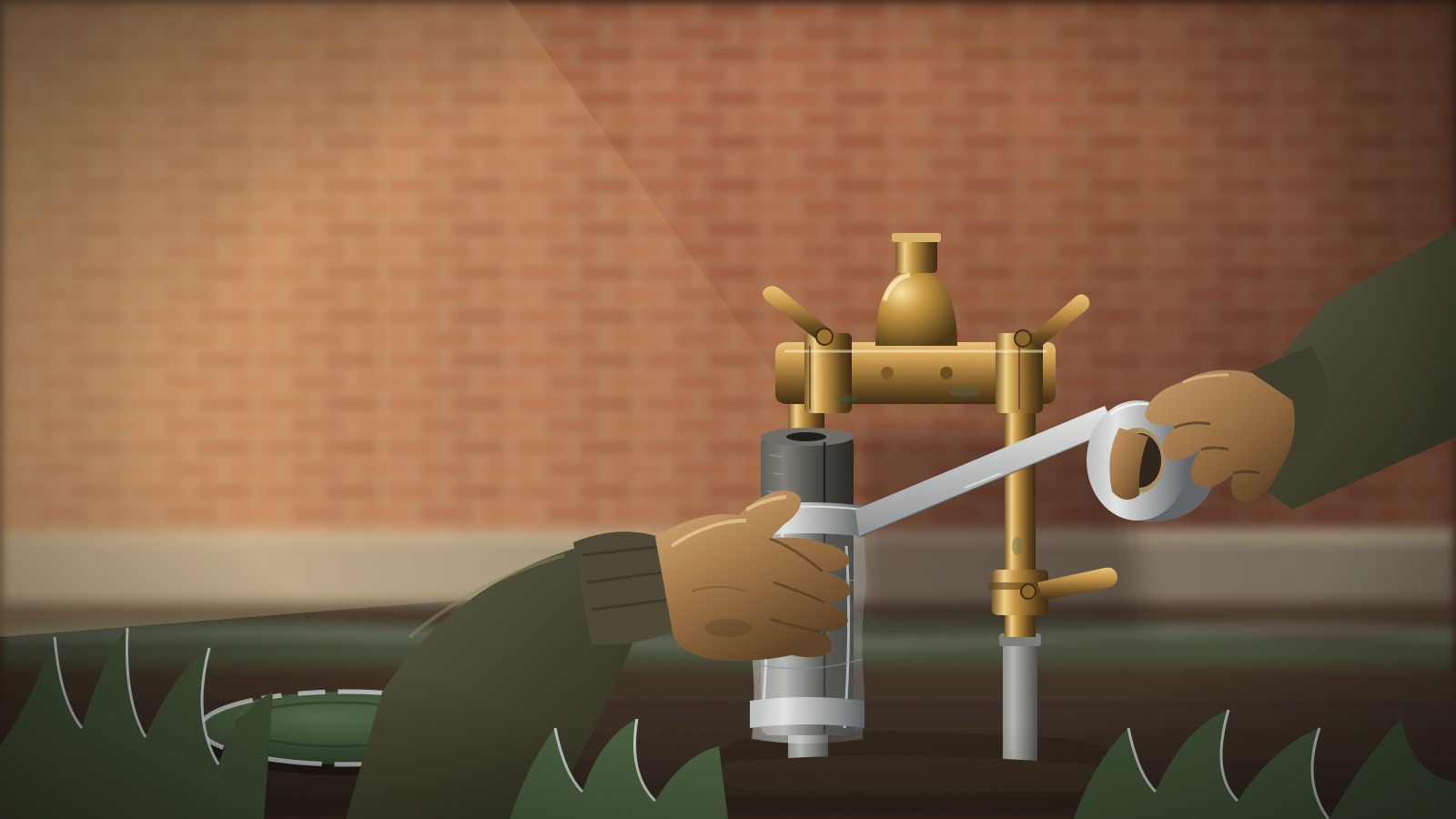
That's why professional winterization covers it. Conserva Irrigation in Des Moines, for example, says its service drains water from the system "including the backflow prevention device." After the system is drained, Colorado State University Extension recommends wrapping it: "Use insulation wrapped with plastic and be sure to include pipes to ground level," then secure the wrap with duct tape.
DIY or hire a pro?
CSU Extension's advice is direct: "Preferably have the systems blown out by professionals with an air compressor. You can do this yourself with the right compressor, pressure regulation and knowledge." It also warns that "poorly handled air pressure can damage a system, as can leaving residual water in the system."
CSU adds that even systems with inline drains can benefit from a blowout, because lines settle over time and form low spots where water collects.
So here's the honest test: do you have the right compressor and a pressure regulator, or are you willing to rent them? If not, hire it out.
The compressor has to be big enough
Sprinkler maker K-Rain says the compressor "must be capable of delivering 20 to 25 Cubic Feet Per Minute of air volume," and warns that "some small shop compressors (2 hp) may not be adequate." The garage compressor you use for tires and nail guns probably won't do it. K-Rain specifically warns against using a compressor with high pressure (120 psi) and low volume. If you don't have a suitable compressor, K-Rain says to call an irrigation contractor.
Renting is an option. LawnStarter puts compressor rental at $30 to $60 a day, and Denver's Mile High Lifescape cites $40 to $60 a day.
Keep the pressure at or below 50 psi
K-Rain is clear on this: "Air pressure must not exceed 50 pounds per square inch (psi)." Use a pressure-regulating valve set to 50 psi between the compressor and the system. You need a lot of air volume, but only moderate pressure.
How to blow out a sprinkler system, step by step
This sequence follows K-Rain's manufacturer procedure. If your system's manufacturer or installer gave you different instructions, follow theirs.
-
Put on eye protection. K-Rain prints this in capital letters: "WEAR PROPER EYE PROTECTION!"
-
Set the regulator to 50 psi and confirm the compressor can deliver 20 to 25 CFM.
-
Open the zone farthest from the air connection first. K-Rain says to activate that circuit "before introducing air into the piping." Never run the compressor without at least one sprinkler control valve open.
-
Blow each circuit for no more than 1 minute at a time. K-Rain warns that sustained heat from compressed air can damage pipe and components.
-
Work back toward the connection, zone by zone. Don't stand over pipes, sprinkler heads or valves while air is flowing.
-
Repeat the full cycle two or more times. Short bursts repeated across all zones work better than one long push.
-
Leave one zone on while you shut down the compressor. Don't let pressure build up against closed valves.
-
Wrap the backflow preventer in insulation and plastic, all the way down to ground level, and tape it in place (CSU Extension method).
A note for Portland homeowners
Portland has its own rules. The Portland Water Bureau says "backflow prevention assemblies must be protected from severe environmental conditions," and only commercially manufactured, prefabricated, insulated outdoor enclosures are approved. Owners must also have their assemblies tested every year. If your assembly lacks an approved enclosure, add that to your list.
What pros charge: price check by city
Denver metro
-
Sunlight Sprinkler: $100 for 1 to 4 zones, $110 for 5 to 8, $120 for 9 to 16 (non-member prices; members pay $5 less). Each additional backflow is $20.
-
Sage Quality Solutions: $150 for up to 8 zones, plus $5 for each additional zone.
-
Mile High Lifescape puts professional winterization at $75 to $150, with most jobs in the $100 to $120 range.
Des Moines area
- A+ Lawn & Landscape, which serves Des Moines, West Des Moines, Ankeny and Urbandale, lists irrigation startup and winterization starting at $90. Its winterization uses compressed air, and it schedules the work in September and October.
Portland area
-
Flowcheck LLC: $80 for a manual drain, $140 for a blowout upgrade. It winterizes only from mid-October through November, and a repair diagnosis call-out is $195.
-
Blue Whale Sprinkler Service: $120 for new customers, $105 for returning customers. That covers a single-family home with one backflow assembly and includes winterizing the backflow device.
National benchmark
LawnStarter (updated Oct. 19, 2026) says most homeowners pay $59 to $144 to winterize, and a blowout runs $85 to $215.
What moves the quote
-
Zone count. LawnStarter's tiers: 1 to 2 zones, $50 to $75; 3 to 4 zones, $80 to $100; 5 to 6 zones, $100 to $130; 7 to 8 zones, $150 to $250. Sage adds $5 per zone past eight.
-
Extra backflow devices. Sunlight charges $20 for each additional backflow. Blue Whale's price assumes one assembly.
-
Loyalty pricing. Sunlight members save $5, and Blue Whale's returning customers pay $15 less than new ones.
-
Drain vs blowout. In Portland, Flowcheck's manual drain costs $60 less than its blowout.
-
Booking late. Mile High Lifescape warns that November requests face "limited availability and higher costs."
What a cracked backflow preventer costs
This is where the math gets lopsided. Sage Quality Solutions publishes its Denver repair prices:
-
Replace a 3/4" backflow preventer: $650
-
Replace a 1" backflow preventer: $750
-
Reduced-pressure (RP) assembly replacement: $995 (RP 850) to $1,600 (RP 825)
-
Replacement parts, installed: $150 (Febco 3/4"), $175 (Febco 1"), $200 (Apollo or Watts/Wilkins)
-
Replace a test cock: $25
Mile High Lifescape puts destroyed backflow preventer replacement at $300 to $800. Either way, one repair can cost several times what a blowout does.
In Portland, there's an extra step. An assembly "must not be removed, replaced, or relocated without the approval of the Portland Water Bureau" (backflow@portlandoregon.gov, 503-823-3256). Irrigation assembly repairs can be done by a landscaper licensed by the Oregon Landscape Contractors Board, and the bureau's testing rules say: "Assemblies must be tested again after repairs are made!"
What to ask when you book
-
Is the price per system or per zone, and how many zones does my price cover?
-
Is draining or winterizing the backflow device included?
-
Do you charge extra for a second backflow assembly?
-
If you find a problem, will you leave a written repair estimate before doing any work?
-
Are you licensed? (In Oregon, irrigation backflow repairs can be handled by a landscaper licensed by the Landscape Contractors Board.)
-
Do you offer a returning-customer or membership rate?
The bottom line
If you own, or are willing to rent, a compressor that delivers 20 to 25 CFM, plus a regulator you can set to 50 psi, and you're comfortable working zone by zone in one-minute bursts, a DIY blowout is reasonable. Rental costs $30 to $60 for the day.
If you're working with a small shop compressor or guessing at the pressure, book a pro. A $90 to $150 visit is cheap insurance against a backflow replacement that runs $650 or more at Denver prices. With freeze alerts already out in all four regions and November slots getting tighter, call this week.
Related reading
-
How to Winterize Outdoor Faucets Before the First Hard Freeze
-
What to Do in the First Three Days After Floodwater Gets Inside
Sources
-
CSU Extension PlantTalk Colorado: Winterizing sprinkler systems
-
Denver Gazette (Oct. 15, 2026): Freeze watch, showers could affect evening commute
-
NWS Denver Freeze Warning, Oct. 16, 2026 (GovOneStop mirror)
-
IowaWeather.com (Oct. 16, 2026): Widespread Freeze Warnings Issued Across Iowa
-
WLOS (Oct. 17, 2026): First freeze of fall expected in western North Carolina mountains
-
Sunlight Sprinkler: Residential Sprinkler Pricing, Denver CO
-
Mile High Lifescape: How much does winterize sprinkler system cost? [2026]
-
LawnStarter: How Much Does it Cost to Winterize a Sprinkler System in 2026? (updated Oct. 19, 2026)
-
Blue Whale Sprinkler Service: Winterization and Spring Activation
-
Portland Water Bureau: Backflow assembly installation requirements
ABOUT THIS SERVICE: CallTheLocal.com is a directory and lead generation service, not a contractor or service provider. Submitting this form does not obligate you to hire anyone or purchase any service. Your information will be shared with licensed, insured home service professionals in your area who may provide quotes for your project. CallTheLocal.com does not guarantee the quality, timeliness, or outcome of any work performed by service providers you connect with through this service. Always verify licensing, insurance, and references before hiring. Get everything in writing before work begins.