Note: This article contains AI-assisted content and has been reviewed by our editorial team.
The Atlantic hurricane season officially opened June 1, and even the quieter forecast this year is not exactly a green light. NOAA's May 22, 2026 outlook calls for a below-normal season with a 55% probability, but the same forecast still predicts 8 to 14 named storms, 3 to 6 hurricanes, and 1 to 3 major hurricanes (NOAA, May 2026). A below-normal year is not a no-storm year. One landfall is all it takes to turn a tired roof into a five-figure problem.
If you own a Florida home, the cheapest insurance you can buy this month is not a policy endorsement. It is a roof inspection. A $150 to $400 visit from a licensed inspector now can prevent a $13,000 to $46,000 replacement bill, a denied insurance claim, or worse, a non-renewal notice in the mail.
What a Florida Pre-Storm Roof Inspection Actually Includes
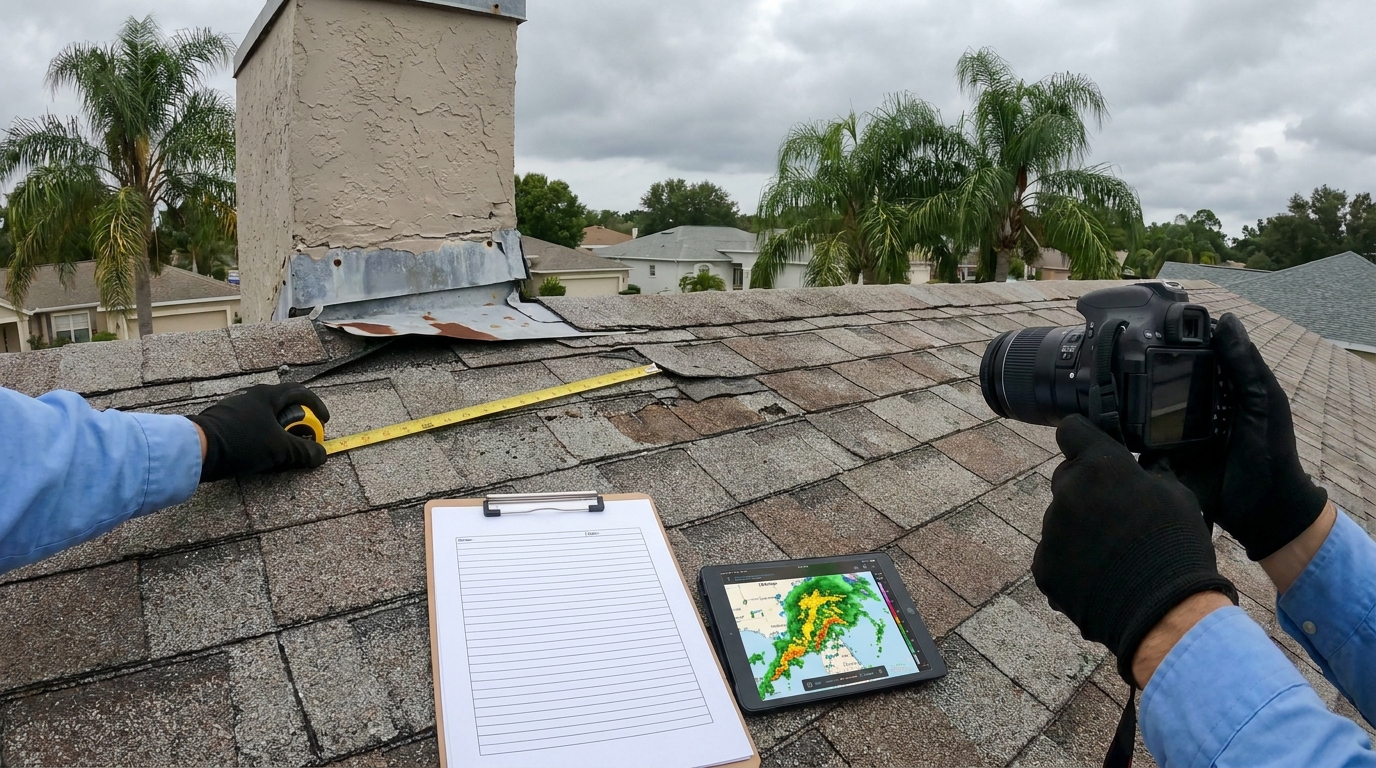
Current 2026 pricing for a residential roof inspection in Florida typically runs $150 to $400, with detailed insurance-grade or wind-mitigation reports reaching $250 to $800 in coastal counties or on tile and two-story homes (HALOFIX, 2026). For that fee, a competent inspector should deliver:
-
A visual decking and shingle survey from the ground, the roof surface, and the attic
-
Fastener pull tests on a sample area to check holding power
-
A flashing and penetration check at chimneys, skylights, vents, and pipe boots
-
Ridge and hip cap inspection for lifting or loose pieces
-
An attic moisture survey and a look at the rafter-to-wall connections (hurricane straps)
-
A timestamped photo report and a written remaining-useful-life letter
That last item, the useful-life letter, is the document that does the heavy lifting with your insurance carrier.
Why 2026 Is Different: Statute 627.7011 and SB 808
Florida law changed the math on roof age a few years ago, and it tightens again this summer. Under Florida Statute 627.7011, a carrier cannot refuse to renew a homeowners policy solely because the roof is under 15 years old. Once the roof crosses the 15-year mark, however, the carrier can require an inspection, and they must continue coverage if a licensed inspector certifies the roof has at least 5 years of remaining useful life (Lewis Insurance, 2026; Mesa Insurance, 2026).
Effective July 1, 2026, Senate Bill 808 expands who can sign off on that inspection. The qualifying list now includes licensed home inspectors, certified building-code inspectors, general/building/residential/roofing contractors, professional engineers, and architects. That is good news, more available appointments before peak storm season, but it also means quality varies. Ask which credential your inspector holds before you book.
The Engineering That Decides Whether Your Roof Stays On
Hurricane wind does not usually pull a whole roof off in one motion. It peels. Once a single shingle or section of decking lifts, wind pressure gets underneath and the failure cascades. Three construction details decide which roofs survive that first lift:
-
Sealed roof decks. The IBHS FORTIFIED standard requires ring-shank nails on 7/16-inch or thicker sheathing, typically spaced 6 inches on the edges and 12 inches in the field, with taped or membrane-sealed seams. Even if shingles blow off, wind-driven rain cannot enter the attic (IBHS FORTIFIED Technical Documents; DOE Building America).
-
Hurricane straps at every rafter-to-wall connection. Most pre-2002 Florida homes were not built with them. They are often retrofittable from the attic and they are the difference between a roof that holds and a roof that takes flight (DOE Building America).
-
Tight, intact ridge and hip caps. These are the first pieces wind tests, and the first ones an inspector will flag.
The performance data is striking. IBHS reports that homes built to the FORTIFIED Roof standard filed roughly 35% fewer insurance claims after Hurricanes Matthew, Florence, Dorian, and Isaias compared to standard construction (IBHS).
AI workflows for revenue teams
Placeholder house ad for Conservus.ai. Swap with final creative when brand assets are ready.
Partner with Conservus.aiRed Flags Your Inspector Is Hunting For
A pre-storm inspection is, in part, a triage exercise. The list below covers what should make it into the report, and roughly what each finding signals about cost:
-
Loose or lifted ridge caps: $300 to $1,200 to re-seat and re-fasten; ignored, they become the entry point for a full deck failure.
-
Popped or exposed nails: A $200 to $600 service call now; left alone, each one is a future leak path.
-
Soft or spongy decking underfoot: Localized deck replacement, $500 to $2,500 per section.
-
Missing hurricane straps: Often retrofittable from the attic for $1,500 to $4,000, and frequently eligible for a wind-mitigation premium discount.
-
Deteriorated pipe boots and vent flashings: $150 to $400 each; the number one source of "mystery" ceiling stains.
-
Caulk-only flashing repairs from a prior roofer: A tell that the underlying flashing was never properly replaced. Plan on $1,500 to $4,000 to do it right.
Catch any of these for a few hundred to a few thousand dollars now, and you avoid the scenario where storm damage compounds pre-existing wear into a $25,000 to $45,000 full replacement that your carrier may decline to cover.
Regional Cost Comparison: What a New Roof Actually Costs in 2026
The price gap between an inspection and a replacement is what makes the math obvious:
-
Florida: Roughly $13,000 for a basic 2,000 sq ft asphalt-shingle roof, around $25,000 for typical 1,700 to 2,000 sq ft jobs, and $20,000 to $50,000+ for tile. Metal roofs run $16,000 to $36,000 (Coastal Roofing, 2026; InstantRoofer, 2026).
-
Texas: $7,000 to $12,000 for a typical 2,000 sq ft asphalt roof, with a statewide average closer to $17,774 across all sizes (Rise Roofing, 2026).
-
The Carolinas: Generally 5% to 15% below the national average of about $11,000, though hail and storm events can spike local prices 15% to 30% (Landmark Roofing, 2026).
Now layer the hurricane deductible on top. Florida hurricane deductibles typically run 2% to 5% of dwelling coverage, meaning a $400,000 home carries an $8,000 to $20,000 out-of-pocket before the carrier pays a dollar on a hurricane claim (3MG Roofing, 2026). A pre-storm inspection that prevents borderline damage from getting worse is, very literally, paying down that deductible in advance.
The Three Magic Words That Deny Claims
If your claim is going to be denied or reduced, it will almost certainly come back with one of three phrases attached: "wear and tear," "pre-existing damage," or "lack of maintenance" (GreatFlorida Insurance, 2026). All three are essentially the same argument: the damage was there before the storm.
This is exactly why a dated pre-storm inspection report with timestamped photos is the single most valuable document a Florida homeowner can hold. It establishes the condition of the roof on a known date. After the storm, the comparison photos do the talking. The carrier's adjuster has a much harder time arguing pre-existing damage when you can show them a 60-day-old photo report.
AI workflows for revenue teams
Placeholder house ad for Conservus.ai. Swap with final creative when brand assets are ready.
Partner with Conservus.aiVetting Roofers After a Storm: How to Spot a Storm-Chaser
The 72 hours after a hurricane landfall is when the out-of-state plates roll in. Florida has clear laws on this, and the red flags are consistent (FoxHaven Roofing, 2026; Crown Roofing):
-
"We'll waive your deductible" or "free roof" pitches. Both are explicitly illegal in Florida. Walk away.
-
Pressure to sign a contract on the spot, especially an "assignment of benefits" form before any inspection.
-
No Florida DBPR license. Verify every roofer at myfloridalicense.com before you sign anything.
-
Out-of-state plates and a P.O. box address. The crew that drove in last week will be gone before any warranty matters.
-
Cash-only or full payment up-front. Reputable roofers take a deposit, not the whole job.
If you do sign something in the panic of a post-storm week, Florida law gives you a 10-day right to cancel any roofing contract signed during a declared state of emergency. Use it without apology.
Your 30-Day Action Checklist
-
Schedule the inspection in the next 30 days. Reputable inspectors book out fast once a named storm is in the cone.
-
Ask specifically for the wind-mitigation form (OIR-B1-1802). This is the document that unlocks premium discounts for features like hurricane straps, sealed decks, and impact-rated openings.
-
Verify the inspector's license at myfloridalicense.com. Under SB 808 the qualifying list is broad; confirm yours is on it.
-
Request photo documentation, not just a summary letter. Timestamps matter.
-
Store the report digitally in cloud storage with a second copy emailed to yourself, your spouse, and your insurance agent.
-
If repairs are flagged, schedule them now. The same red flags that worry an inspector will be cited verbatim in a future denial letter.
A $400 inspection in June is not a luxury. In a year when even NOAA's quieter outlook still puts up to 14 named storms and 6 hurricanes on the board, and when carriers are leaning harder than ever on Statute 627.7011 to non-renew aging roofs, that single appointment is the cheapest defensive move on the menu. The replacement bill it might prevent runs in the tens of thousands. The insurance policy it might save is the one keeping your mortgage in good standing.
Call a local, licensed roofing professional this week. The storms are not waiting.
Related reading
AI workflows for revenue teams
Placeholder house ad for Conservus.ai. Swap with final creative when brand assets are ready.
Partner with Conservus.aiSources
-
NOAA Climate Prediction Center: 2026 Atlantic Hurricane Outlook (May)
-
Lewis Insurance: Florida Roof Insurance Requirements Guide for 2026
-
[Coastal Roofing: Florida Roof Replacement Costs 2026](https://coastalroofingofsouthflorida.com/blog/florida-roof-replacement-costs-2026-complete-pricing-guide/)
-
Rise Roofing: Average Cost of Roof Replacement in Texas, 2026
-
3MG Roofing: Does Homeowners Insurance Cover Roof Replacement in Florida?
-
FoxHaven Roofing: Preventing Roofing Scams After Storms in Florida, 2026
ABOUT THIS SERVICE: CallTheLocal.com is a directory and lead generation service, not a contractor or service provider. Submitting this form does not obligate you to hire anyone or purchase any service. Your information will be shared with licensed, insured home service professionals in your area who may provide quotes for your project. CallTheLocal.com does not guarantee the quality, timeliness, or outcome of any work performed by service providers you connect with through this service. Always verify licensing, insurance, and references before hiring. Get everything in writing before work begins.