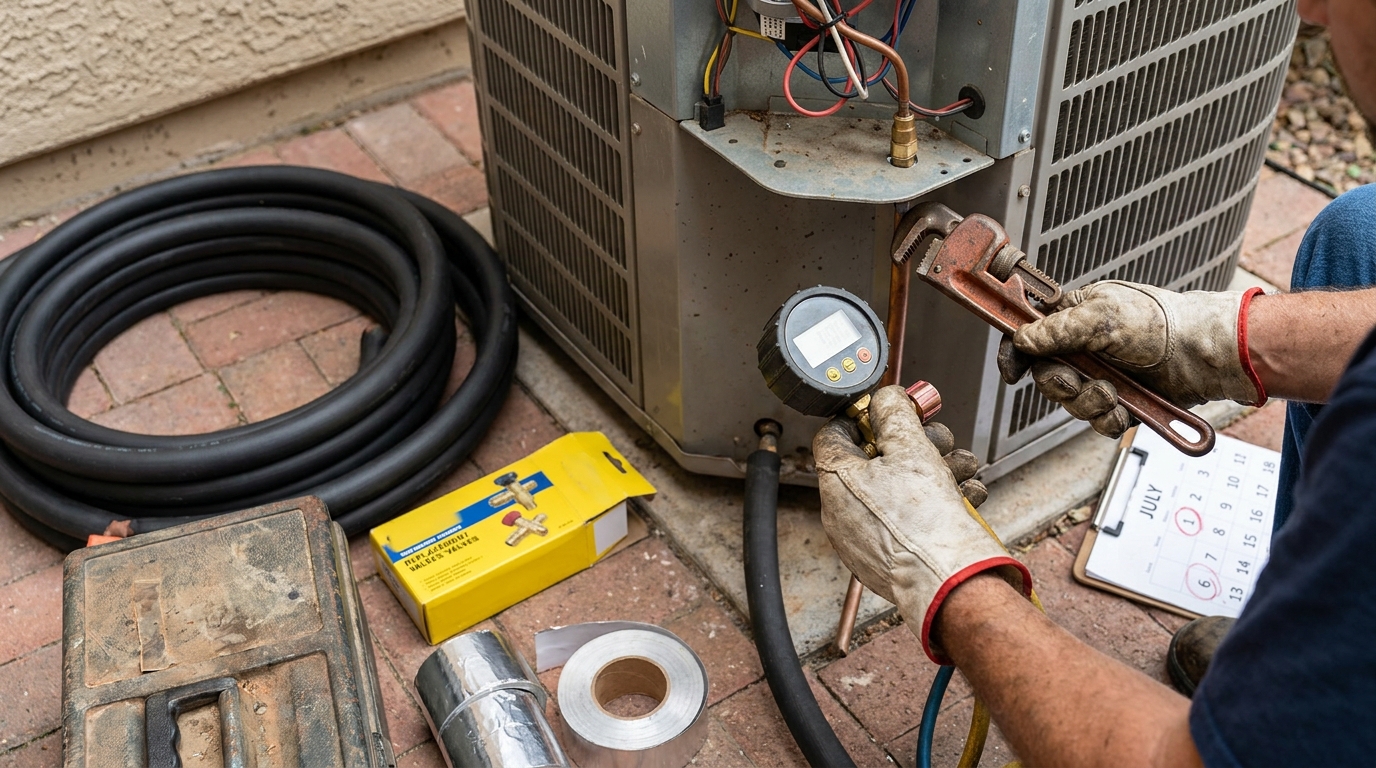
If you got a quote for a new heating and cooling system back in February and thought you had time to sleep on it, here is some news you will want before you call your contractor back: the price went up again. On July 1, 2026, a second wave of supplier increases took effect, and this round is different from the headline equipment hikes you already heard about. It hit the parts inside your install. The insulation, the venting, the valves, the heating elements. The stuff that does not have a brand name on the front of the box but shows up on every line of your invoice.
Here is the plain-neighbor version: a full system replacement quoted in July costs measurably more than the same job quoted in late winter, even before anyone reprices the condenser or the furnace itself. Below is exactly what changed, why the widely reported tariff ruling did not bring prices down, and what a realistic 2026 job actually runs so you can plan instead of panic.
The receipts: what actually went up on July 1
According to ACHR News's July 2026 price-increase tracker, the trade publication that follows these announcements, the following supplier increases took effect July 1, 2026:
-
Johns Manville: 6 to 8% on insulation. This is the material that lines your ductwork and helps your system hold the temperature it worked to create.
-
Duravent Group: 7% on venting. This covers the DuraVent, AmeriVent, and Builder's Best lines, which are the pipes that safely carry combustion gases out of your home on a furnace install.
-
JB Industries: 7.5% on brass access valves, capillary tubing, and fittings, plus 10% on vacuum pump oil. These are the small connective parts a technician uses to charge and seal your refrigerant lines.
-
Tutco: 10% on heating elements. These are the components that produce heat in electric furnaces and heat pump backup strips.
One more lands a bit later. CertainTeed's 6% increase is effective July 20, 2026, a distinct date, not part of the July 1 batch. Worth knowing if your quote is dated in that window.
The reason this matters for your wallet: these are install components, not the nameplate equipment. So a full replacement quoted this summer costs more than the identical job quoted in February even before the manufacturer touches the price of the AC unit or furnace. A contractor-maintained log from Paschal Air, Plumbing & Electric tracks these same brand and timing patterns if you want to cross-check what your installer tells you.
Wait, didn't the tariffs get struck down? Why prices didn't fall
This is the part that confuses a lot of homeowners, and it is a fair thing to be confused about. On February 20, 2026, the Supreme Court struck down the IEEPA "reciprocal" tariffs and the China, Canada, and Mexico tariffs in a 6 to 3 ruling (Learning Resources v. Trump), confirmed in this legal summary from WilmerHale. So naturally you would expect prices to ease. They did not, and here is why:
-
Different tariffs are still in force. The Section 232 tariffs on steel, aluminum, and copper remain fully in effect. Those metals are core HVAC inputs, so the ruling left the tariffs that matter most to your system untouched.
-
2025 costs are already baked in. Last year's tariff costs were absorbed into current equipment pricing and are not being unwound.
-
The cheap inventory is gone. Pre-tariff stock was exhausted by the middle of 2025, so there is no older, lower-cost supply to draw down.
-
Any savings stayed in the channel. Distributors kept whatever margin relief existed rather than passing it to installers, and manufacturers announced fresh increases during the same window the tariff relief arrived.
A consumer-friendly breakdown from UniColorado and a broader explainer from Money both land on the same conclusion: the court ruling made headlines, but it did not reach your quote.
The bigger driver most homeowners miss: the refrigerant switch
If the supplier hikes are the visible bump, the refrigerant transition is the structural one underneath everything. New R-410A residential equipment manufacturing stopped on January 1, 2025. The industry moved to A2L refrigerants, primarily R-454B, and the equipment built for it costs roughly 15 to 40% more up front than the prior R-410A generation, according to a 2026 R-454B guide from Surplus City.
The refrigerant itself got dramatically more expensive too. R-454B cylinder prices reportedly climbed from about $345 in 2021 to over $2,000 in 2025, and recharge costs rose from roughly $68 per pound to about $85 per pound. That reshapes the math on both new installs and repairs, which is part of why "just recharge it" is a less appealing answer than it used to be.
Add it up and industry sources put total 2026 HVAC cost inflation at roughly 15 to 25%, driven by the refrigerant phase-out, a skilled-labor shortage, materials inflation, and the regulatory and supply-chain picture. The July component hikes sit on top of all of that.
What a full 2026 system swap actually costs
Let's talk real numbers. For a typical 2,000 square foot home, a full HVAC system replacement (air conditioner plus furnace) realistically runs about $7,000 to $20,000 in 2026. Across the country the range stretches wider, roughly $5,000 to $28,000, depending on your home's size, your ductwork condition, and the equipment tier you choose. Cost datasets from CBS News, Angi, and HomeGuide all track ranges in this neighborhood for 2026.
What moves you within that range:
-
Home size. A larger house needs more capacity and more material, which pushes you up the range.
-
Ductwork. If your ducts need repair or replacement, that is often thousands on its own, and it is exactly where the Johns Manville insulation increase shows up.
-
Equipment tier. A base efficiency single-stage system sits at the bottom of the range; a high-efficiency variable-speed setup sits near the top.
-
Regional variation. Labor and permitting costs differ by market, so expect higher totals in high-cost metro areas than in smaller or rural markets. Ask your installer where your quote falls relative to local averages.
The July component hikes of 6 to 10% do not land on the whole total. They land on the specific parts each supplier makes, which is why the increase to your bottom line is real but incremental rather than a full double-digit jump on the entire job.
Lock a quote now, or wait for the off-season?
There is a genuine case on both sides, so here is how to think about it as a homeowner rather than a forecaster.
The case for locking now: increases have been arriving in waves throughout 2026, and each wave has been layered on top of the last rather than reversed. If you already know your system is failing, a signed quote protects you from the next announcement. Ask specifically whether the quote is price-protected and for how long.
The case for waiting: if your system is still limping along, replacing in the shoulder seasons of spring or fall usually gets you better contractor availability and less mid-summer premium scheduling. Emergency replacements in a July heat wave are where you overpay.
Either way, do not skip the federal incentives. Qualifying heat pumps can earn up to a $2,000 tax credit, and qualifying central AC upgrades can earn up to $600. Those will not erase a 2026 price bump, but they meaningfully soften it, so confirm which models on your quote actually qualify before you sign.
Homeowner checklist: how to read a 2026 quote
-
Ask for equipment and components as separate lines. You want to see where the refrigerant-driven equipment premium ends and where the component costs (insulation, venting, valves) begin.
-
Confirm the refrigerant. New residential systems should be A2L / R-454B compatible. If a quote is priced around older R-410A equipment, ask why.
-
Ask if the price is locked. Given the wave pattern this year, a written price-protection window is worth requesting.
-
Get the tax-credit models in writing. Have the contractor note which specific units qualify for the heat pump or central AC credits.
-
Avoid emergency summer scheduling if you can. If the system is not fully dead, timing the job for a cooler month tends to lower both the price and the stress.
-
Get at least a couple of quotes. Ranges this wide mean comparison shopping genuinely pays, and it helps you spot an outlier bid in either direction.
The bottom line
The July 1 wave is a reminder that in 2026, HVAC pricing is moving in steps, not sliding back down. The tariff headlines did not help homeowners because the tariffs that matter stayed in place, and the refrigerant transition continues to push equipment structurally higher underneath it all. None of that means you should overpay in a panic. It means you should get itemized quotes, understand which line items just went up and why, use the federal credits you qualify for, and time the work when you reasonably can. Informed beats rushed every time.
Related reading
-
[Seven HVAC Brands Are Being Sued for Allegedly Fixing Prices Since 2020: What the Class Action Means for Your 2026 AC Quote](/guides/hvac-price-fixing-lawsuit-2026-ac-quote)
-
The HVAC Tariff Got Cut From 25% to 15% in June, So Why Did Your AC Quote Still Go Up?
-
[The $200 Fine Just Became $1,500: What California, Florida, and New Jersey's 2026 Unlicensed Contractor Rules Mean for Your Wallet](/guides/unlicensed-contractor-crackdown-california-florida-new-jersey-2026)
Sources
-
2026 HVAC Price Increases by Brand — Paschal Air, Plumbing & Electric
-
How much does a new HVAC system really cost in 2026? — CBS News
-
How Much Does a New HVAC System Cost to Install or Replace? (2026) — HomeGuide
-
[R-454B Refrigerant: The Complete Guide for 2026 — Surplus City](https://surpluscityliquidators.com/blogs/news/r-454b-refrigerant-a-2025-guide)
-
Supreme Court Strikes Down IEEPA Tariffs — What Now? — WilmerHale
Note: This article contains AI-assisted content and has been reviewed by our editorial team.
ABOUT THIS SERVICE: CallTheLocal.com is a directory and lead generation service, not a contractor or service provider. Submitting this form does not obligate you to hire anyone or purchase any service. Your information will be shared with licensed, insured home service professionals in your area who may provide quotes for your project. CallTheLocal.com does not guarantee the quality, timeliness, or outcome of any work performed by service providers you connect with through this service. Always verify licensing, insurance, and references before hiring. Get everything in writing before work begins.