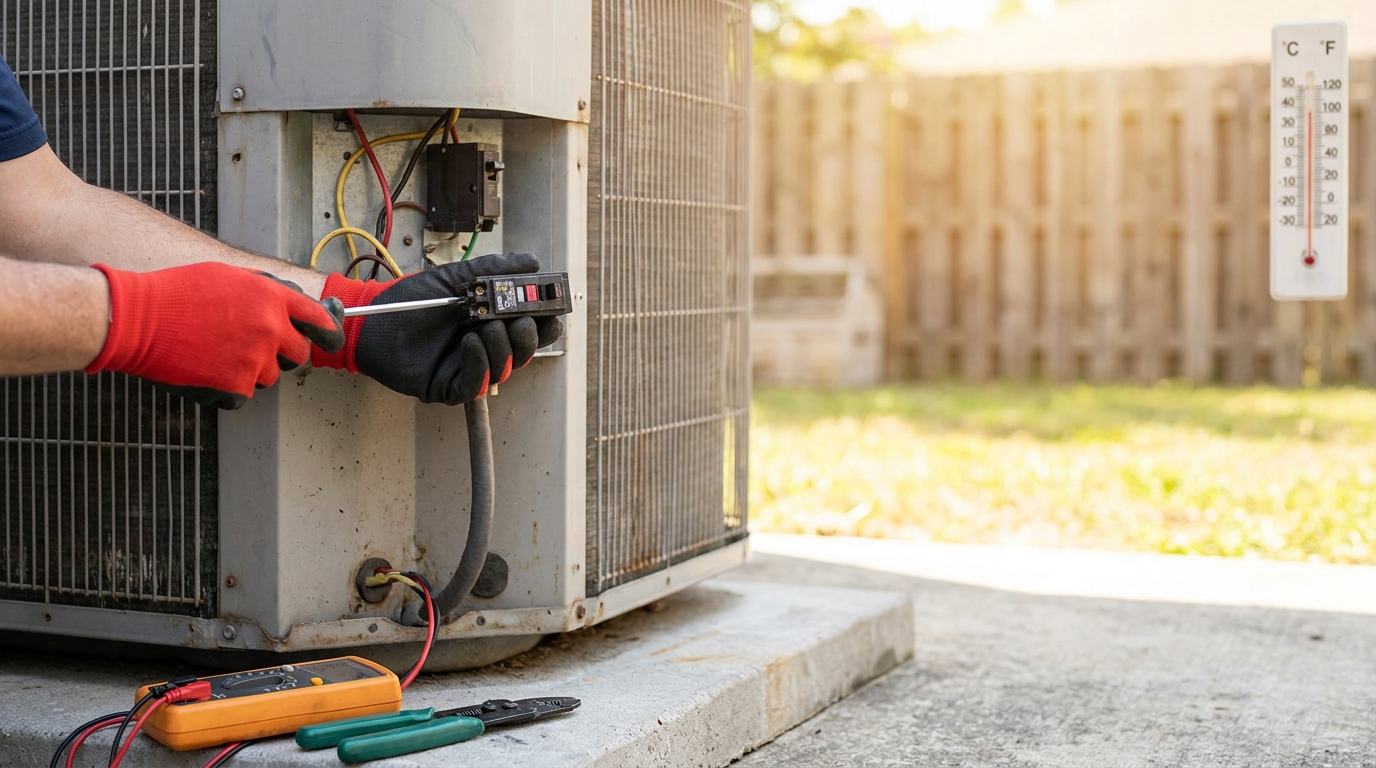
Picture the worst version of this: a brand new high-efficiency heat pump, installed in July, and on the first 95-degree afternoon the breaker pops. You reset it. It pops again. The equipment is fine. The wiring is fine. The protective device is doing exactly what it was designed to do, and it is reading normal operation as a fault.
That is the scenario the HVAC industry spent four years arguing about, and on September 1, 2026, the argument runs out of time in a large chunk of the country.
Here is the part that surprises most homeowners: nothing is being voted on. No agency is issuing a new rule. The change happens because a sunset clause written into the code text of the National Electrical Code simply expires on its own. Section 210.8(F) of the NEC requires ground-fault circuit interrupter (GFCI) protection for outdoor outlets at homes. Exception No. 2 carved out listed HVAC equipment, and that exception ends with a single sentence in the code: "This exception shall expire September 1, 2026." No state has to act for it to lapse. If your jurisdiction enforces the 2020, 2023, or 2026 NEC without amending that section, the carve-out is just gone.
Whether any of this touches your project depends almost entirely on which state you live in. The same $400 line item on an install quote can be legitimate in one state and pure padding in the next one over. Let's sort out which one you're in.
What the rule actually requires
In plain terms, once the exception lapses, outdoor outlets at dwellings that serve equipment like AC condensers and heat pumps need GFCI protection when the circuit is:
-
Single-phase
-
Rated 150 volts or less to ground
-
Rated 50 amperes or less under the 2020 and 2023 NEC, or 60 amperes or less under the 2026 NEC, which raised the threshold
Most residential condensers sit comfortably inside that window, which is why this lands on ordinary homeowners and not just commercial jobs.
The detail that catches people is the replacement trigger. The code says that if equipment supplied by a covered outlet is replaced, the outlet shall be supplied with GFCI protection. In an enforcing jurisdiction, swapping out a 14-year-old condenser can pull that outlet into scope even though you never asked to touch the electrical.
What it does not cover
The rule is narrower than "everything outside." Guidance from the Minnesota Department of Labor and Industry spells out that 210.8(F) does not apply to outdoor outlets that are not readily accessible, including submersible well pumps, sewer lift pumps, load management controllers, and surge protection devices. It also does not apply to outdoor lighting outlets. If a contractor tries to fold your well pump or your landscape lighting into a GFCI compliance bill, that is worth a question.
Why the industry fought this, and why it lost
The technical objection is real and it is specific. High-efficiency HVAC equipment now runs on inverters and variable-frequency drives. Those drives produce high-frequency leakage current as a normal byproduct of operation. A conventional Class A GFCI trips at roughly 4 to 6 milliamps and was historically evaluated only at 60 Hz, so it can read that high-frequency leakage as a ground fault and cut power to a perfectly healthy system.
Contracting Business reports widespread nuisance tripping already showing up in early-adopting states including Minnesota and Texas, with variable-speed and inverter systems at greatest risk. There is no published trip-rate study, so treat any contractor who quotes you a failure percentage as making it up.
Wes Davis, director of technical services at the Air Conditioning Contractors of America, put the industry's position this way: "The extension will expire on Sept. 1; at this time, proof that new GFCI receptacles will perform as expected has only been demonstrated in a UL testing lab."
The paper trail matters here because it tells you how settled this is. Section 210.8(F) entered the code in the 2020 cycle in response to reports of electrical fire and electrocution involving outdoor equipment. A task group of HVAC, mini-split, and GFCI manufacturers produced two Tentative Interim Amendments in 2022 that created the September 1, 2026 delay we are now watching expire. During the 2026 code cycle, two further-delay proposals were rejected. At the 2025 NFPA Technical Meeting, floor motions to extend the exception to 2029 failed to reach a simple majority of voting members. And on August 20, 2025, the NFPA Standards Council denied the industry's consolidated appeals from ACCA, AHRI, and Mitsubishi Electric US in Decision D#25-5, noting that it overturns the process "only where a clear and substantial basis for doing so is demonstrated" and finding none here.
The industry lost at every procedural level available to it. That is why September 1 is a real date and not a trial balloon.
The live wildcard: this could still move
You deserve to know this rather than find out later. AHRI has submitted TIA 1924, which would push Exception No. 2's expiration to September 1, 2028 across the 2020, 2023, and 2026 editions. It is a compromise, scaled back from an initially requested three-year extension.
The catch, per EC&M: the public comment period closes September 9, 2026, eight days after the deadline it is trying to move. The outcome is undetermined as of publication.
So the honest read is: the requirement takes effect September 1 and your inspector will enforce it, but the ground could shift within weeks. If you have a flexible install date and you live in an enforcing state, that is worth a conversation with your contractor.
The two compliance paths, and the honest tradeoffs
1. HF-rated Class A GFCI
In August 2025, UL revised UL 943 to add "Supplement SB, Optional High Frequency, HF Rating." Instead of evaluating a Class A GFCI only at 60 Hz, it tests immunity to differential currents across the 60 Hz to 150 kHz range. That is aimed squarely at the inverter leakage problem.
You identify these in the field by an "HF" marking on the device, and you can verify certification in UL Product iQ under categories KCXS or DKUY. Ask your electrician to show you the mark on the actual installed unit, not a spec sheet.
Supply is uneven. Leviton reported in March 2026 that every one of its residential GFCI receptacles has been upgraded to the UL HF standard and is already in the marketplace, with packaging updates still catching up. Receptacle-side supply is running ahead of the HVAC breaker side.
2. Class C SPGFCI
A Special Purpose GFCI under UL 943C takes a different approach: a higher trip threshold. Per UL Solutions, Class C is intended for circuits with no conductor over 300V AC to ground where reliable equipment grounding or double insulation is provided, and it trips above 6 mA, with UL describing the range as roughly 15 to 20 mA.
That higher threshold is what tolerates inverter leakage. It is a tradeoff, not a free upgrade, and anyone selling it to you should say so out loud.
Two things homeowners will not expect:
-
It is only permitted for HVAC by the 2026 NEC. The Class C path lives in a new Exception No. 3 that exists only in the 2026 edition. If your state is still on the 2023 NEC after September 1, you lose the expiring exception and never get this escape hatch. That is the single most frustrating wrinkle in the whole situation.
-
It can require electrical work beyond the breaker. UL notes that oversized grounding conductors are required, along with a GM/I, to maintain a low impedance path limiting maximum potential to 150V AC to earth. In practice that can mean pulling a new, larger equipment grounding conductor out to the condenser, which is a real cost driver.
The 2026 NEC also requires the HVAC disconnect be marked "Warning: Class C SPGFCI Protection Provided for HVAC Unit." If a contractor quotes Class C and there is no label on the disconnect when they leave, the install is not finished.
The map problem: does this even apply to you?
This is the section that will save most readers money. According to NAHB tracking as of August 2026, at least 19 states have amended, delayed, or limited the requirement in some manner, and eight additional states are on NEC editions prior to 2020, which do not contain 210.8(F) at all. Qualified Remodeler corroborates those counts.
That means for a large share of American homeowners, absolutely nothing changes on September 1.
Think of it as four buckets:
-
Enforcing as written (2020, 2023, or 2026 NEC, unamended). The exception lapses. Your outdoor HVAC outlet needs GFCI protection.
-
Amended, delayed, or limited. Your state has done something to soften or postpone the requirement. Details vary enormously.
-
Pre-2020 code. Section 210.8(F) does not exist in your adopted edition. This is a non-event.
-
The 2023 trap. On the 2023 NEC without an amendment, you get the expiration but not the 2026 edition's Class C alternative. Your only compliant option is an HF-rated Class A device.
NAHB does not publish the full 19-state roster, and we are not going to invent one. States named across reporting on this issue include Georgia, Massachusetts, New Mexico, Oregon, South Dakota, Texas, and Utah, but that is not a complete or authoritative list. NAHB separately maintains a state NEC adoption tracker that is a reasonable starting point, though it covers AFCI and GFCI provisions generally rather than 210.8(F) specifically.
The only reliable answer comes from your state electrical board or local building code office. One phone call. Ask which NEC edition is adopted and whether 210.8(F) has been amended.
A worked example: Minnesota
Minnesota is the clearest published case and a good template for the question you should be asking. The state's 2026 NEC FAQ, revised July 30, 2026, confirms the Class C exception and the required disconnect marking. Then it adds this: "Due to the statutory language in 326B.38(4), the department will not require GFCI protection on existing HVAC equipment replacements."
Read that carefully, because it splits the world in two. In Minnesota, a like-for-like condenser swap is exempt. New construction is not.
That new-install-versus-replacement distinction may be the deciding question in your state too. It is one of the specific things to raise with your contractor rather than waiting to see it on the invoice.
Four questions to ask before you sign anything
-
Which NEC edition does my jurisdiction enforce? A contractor who works in your area every week should know this instantly.
-
Has my state or city amended 210.8(F)? If they don't know, they can find out, and you can verify with the state electrical board.
-
Does my job count as a new installation or an equipment replacement? In some jurisdictions this is the whole ballgame.
-
Is the device you're quoting HF-marked, or a listed Class C SPGFCI? And if it's Class C, is the required disconnect warning label included, and does the job need a larger equipment grounding conductor?
Get the answer as a line item in writing on the quote. "Code compliance" as a lump sum tells you nothing.
Red flags to watch for
Padding. A GFCI compliance charge in a state that amended the requirement out, or in a jurisdiction still on a pre-2020 edition, is a charge for nothing. This deadline has gotten enough trade-press coverage that it makes a convenient add-on. Verify the code edition before you accept the line item.
The inverse problem. A suspiciously cheap quote in an enforcing jurisdiction that quietly omits compliant protection will fail inspection, and you will pay for the fix plus a return trip. Cheapest bid is not a bargain if the job cannot be signed off.
Vagueness about the device. "We'll put a GFCI on it" is not an answer. In a 2023-NEC state, a standard Class A device without the HF rating is the exact recipe for the nuisance trips this whole fight is about.
An offer to "just leave it off" or swap in a standard breaker. More on that below, but this is the one to walk away from.
What it costs
Be skeptical of anyone quoting you a confident installed price, including us. No industry-wide installed-cost figure has been published. NAHB and Qualified Remodeler both explicitly decline to give numbers, saying only that limited product availability may force more expensive solutions.
What we can anchor is the part cost. A 60A two-pole GFCI breaker, the Eaton GFTCB260, lists at $273.87 and sells for $165.99 at one online retailer. Call it roughly $150 to $275 at retail for the breaker alone, against about $10 to $20 for a standard breaker of the same size. Note that device is a Class A unit at 5 mA, not a Class C SPGFCI. No residential retail pricing for Class C was available at publication.
On top of the breaker, budget for:
-
Labor for the panel work, which varies by market and by how accessible your panel is
-
Possible grounding conductor upgrade if you go the Class C route, which means running new wire to the condenser
-
Permit and inspection fees where applicable
Supply is the wildcard on price. NAHB reports that certain manufacturers expect residential Class C products to become available only after the deadline passes, and that HF-rated GFCIs are only now entering the market. Thin early supply tends to push prices up, so a quote in September may not look like a quote in March.
When the breaker trips in August
If you end up on the wrong side of this, here is the sequence:
-
Reset it once. One reset attempt is reasonable.
-
Note the behavior. Does it trip immediately on reset, or only after the system runs under load? Does it happen on hot days, during defrost, at startup? Write it down with times. This is the single most useful thing you can hand your contractor.
-
Call the installer. Not a general handyman. The company that put the system in.
-
Have them determine which problem it is. A compatibility trip from inverter leakage and a genuine ground fault look identical from your patio. The fix is completely different.
Here is the part not to soften. Section 210.8(F) was added to the code in response to documented reports of electrical fire and electrocution. A GFCI that trips repeatedly may be correctly reporting a real fault in a corroded outdoor disconnect, a damaged whip, or moisture intrusion at the condenser. Outdoor equipment lives in weather, and those failures are exactly what this section targets.
Do not let anyone bypass the device or swap in a standard breaker to make the tripping stop. It is a code violation, it will fail inspection, and if the trip was real you have just removed the thing that was protecting your family from the hazard. Diagnosis, not defeat.
How to track this
Three places to check, in order of usefulness to you:
-
Your state electrical board or local building code office. Which NEC edition, and any amendment to 210.8(F). This determines whether any of the above applies to you at all.
-
The NFPA docket for TIA 1924. If it passes, the expiration moves to September 1, 2028. Comment closes September 9, 2026, so expect news in the weeks after the deadline.
-
The device itself. When the work is done, go look. An "HF" mark on a Class A device, or a Class C listing plus the "Warning: Class C SPGFCI Protection Provided for HVAC Unit" label on your disconnect. That physical check is the one thing no paperwork can fake.
The frustrating truth is that a code deadline set four years ago is arriving before the products meant to satisfy it are fully in the field. You cannot fix that. What you can do is find out which bucket your state is in, ask the four questions, and get the answer in writing before the crew shows up.
Related reading
-
[The Crew That Didn't Show Up: 349,000 Missing Workers and Why Your Start Date Keeps Sliding](/guides/construction-labor-shortage-contractor-delays-what-homeowners-should-know)
-
[The Local Plumber You Just Called May Answer to Wall Street: Inside the Private Equity Buyout of Neighborhood Trades](/guides/local-plumber-private-equity-buyout-neighborhood-trades)
-
DIY EV Charger Installs Are Ending, But Not Everywhere and Not on the Date You Were Told
Sources
-
NFPA Standards Council Decision (Final) D#25-5, NFPA 70 2026 Edition
-
[NEC 2026 Section 210.8(F), GFCI Protection for Outdoor Outlets, full code text](https://www.electricallicenserenewal.com/Electrical-Continuing-Education-Courses/NEC-Content.php?sectionID=1852)
-
Sept. 1 Deadline Looms for Code Changes on Outdoor Outlets, GFCIs, NAHB
-
TIA Proposed To Extend Expiration Date of Sec. 210.8(F) Exception No. 2, EC&M
-
Special Purpose Ground-Fault Circuit Interrupters, UL Solutions
-
High-Frequency Ground-Fault Circuit Interrupters, UL Solutions
-
2026 NEC FAQ (Revised July 30, 2026), Minnesota Department of Labor and Industry
-
Will the End of the NEC GFCI Exemption Increase HVAC Nuisance Trips?, Contracting Business
-
September Deadline Approaches for Code Changes on Outdoor Outlets, Qualified Remodeler
-
Poll: NEC GFCI exemption for HVAC expires September 1, ACCA HVAC Blog
Note: This article contains AI-assisted content and has been reviewed by our editorial team.
ABOUT THIS SERVICE: CallTheLocal.com is a directory and lead generation service, not a contractor or service provider. Submitting this form does not obligate you to hire anyone or purchase any service. Your information will be shared with licensed, insured home service professionals in your area who may provide quotes for your project. CallTheLocal.com does not guarantee the quality, timeliness, or outcome of any work performed by service providers you connect with through this service. Always verify licensing, insurance, and references before hiring. Get everything in writing before work begins.