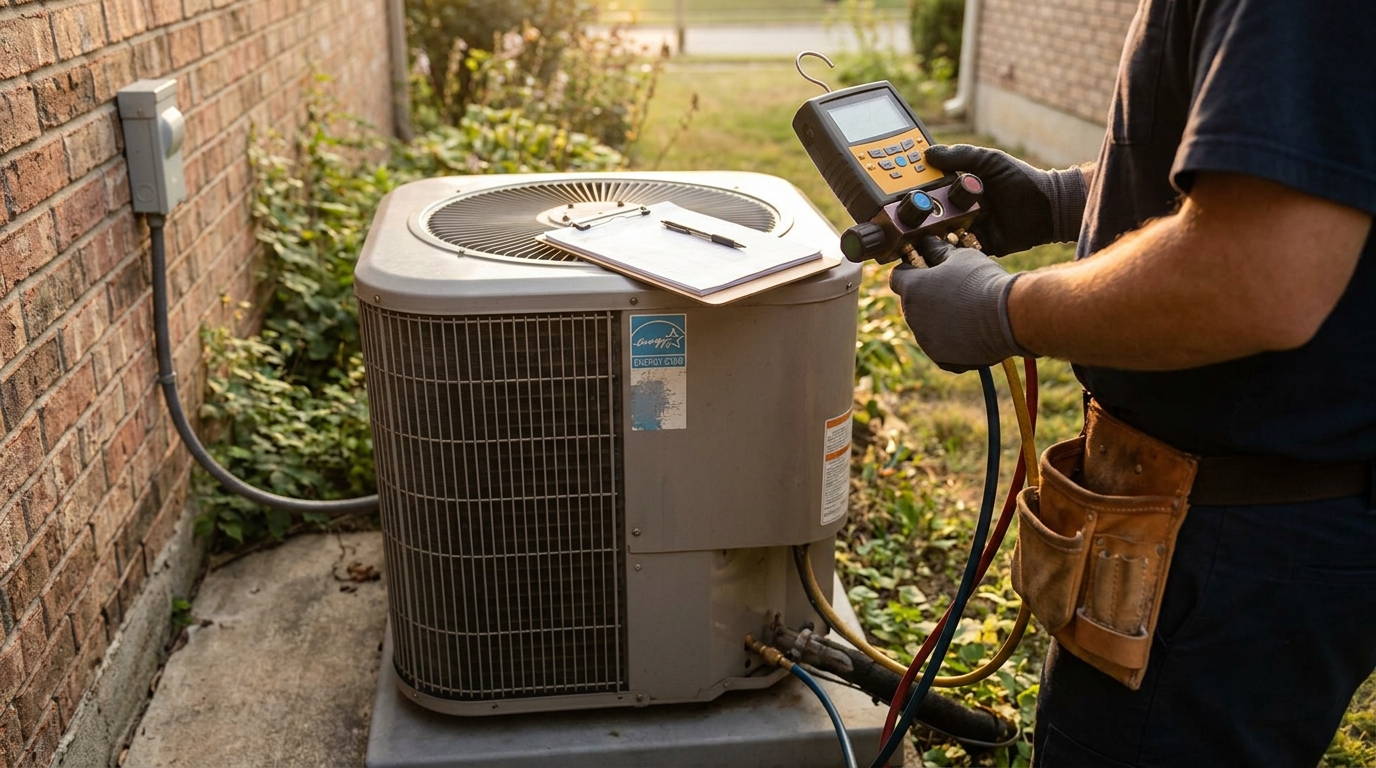
If a contractor tells you to sign before September 1 because the blue Energy Star label is changing hands, you are being sold a deadline that does not exist. Something real does happen that day, but it is a document, not a handover.
On August 28, 2026, the EPA and the Department of Energy released the final 2026 Energy Star Program Transition Plan. In it, the two agencies commit to finalizing a separate Trademark and Agreement Transfer Plan by September 1, 2026. The plan then says, in plain language, that transfer of control of the trademarks from EPA to DOE will not occur until after that Transfer Plan is finalized, with the transfer date to be specified as part of the plan.
Translation for homeowners: September 1 is a paperwork deadline for two federal agencies. The actual date the label changes owners has not been announced. Nobody outside those agencies knows it, which means nobody quoting your kitchen can tell you what it is.
What actually happened, and when
The ownership shift is not new. EPA and DOE signed a Memorandum of Agreement on March 3, 2026 making DOE the lead federal agency for Energy Star, effective June 1, 2026. The agreement runs ten years. So DOE has already been in the lead seat for roughly three months as you read this. The August 28 transition plan is the operating manual for finishing the move, not the starting gun.
Here is the part that settles most of the anxiety. Energy Star is congressionally authorized under Section 131 of the Energy Policy Act of 2005 (42 U.S.C. 6294a), which established the voluntary labeling program inside both DOE and EPA and told the two agencies to divide the responsibilities between themselves by agreement. The 2026 agreement is a reallocation of duties under a statute that already named both agencies. It is not the creation of a new program and it is not the elimination of an old one. If someone tells you the label is going away, that statute is your answer.
The transition plan sets a completion window of no more than twelve months after the plan was finalized, which puts the outside date at roughly late August 2027.
Why the label on your new equipment still works
Product certification does not run through federal employees. It runs through third-party Certification Bodies that verify a model against the criteria and report certified models into the program. A change in which agency holds the trademark does not reach back and invalidate a certification that a Certification Body already issued.
The paperwork underneath is mostly already in order too. According to the transition plan, most partnership agreements are already held with both EPA and DOE. Only a small percentage are EPA-only and need modification. That is why manufacturers are not pulling labels off boxes: the great majority of them do not need to re-sign anything.
Scale is the other reason a quiet transition is the likely outcome. The plan counts 1,500 manufacturers, 1,200 retailers, 840 utilities, more than 15,000 active partners, and roughly $100 billion in private markets that depend on Energy Star. Both agencies commit in writing to efficient continuity of operations for the program with minimal disruption to outside stakeholders. That 840 utilities figure is the one to remember, because utilities are where your rebate money actually comes from.
The real risk window is filing, not validity
There is a legitimate thing to plan around, and it is unglamorous: an IT migration.
The transition plan lists the systems moving from EPA hosting to DOE, targeted for completion before July 2027. Among them: the energystar.gov website and its CMS, ES Connect, Portfolio Manager, the Energy Star Help Desk, the Business Intelligence Data Warehouse, and, most relevant to you, the Product Finder, the Qualified Product Exchange, and the Incentive Management Platform.
Those last three are the machinery utilities and rebate administrators query to confirm that the model number on your invoice was in fact certified. The plan also says the migration will be phased, not a single cutover, because there are so many IT components. DOE gets access to systems before hosting moves.
So the practical scenario is not "the label stops counting." It is "you file a rebate claim in month nine and the lookup tool the reviewer uses moved last week." That is a delay problem, and the fix is having your own copy of the proof.
Say this part plainly: the federal tax credit is gone
This is the correction most fall 2026 buyers actually need, and it has nothing to do with the transition.
Under Public Law 119-21, signed July 4, 2025, the Section 25C Energy Efficient Home Improvement Credit is, per IRS guidance, not allowed for any property placed in service after December 31, 2025. Placed in service is the governing date. Signing a contract earlier, or buying the equipment earlier, does not preserve it. Section 25D, the residential clean energy credit, was terminated on the same track.
There is no federal tax credit for a heat pump, furnace, or AC installed this fall. If a quote sheet has a line reading "minus $2,000 federal credit," that quote is citing an expired law, and you should treat everything else on the page with the same suspicion.
What is still live is money from utilities and states. DOE's HOMES and HEAR home energy rebate programs are appropriated-funds programs that survived the tax credit repeal, but rollout is uneven state to state and DOE suspended approvals of state launch requests pending review. Check your state energy office directly rather than trusting a contractor's summary of it.
For utility programs, the Energy Star Rebate Finder is live, ZIP code based, and carries no transition notice. It is the right first stop. Worth noting: it sits inside the same IT portfolio that is migrating, which is one more argument for saving what you find rather than assuming you can look it up again in eight months.
There is no efficiency tier deadline to beat this fall
Buried in the transition plan is a line almost nobody has picked up: EPA has not been engaged in updating specifications since early 2025, and the transition will include documentation of known outstanding issues to be addressed as specifications are reviewed by DOE.
The specification pipeline has been effectively frozen for around eighteen months. Current Energy Star tiers are static. That is the direct factual rebuttal to any "buy now before the requirements change" pitch. The requirements have not been changing, and there is no announced date on which they will.
Your documentation checklist
Do these at install, not at claim time. It takes fifteen minutes and it is the entire defense against a migrating database.
-
Screenshot or PDF the Energy Star product listing for your exact model on the day you buy. Save it with the date visible.
-
Get the AHRI Certified Reference Number and the certificate from your installer before they leave the driveway. AHRI confirms that many rebate programs require an AHRI Certificate of Product Performance and/or a Certified Reference Number, which identifies a specific matched indoor and outdoor combination. Lookups are at ahridirectory.org.
-
Know the five-year limit. AHRI can only provide certification data for equipment currently being manufactured, in the supply chain, or discontinued for less than five years. Past that, you are calling the manufacturer. This is an independent reason to capture the certificate at install, unrelated to any federal transition.
-
Keep the itemized invoice with model and serial numbers for both the indoor and outdoor units, plus the install date.
-
File utility rebate paperwork within 30 to 60 days of install. The old habit of holding everything until tax season made sense when there was a credit to claim on a return. There is not one now, and utility programs run on their own deadlines.
Red flags in a 2026 quote
-
Any federal tax credit amount applied to a 2026 install. The law that authorized it ended for property placed in service after December 31, 2025.
-
Any rebate figure without a named program and a qualifying model number. "Up to $1,500 in rebates available" is marketing, not a rebate.
-
Any claim that the Energy Star label expires, lapses, or ends. It is congressionally authorized and both agencies have committed to continuity.
-
Any "buy before the rules change" urgency. The specification pipeline has been frozen since early 2025.
-
Any use of September 1, 2026 as a customer deadline. It is a deadline for two federal agencies to finish a plan.
What this costs, and why you should not trust a national average
Published 2026 cost guides from Angi, HomeGuide, Fixr, and This Old House cluster heat pump installations at roughly $5,000 to $15,000, with national averages landing somewhere near $8,400 to $10,600. Ducted whole-home systems in those same guides run about $12,000 to $18,000, and ductless mini-splits about $2,000 to $8,000. High-efficiency 96 percent AFUE gas furnaces cluster around $7,500 to $12,000 installed.
Treat those as orientation, not as a target. They are aggregator figures drawn from mixed national samples, and regional spread is wide. Labor in a dense metro, permit and inspection requirements, electrical panel capacity, and whether your ductwork needs work can move a heat pump project by five figures. Three itemized local quotes will tell you more about your actual price than any national average will.
The honest close
The program is authorized, operating, and staffed enough to keep certifying products through third parties. It is also fair to say the outlook is not uniformly settled. The U.S. Green Building Council's Ben Evans said the move raises many questions about how the program will be funded and staffed, and poses risks of disruption, and more than 1,000 organizations including Ford, Samsung, and LG previously opposed privatizing the program. The transition plan itself says EPA will send unspent FY26 appropriations to DOE and acknowledges that the long-term success of the program depends on adequate funding.
None of that is a reason to rush an HVAC purchase. All of it is a reason to keep your own records. The label is not at risk this fall. The systems that prove your equipment qualified are moving while you are filing, and the homeowner with a saved PDF and an AHRI certificate in a folder is the one who does not care.
Worth a phone call
Before you file anything, ask your utility three questions: what documentation the rebate application requires, how many days after installation you have to submit, and whether they anticipate any verification changes during the federal system migration. Then check your state energy office for HOMES and HEAR status, which varies sharply by state. Ten minutes on the phone beats a rejected claim.
Related reading
-
Your Water Utility's Letter Probably Says 'Unknown.' That One Word Decides Who Pays.
-
Oil at $5.70 a Gallon Changes the Heat Pump Math in the Northeast
Sources
-
2026 Energy Star Program Transition Plan, finalized August 28, 2026 (EPA and DOE)
-
2026 Memorandum of Agreement on the Energy Star Program Between EPA and DOE, signed March 3, 2026
-
IRS FAQs on modification of sections 25C, 25D and others under Public Law 119-21
-
Energy Star Rebate Finder
-
AHRI: Information for Rebate Applications
-
AHRI Directory of Certified Product Performance
-
HPAC Engineering: EPA Transfers Energy Star Program to Energy Dept.
Note: This article contains AI-assisted content and has been reviewed by our editorial team.
ABOUT THIS SERVICE: CallTheLocal.com is a directory and lead generation service, not a contractor or service provider. Submitting this form does not obligate you to hire anyone or purchase any service. Your information will be shared with licensed, insured home service professionals in your area who may provide quotes for your project. CallTheLocal.com does not guarantee the quality, timeliness, or outcome of any work performed by service providers you connect with through this service. Always verify licensing, insurance, and references before hiring. Get everything in writing before work begins.
Related reading
- On September 1 Your New Air Conditioner Needs a GFCI Breaker, and the Industry Says It Will Trip on Hot Days
- The Grid Browned Out Before Your AC Died: What Record Summer Demand Actually Does to a Compressor, and the $300 Part That Prevents It
- The Rebate That Replaced Your Lost Heat Pump Credit Now Refuses to Pay for a Heat Pump If You're Switching Off Gas
- Congress Is Rewriting the Furnace Rule Right Now, and Some Quotes Are Still Selling You a 2028 Deadline