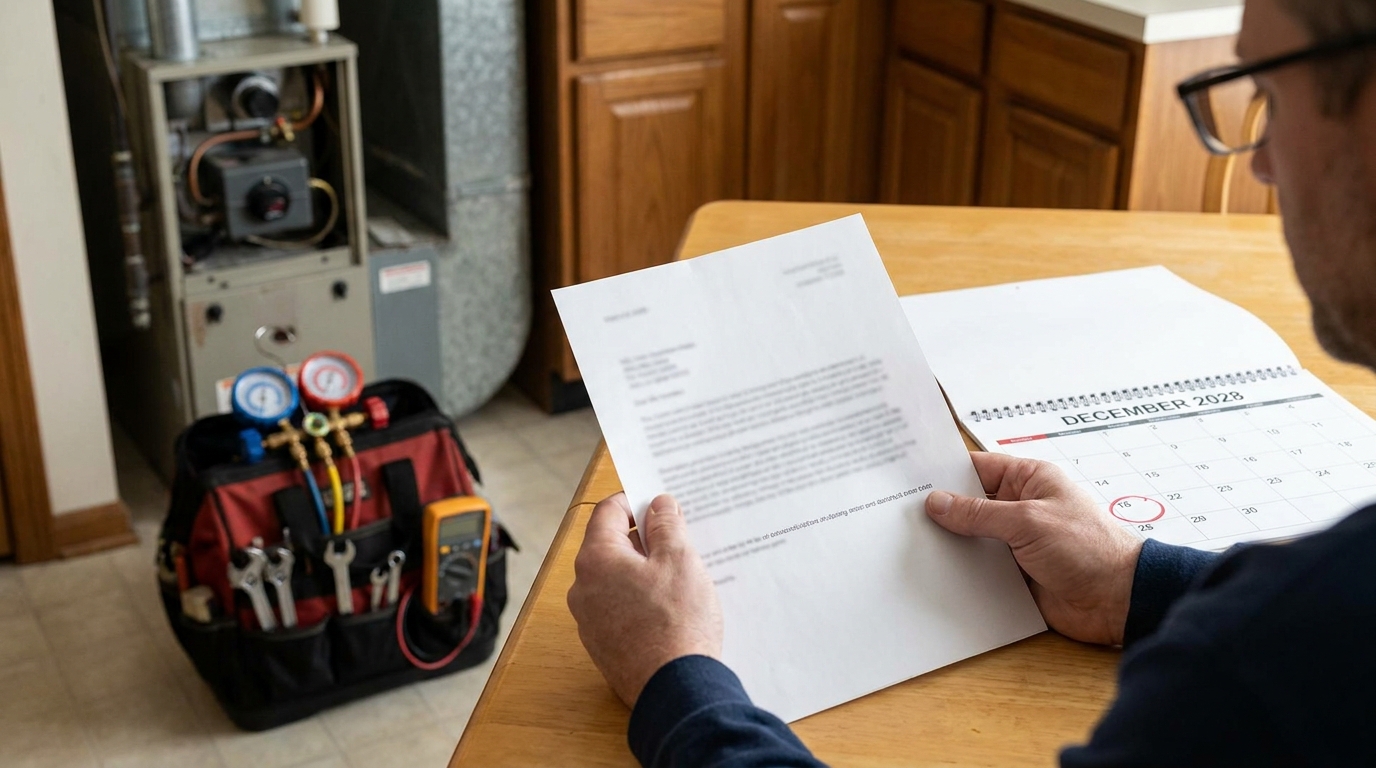
Here is a sentence showing up on furnace quotes this fall: "Federal ban hits in 2028, so prices go up next year. Lock in now."
It sounds urgent. It is also doing a lot of work that the underlying rule does not support. There is a real federal furnace efficiency standard on the books, it is real that it has a December 18, 2028 date attached, and it is real that the heating industry has been fighting it for two years. But three separate things happened in 2026 that make "the 2028 deadline" a shaky basis for a fall purchase, and none of them show up in the sales pitch.
Here is what the rule actually does, what changed this year, and what it means for the quote sitting on your kitchen table.
What the rule actually says
The current federal minimum efficiency for a standard residential gas furnace is 80% AFUE. AFUE stands for Annual Fuel Utilization Efficiency, and it is simply the share of fuel that becomes heat in your house. An 80% furnace sends roughly 20 cents of every fuel dollar up the flue.
In 2023, the Department of Energy finalized a rule raising that minimum to 95% AFUE for furnaces manufactured on or after December 18, 2028. It was the first update to the furnace standard since 2007, and it applies nationally to non-weatherized gas furnaces and mobile home gas furnaces. DOE projects it saves consumers $1.5 billion a year, $24.8 billion over 30 years, and cuts 332 million metric tons of carbon dioxide (DOE announcement).
Now the part the sales pitch leaves out. The standard governs what manufacturers may build. It is keyed to the furnace's date of manufacture. It is not a mandate on homeowners.
Two things follow from that, and they are the most important paragraphs in this article:
-
Nobody has to replace a working furnace. There is no provision anywhere in this rule requiring you to remove an 80% AFUE unit, in 2028 or ever.
-
80% AFUE furnaces are legal to buy and install today, in every state. The standard does not take effect until late 2028, and even then it governs new production. The trade press (see ACCA's reporting) has consistently read the rule as carrying no sell-through or installation deadline, meaning units built before the date remain installable after it. That reading comes from contractor-facing sources rather than DOE rule text, so treat it as the industry's working assumption rather than a guarantee, but the direction is clear.
Clearing up the "northern states" confusion
Some homeowners half-remember a rule about 90% furnaces in cold states. That memory is real, and it is not what is happening now.
In June 2011, DOE issued a direct final rule that set an 80% national standard plus a 90% AFUE regional standard for roughly 30 northern states. The American Public Gas Association sued in December 2011. The court approved a settlement vacating the regional piece on April 24, 2014. That northern 90% standard never took effect (Congressional Research Service, Report R43815).
What is in front of the courts today is different: a single national 95% standard from 2023. If a contractor tells you your state has its own furnace efficiency mandate, ask them to show you which one. See the code section below for what actually does vary locally.
What happened in 2026, in order
Four developments this year, each of which matters and none of which has actually changed the rule yet.
February 19, 2026: the industry asked for a delay. DOE received a petition from the American Gas Association, the American Public Gas Association, and the National Propane Gas Association asking it to push compliance dates for commercial water heating equipment (currently October 6, 2026) and consumer furnaces (currently December 18, 2028) to January 1, 2030 "at a minimum."
April 27, 2026: DOE opened that petition for public comment under docket EERE-2026-BT-STD-0001, with a 30-day comment window (DOE notification of petition for rulemaking). Asking for comment is not the same as agreeing. As of publication, DOE has not ruled on the petition.
June 8, 2026: the Supreme Court reopened the case. In American Gas Association v. DOE, No. 25-879, the Court granted, vacated, and remanded, sending the D.C. Circuit's November 2025 decision (a 2 to 1 ruling that upheld the standards) back for reconsideration in light of the Solicitor General's position. The government's own lawyer had told the Court the Biden-era rules were "factually and legally flawed" (Utility Dive). The legal question is EPCA's anti-backsliding provision: whether a non-condensing gas furnace is a distinct "performance characteristic" that DOE is not allowed to eliminate. After Loper Bright, DOE gets no judicial deference on that reading (Holland & Knight).
Critically: the standards remain in effect on remand, and no deadline was set for the D.C. Circuit's new decision.
Early July 2026: DOE proposed rewriting its own rulemaking process. A proposed Process Rule would add a "significant energy savings" definition and economic thresholds that must be cleared before a standard can be set. DOE framed it as an effort to "permanently end" home appliance mandates (Utility Dive). Note that the Senate committee release dates the proposal July 7, 2026 and Utility Dive reported it July 2, 2026, so pin the exact day before quoting it.
August 6, 2026: Sen. Mike Lee introduced S. 5338, the Energy Efficiency Reform Act of 2026 (Senate Energy and Natural Resources Committee). It would bar DOE from setting standards that are not technologically feasible and economically justified, require a final Process Rule within 270 days after enactment (reverting to the 2020 Process Rule if DOE misses it), eliminate the mandatory six-year lookback, and broaden federal preemption so states cannot restrict covered products by fuel type (bill text).
Say each of these plainly, because the sales version blurs them:
-
A petition to delay is not a delay.
-
A Supreme Court GVR is not a repeal. It reopens the process rather than striking the rule.
-
An introduced bill is not a law. S. 5338 has been introduced and referred to committee. That is all.
-
The 270-day clock in that bill starts at enactment, not at introduction. It has not started.
So what is true today?
The 95% AFUE standard is in effect and the December 18, 2028 date stands. If nothing else happens, that is the date.
The honest read is that the date looks more likely to slip than to hold, given a pending delay petition, a remanded court case, an unsympathetic DOE, and a Senate bill pointed the same direction. But "more likely to slip" is a forecast, not a fact, and it is the opposite of a reason to buy a furnace this month.
Advocates on the other side are not conceding anything. Andrew deLaski of the Appliance Standards Awareness Project said of the remand: "The circuit court already found that the standards are legally sound, and there's no reason that should change now just because the current administration opposes them."
One more number explains why this fight is loud: non-condensing furnaces are roughly 55% of the current U.S. gas furnace market, according to ACCA. Over half the category is at stake, which is why "80% is going away" talk travels so fast.
What a furnace actually costs this fall
Fixr's 2026 furnace guide puts replacement at $2,800 to $7,500 installed, with a national average around $4,800 (Fixr). Eighty percent AFUE units sit at the low end of that band; high-efficiency condensing units sit at the high end. Treat this as an estimator aggregate rather than primary data, and expect your own market to move the numbers.
The part worth understanding is why the high-efficiency number is higher. It is mostly not the equipment. A 95%+ condensing furnace extracts so much heat that the exhaust comes out cool and wet, which means it cannot vent up a hot masonry chimney. Instead it needs:
-
New PVC venting run to a sidewall or roof
-
A condensate drain line, and sometimes a condensate pump
-
Depending on the house, work on the existing chimney or flue
Contractors commonly quote roughly $1,000 to $2,500 for that conversion work on top of the furnace itself. Take that as a typical quoted range rather than a documented figure, because no primary source pins it down. The qualitative point is solidly sourced: ACCA states that retrofitting older homes for condensing furnaces "often requires costly structural modifications and can create real safety concerns."
The difference between a legitimate upcharge and a deadline pitch
This distinction is the whole article in two sentences.
A contractor charging more to run new PVC, install a condensate drain, and deal with your chimney is describing real labor and real materials. Push back on the number if it seems high, but the line item is legitimate.
A contractor charging more because "the ban is coming" is describing a rule that does not affect a 2026 installation and that may not survive 2027 in its current form. That is not a cost. That is a closing technique.
The tax credit that quietly disappeared
Watch for a second urgency claim. The 25C Energy Efficient Home Improvement Credit paid 30% of project cost, up to $600, for an ENERGY STAR certified gas furnace at 97% AFUE or higher. It applied only to products purchased and installed between January 1, 2023 and December 31, 2025 (ENERGY STAR).
It was not extended. There is no federal furnace tax credit for a fall 2026 install. If a quote still shows one, or a salesperson mentions "the $600 credit," the contractor is working off an outdated sheet. Treat that as information about the rest of the estimate, not just that one line.
The shared flue problem nobody warns you about
If you take one technical thing from this piece, take this one, because it is where surprise costs actually come from.
In a lot of older homes, an 80% furnace and a gas water heater share a single masonry chimney. The furnace is the big heat producer in that pair, and its hot exhaust is what keeps the flue warm enough to draft properly.
Convert the furnace to a condensing unit and it goes out through PVC in the sidewall. Now the water heater is venting alone into a chimney sized for two appliances. An oversized, cool flue can fail to draft, which risks condensation inside the masonry and, in the bad case, combustion gases spilling back into the house. This is called orphaning the water heater.
The fix is normal work: relining the chimney to a smaller diameter, or moving the water heater to a power-vented or direct-vent model. It is code-driven, it is safety-driven, and it can add meaningfully to the job.
Two takeaways. First, if you are considering a high-efficiency furnace, ask specifically what happens to your water heater's venting. Second, if a quote includes chimney relining or water heater work, that is not padding. That is a contractor who looked at your actual mechanical room.
Questions to ask, in this order
-
"What is the AFUE of this exact model, and can I see the model number in writing?" Get the number on the quote, not in conversation.
-
"Does my local permit or building code require anything above 80% for this replacement?" Federal law broadly preempts state appliance efficiency standards, and no state was found to impose its own AFUE minimum on residential furnace replacements. Local building and energy codes and permit requirements are the genuine variable. Your permit office answers this, not a salesperson.
-
"What specifically changes in the venting, and what is that line item?" Make them separate equipment cost from installation cost.
-
"What happens to my existing chimney or flue, and is my water heater sharing it?" See above. This is the question that finds hidden cost early instead of mid-job.
-
"Is anything in this price tied to a future federal deadline, and can you show me the rule?" A good contractor will say no. A contractor who cannot produce the rule is quoting you on a story.
When replacing early actually makes sense
It pencils out when: the furnace is already failing, there is a cracked heat exchanger (that is a genuine safety issue and a replacement conversation, not a repair one), a major repair is quoted on a unit past 15 to 18 years, or you are already opening up venting for another project and the incremental cost of doing it right is small.
It does not pencil out when: you have a working 12-year-old 80% furnace and the only reason on the table is December 18, 2028. A furnace bought under deadline pressure in September 2026 is a furnace bought at whatever price the pressure supported.
What would actually change this
If you want to track it yourself, these are the four things to watch. None of them has happened as of publication.
-
DOE granting or denying the AGA/APGA/NPGA petition on docket EERE-2026-BT-STD-0001
-
The D.C. Circuit's decision on remand in American Gas Association v. DOE, No. 25-879 (no timeline set)
-
A new DOE rulemaking to revise or withdraw the 2023 standards
-
Committee action or a floor vote on S. 5338
Bottom line
Buy a furnace based on the condition of the furnace you have and the quality of the installation you are being offered. Not on a deadline that regulates factories rather than homeowners, sits two-plus years out, is under active petition at DOE, was sent back to the appeals court by the Supreme Court in June, and is the target of a pending Senate bill.
Get the model number and AFUE in writing. Get venting and chimney work itemized. Call your permit office. And if a quote leans on the federal rule, ask which rule, then mention that the Supreme Court remanded the case on June 8, 2026 and the standards are still being reconsidered. The answer you get will tell you a great deal about who you are dealing with.
Related reading
-
The Energy Star Handover Plan Lands September 1. Your Label Is Not Changing Owners That Day
-
The Solar Company Still Offering You "30% Off" Is Claiming a Credit You Cannot
-
Oil at $5.70 a Gallon Changes the Heat Pump Math in the Northeast
-
Should You Still Replace the Furnace Before a Warm Winter Forecast?
Sources
-
DOE, Energy Conservation Standards for Consumer Furnaces (2023 final rule)
-
Utility Dive, "Supreme Court sends furnace case back to appeals court"
-
Holland & Knight, "U.S. Supreme Court Reopens DOE's Rarely Challenged Efficiency Standards"
-
ACCA HVAC Blog, "Years of Advocacy Pay Off: Supreme Court Reopens Furnace Fight"
-
S. 5338, Energy Efficiency Reform Act of 2026, as introduced
-
Utility Dive, "DOE wants to 'permanently end' appliance efficiency requirements"
-
ENERGY STAR, "Federal Tax Credits: Furnaces (Natural Gas, Oil)"
Note: This article contains AI-assisted content and has been reviewed by our editorial team.
ABOUT THIS SERVICE: CallTheLocal.com is a directory and lead generation service, not a contractor or service provider. Submitting this form does not obligate you to hire anyone or purchase any service. Your information will be shared with licensed, insured home service professionals in your area who may provide quotes for your project. CallTheLocal.com does not guarantee the quality, timeliness, or outcome of any work performed by service providers you connect with through this service. Always verify licensing, insurance, and references before hiring. Get everything in writing before work begins.
Related reading
- The Energy Star Handover Plan Lands September 1. Your Label Is Not Changing Owners That Day
- On September 1 Your New Air Conditioner Needs a GFCI Breaker, and the Industry Says It Will Trip on Hot Days
- The Grid Browned Out Before Your AC Died: What Record Summer Demand Actually Does to a Compressor, and the $300 Part That Prevents It