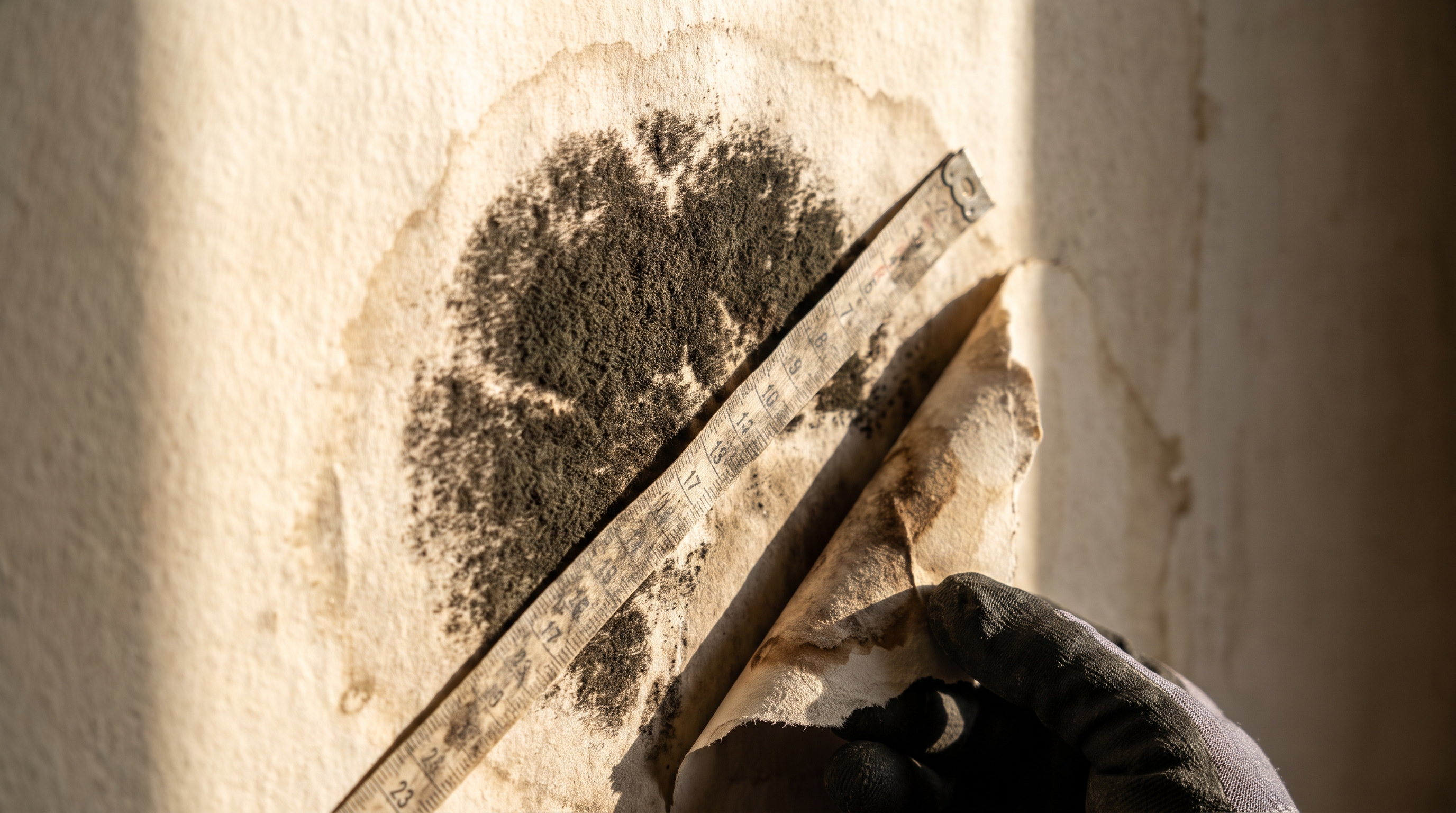
A supply line under the kitchen sink lets go on a Tuesday. You catch it, shut the valve, mop out the cabinet, and forget about it. Two weeks later there is a dark patch on the drywall the size of a dinner plate. Is that a Saturday with a bucket, or a phone call?
The honest answer to DIY mold removal vs professional work starts with size, but it does not end there. The number everybody quotes comes from the EPA, and it is real. It is also only one of four things that have to be true before you pick up a scrub brush.
How much mold can you clean up yourself?
The EPA's guidance is specific: "If the moldy area is less than about 10 square feet (less than roughly a 3 ft. by 3 ft. patch), in most cases, you can handle the job yourself." A dinner plate is nowhere near 10 square feet. A 3 ft by 3 ft patch is about the size of a bath towel laid flat on the wall.
That number is not arbitrary. It comes from the size tiers in the EPA's remediation guide for schools and commercial buildings, which sorts the work three ways: under 10 square feet needs only an N-95 respirator, gloves and goggles with no containment; 10 to 100 square feet calls for limited containment and professional judgment; over 100 contiguous square feet calls for full containment and full personal protective equipment.
Is the 10 square foot rule a law?
No. The EPA number is guidance, not a regulation, and there are no federal mold standards behind it. Where square footage does become law is at the state level, and the states do not agree with each other or with the EPA. More on that below, because it is the part most homeowners skip.
The four tests a patch has to pass
Run this in five minutes before you decide anything. Fail any one of the four and the job moves out of DIY territory, no matter how small the patch looks.
-
Size. Under about 10 square feet of visible growth, per the EPA.
-
Material. The surface is hard and non-porous, or it is porous and cheap enough to cut out and replace.
-
Water. The water that caused it was clean, and it was clean recently.
-
Health. Nobody in the house has asthma, allergies, COPD, another lung condition, or a suppressed immune system.
The CDC is blunt on that last one: people with allergies, immune suppression, underlying lung disease, asthma or COPD should not take part in the cleanup, and should not even be in the home while it is being cleaned. If that describes someone who lives there, the square footage stops being the deciding factor.
Why porous materials break the rule even at 2 square feet
Mold does not sit on top of drywall paper, carpet, ceiling tile or fiberglass insulation. It grows into them. The EPA says ceiling tiles and carpet may simply have to be thrown away, because the growth is difficult or impossible to remove completely. Scrubbing a porous surface gets you a lighter stain and the same problem.
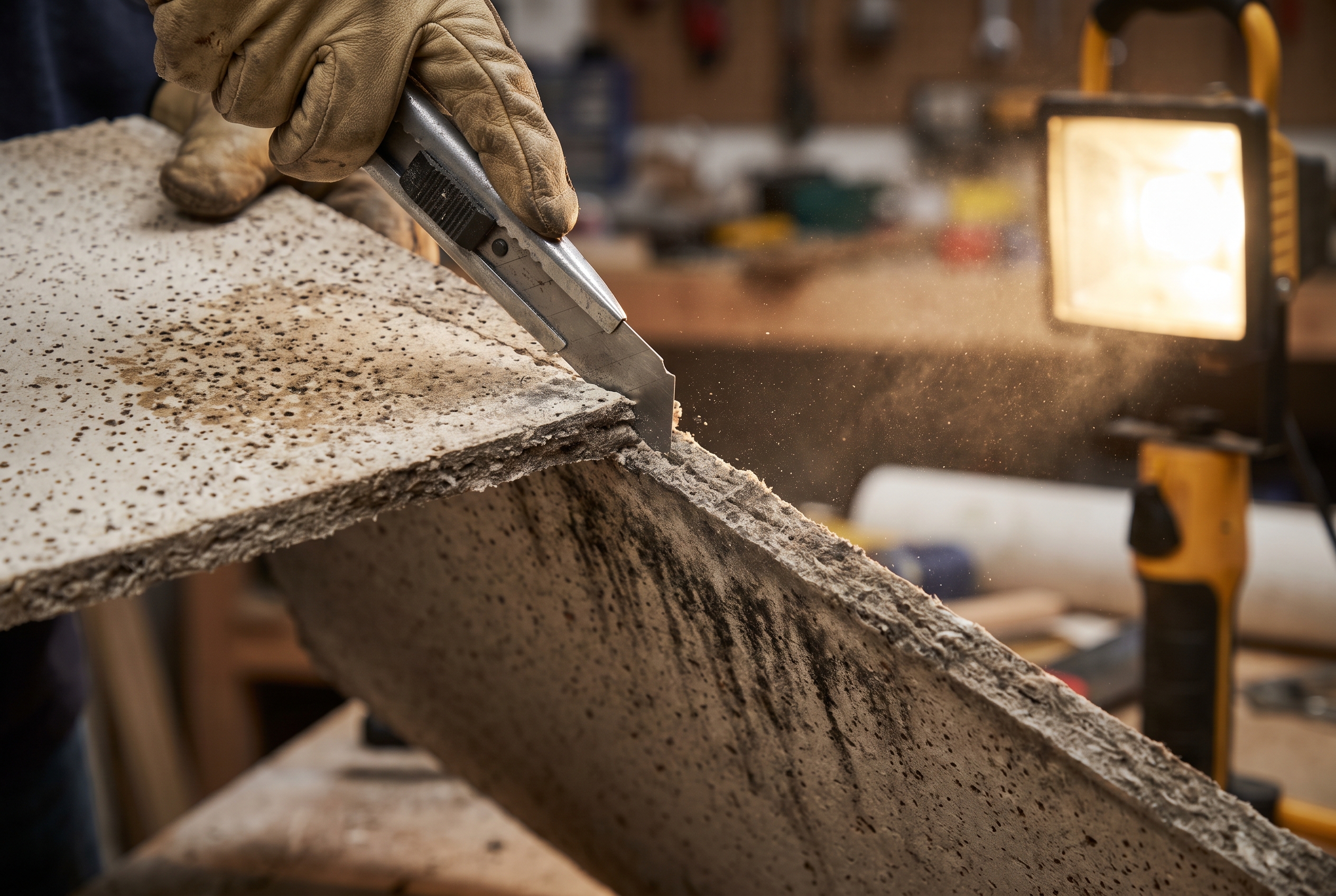
Scrubbing is for hard surfaces: tile, glass, sealed concrete, painted metal, finished wood trim. Those get detergent and water, then a thorough dry. Porous materials get cut out and replaced, which is a demolition job with a dust and containment problem attached. A two square foot patch of moldy carpet pad is a removal job. A two square foot patch on a tiled shower wall is a Saturday.
Does the age of the leak change the answer?
It changes it more than the size does. The EPA's brief guide to mold and moisture says that if wet materials are dried within 24 to 48 hours after a leak or spill, in most cases mold will not grow. The Insurance Information Institute gives homeowners the same window for soaked carpet, padding and upholstery: dry it or remove it inside 24 to 48 hours.
Past that window, the water itself changes. Under the IICRC S500 standard, which is what reputable restoration firms work to, clean Category 1 water can deteriorate into Category 2 or Category 3 depending on time and temperature. A clean supply line leak you found two weeks later is not a clean water job anymore. That is why the dinner plate patch in the opening scenario deserves a closer look than its size suggests.
When sewage is involved, size stops mattering
Category 3 water under the S500 is grossly contaminated and can carry pathogenic, toxigenic or other harmful agents. Sewage and toilet backflows are the textbook examples. The CDC, EPA, FEMA and HUD joint guidance directs that drywall and insulation contaminated with sewage or floodwater be removed and discarded, not cleaned.
The price gap makes the point concrete. Homewyse (September 2026) puts basic mold surface cleaning at $2.34 to $2.85 per square foot, explicitly excluding removal or repair of structure and finishes. Sewage cleanup runs $13.92 to $17.18 per square foot over the same period, with a 500 square foot minimum and framing, flooring, drywall and paint all excluded. Those are two different jobs with two different risk profiles, and a homeowner is only equipped for one of them.
One more carve-out worth knowing: if you suspect the HVAC system is contaminated, do not run it. Running it spreads spores through every room in the house. Air duct mold is a hire-it-out job.
What the DIY job looks like when you do qualify
Fix the moisture source first. Everything after this is pointless if the leak is still leaking.
-
Gear: a NIOSH-approved N95 respirator, non-latex gloves (vinyl, nitrile or rubber), and goggles that give complete eye protection with no open vents.
-
Cleaner: detergent and water is the EPA's method for hard surfaces. If you use bleach, the CDC caps it at no more than 1 cup of household laundry bleach per 1 gallon of water.
-
Never: mix bleach with ammonia or any other cleaner. Ventilate the room while you work.
-
Finish: dry the surface completely. Do not paint or caulk over a surface that still has growth on it.
Do you need a licensed mold remediator in your state?
This is where the EPA number stops governing. Three states show how far apart the rules sit.
Texas sets the licensing trigger at 25 contiguous square feet. Under Tex. Occ. Code 1958.102(c), hired mold remediation below that threshold does not require a license, and an owner or managing agent of residential property with fewer than 10 units can do the work unlicensed. Above 25 contiguous square feet, hired work has to run through licensed people. The Texas Department of Licensing and Regulation is where you look up a contractor's license, and a licensed job produces a Certificate of Mold Damage Remediation.
Florida writes the threshold into the definition itself. Florida Statutes 468.8411 defines mold remediation as treatment of mold-contaminated matter of greater than 10 square feet, which is the point where a DBPR-licensed mold remediator is required.
New York goes furthest. Labor Law Article 32 defines regulated mold work as areas greater than ten square feet, and Section 931 requires assessors, remediation contractors and abatement workers to hold separate licenses and display them at the work site. The assessor and the remediator cannot be the same company, and the assessor writes a work plan before the remediator starts. The New York State Department of Labor notes limited exceptions for owners working on their own property.
If you live somewhere else, look up your own state before assuming the EPA figure applies. A 20 square foot patch is a licensed job in Florida and New York and an unlicensed one in Texas.
How much does professional mold remediation cost?
The sanity check is $10 to $30 per square foot nationally. Fixr (updated August 2025) puts the national average at $3,500 with a typical range of $1,500 to $9,000, and breaks it out by room:
-
Bathroom: $500 to $1,500
-
Crawl space: $500 to $2,000
-
Basement: $1,500 to $4,000
-
Attic: $1,500 to $9,000
-
HVAC system: $3,000 to $10,000
Bob Vila (April 2024) lands in similar territory: a $2,254 national average, a $1,125 to $3,439 typical range, $10 to $25 per square foot, $500 to $1,000 for a bathroom, $600 to $2,000 for air ducts, and $10,000 to $30,000 for a whole house.
What the per-square-foot number almost never includes: drywall replacement, insulation, paint, trim, flooring and post-remediation clearance testing. That is why a $2.85 per square foot cleaning quote and a $4,000 basement invoice can both be accurate. Ask which one you are being quoted.
Should you test for mold before cleaning it?
Usually not. The EPA's position is that if visible mold growth is present, sampling is generally unnecessary, because there are no federal standards to compare a result against. Testing earns its keep on the back end, verifying that a remediation worked. Fixr puts a mold inspection at $450 to $800, often waived if the same firm does the remediation.
That waiver is the part to watch. A company that inspects, prices the job, does the job and then certifies its own work has an obvious conflict. New York made that arrangement illegal for regulated projects. Everywhere else it is legal and still a bad idea. Pay a separate assessor for clearance testing on anything larger than a closet.
Does homeowners insurance cover mold removal?
Start from no. The Insurance Information Institute puts it plainly: "Mold, like rot and insect infestation, is a home maintenance issue and these are generally not covered by standard homeowners insurance policies." Mold that is the direct result of a covered peril, a burst pipe being the common example, may be covered, and even then most policies carry a mold sublimit.
Practical order of operations: photograph everything before anyone touches it, then call your carrier before demolition starts. Prevention is the cheaper lever. The III recommends keeping indoor humidity between 30 and 60 percent and drying or removing soaked carpet, padding and upholstery within 24 to 48 hours.
Three questions for any remediation bid
If the patch failed even one of the four tests, get two bids and ask each contractor the same three things.
-
What is the written scope and containment plan? Not a dollar figure on a business card. A document that names the affected square footage, the materials being removed, and how the work area is sealed off.
-
Who does the clearance test? The right answer is somebody who is not you.
-
What is the line item for rebuild? Remediation ends at bare studs. Drywall, insulation, paint and flooring are separate money, and a bid that stays silent on them is not comparable to one that does not.
The EPA also tells homeowners to hire contractors who follow EPA, ACGIH or IICRC guidance, which is a fair thing to ask about on the phone before anyone comes out.
And if the patch passed all four tests, meaning a small patch on a hard surface, clean water, dried fast, and no vulnerable lungs in the house, then buy the respirator instead. That is a $30 decision, not a $3,500 one.
Related reading
-
Should You Buy Impact Windows or Hurricane Shutters This Fall?
-
How to Find a Licensed Roofer on Kauai When the Whole Island Needs One
-
Why Exterior Paint Quotes Swing So Widely From House to House
-
California Moves to Set the First Rules for Smoke Damaged Homes
Sources
-
Mold Remediation in Schools and Commercial Buildings Guide, Chapter 5, US EPA
-
Homeowners and Renters Guide to Mold Cleanup After Disasters, CDC
-
Mold Assessors and Remediators Program, Texas Department of Licensing and Regulation
-
Protecting your home from mold, Insurance Information Institute
State statutes change. Confirm the current text for your state before relying on a licensing threshold.
ABOUT THIS SERVICE: CallTheLocal.com is a directory and lead generation service, not a contractor or service provider. Submitting this form does not obligate you to hire anyone or purchase any service. Your information will be shared with licensed, insured home service professionals in your area who may provide quotes for your project. CallTheLocal.com does not guarantee the quality, timeliness, or outcome of any work performed by service providers you connect with through this service. Always verify licensing, insurance, and references before hiring. Get everything in writing before work begins.
Note: This article contains AI-assisted content and has been reviewed by our editorial team.