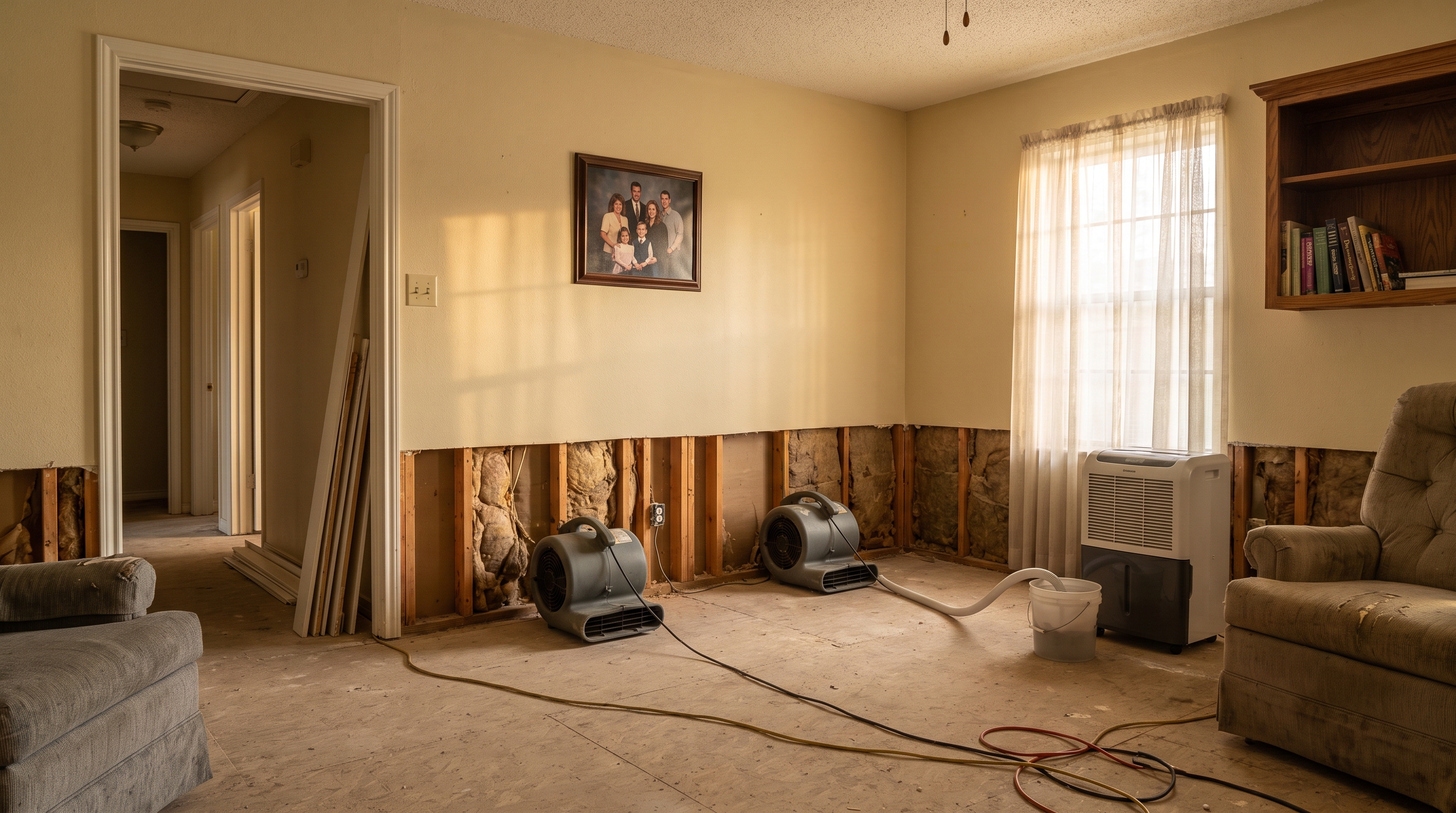
Ask a restoration crew how long to dry flooded house rooms and the honest answer is a range: three to five days for a typical single room loss, and one to two weeks when hardwood, plaster or a concrete slab is soaked. Drying ends at a moisture reading, not on a calendar day.
That distinction matters right now in Southeast Texas. Hardin County took roughly 18 to 20 inches of rain over two days from the remnants of Tropical Storm Edouard on September 2 and 3, against a September average of 5.51 inches, according to AP reporting. The National Hurricane Center's final advisory, issued at 4:00 a.m. CDT on September 3, put totals along the storm path at 5 to 10 inches with maximum amounts up to 22 inches. The National Weather Service declared a flash flood emergency for Kountze, Village Mills and Honey Island around dawn on September 2. Twelve motorists were pulled from flooded roads, two people were rescued from a home, and 21 residents were evacuated from a damaged assisted living facility.
Your drying clock started while that water was still standing. This article covers three things: how many days it actually takes, what those days cost, and which materials are already gone no matter how fast a truck shows up.
What "dry" actually means
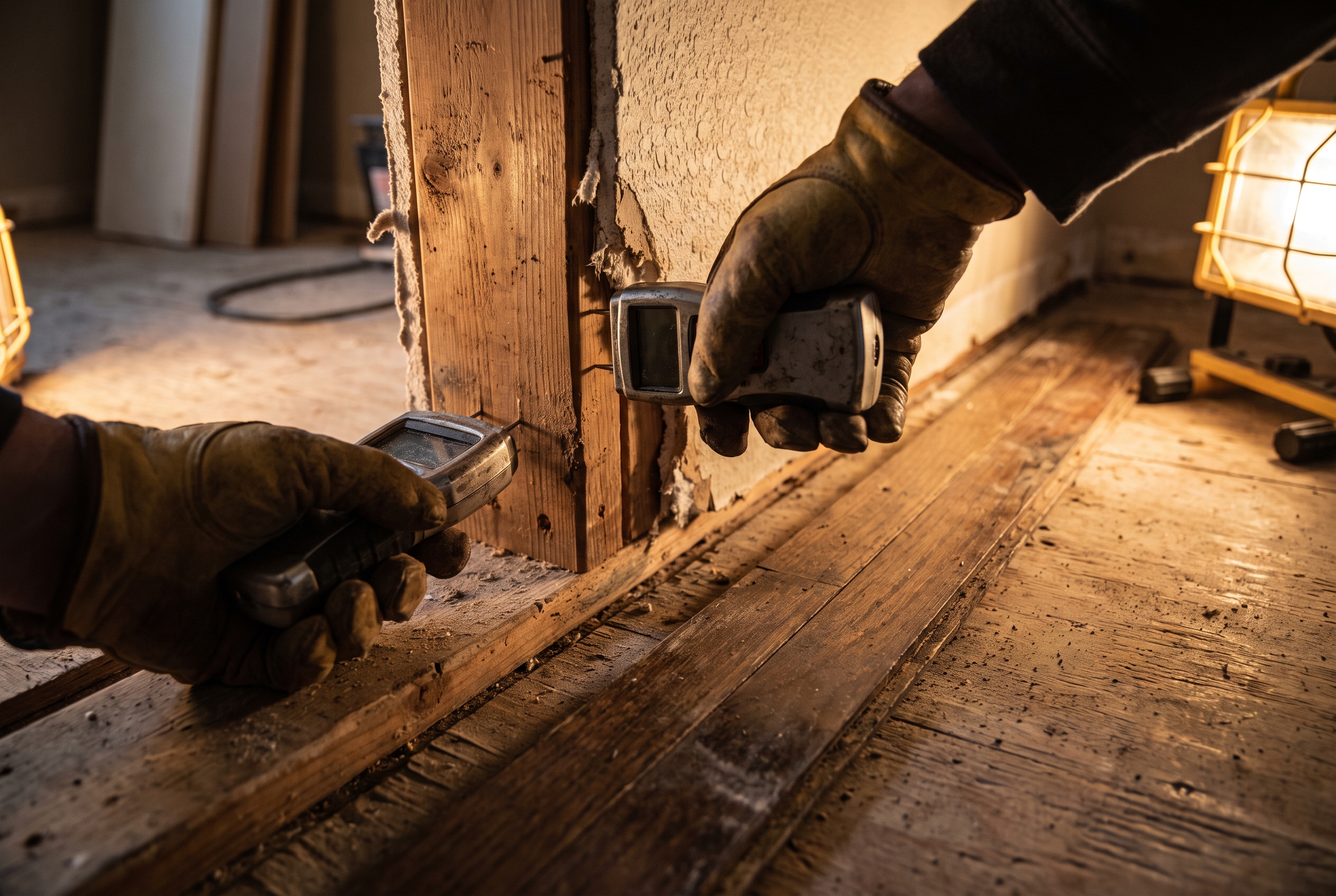
There is no standard anywhere that says a flooded house dries in three to five days. The IICRC S500 standard for professional water damage restoration defines the finish line as a drying goal: affected materials returned to within a few percentage points of the moisture content of unaffected reference materials in the same building. A technician takes readings on a dry closet wall upstairs, then dries your soaked living room wall until the meter matches.
That means the only defensible answer to "are we done" is a number on a meter, backed by daily psychrometric readings (temperature, humidity, grains of moisture) logged on site. A crew that pulls equipment on day four because day four felt right is guessing. Ask on day one for the drying goal in writing and the promise of a daily moisture log. If the answer is vague, that is your first red flag.
The realistic timeline, day by day
Day 0 to 1: extraction and demolition decisions. Standing water comes out first, then the crew decides what is coming out with it. This is the loudest, most disruptive day.
Day 1 to 3: bulk evaporation. Air movers push a boundary layer across wet surfaces while dehumidifiers pull that moisture out of the air. Most of the water leaves your house in this window. Fixr states extraction and drying take at least three days, and Bob Vila cites roughly 72 hours for affected areas to dry after extraction.
Day 3 to 5: the tail. Surfaces read dry, but wall cavities, framing and subfloor are still catching up. Equipment usually stays.
Beyond day 5. Standard drying conditions run 70F to 90F dry bulb at 40 to 60 percent relative humidity, which produces roughly 1 to 2 percent moisture content reduction per day. Hardwood, plaster and concrete give up water slowly, so those assemblies routinely stretch past a week and sometimes to two.
What puts you at three days or twelve
S500 sorts losses into four classes, and the class is the best single predictor of duration. Class 1 is minimal absorption. Class 2 is an entire room of carpet and cushion with wicking under 24 inches up the walls. Class 3 is saturation including overhead. Class 4 involves low porosity materials such as hardwood, plaster and concrete, and the standard explicitly calls for extended drying.
The other variables that move your number:
-
How long the water sat before extraction started
-
Whether the house had power during the first 48 hours (no power means no dehumidification)
-
Outdoor dew point, which in a Gulf Coast September works against you every time a door opens
-
Whether the wet assembly is porous (drywall, carpet cushion, fibrous insulation) or low porosity (oak flooring, plaster, slab)
-
How deep the water climbed, since wicking height sets the demolition line
AI workflows for revenue teams
Placeholder house ad for Conservus.ai. Swap with final creative when brand assets are ready.
Partner with Conservus.aiWhy the equipment count on the bid matters more than the brand
S500 gives crews arithmetic, not intuition. The published rules of thumb put roughly one air mover per 10 to 16 linear feet of wall, plus one more for each small bathroom, closet or inset, angled at the wall at 15 to 45 degrees. Dehumidification for a Class 2 loss is sized by dividing room cubic feet by 50 to get required AHAM pints.
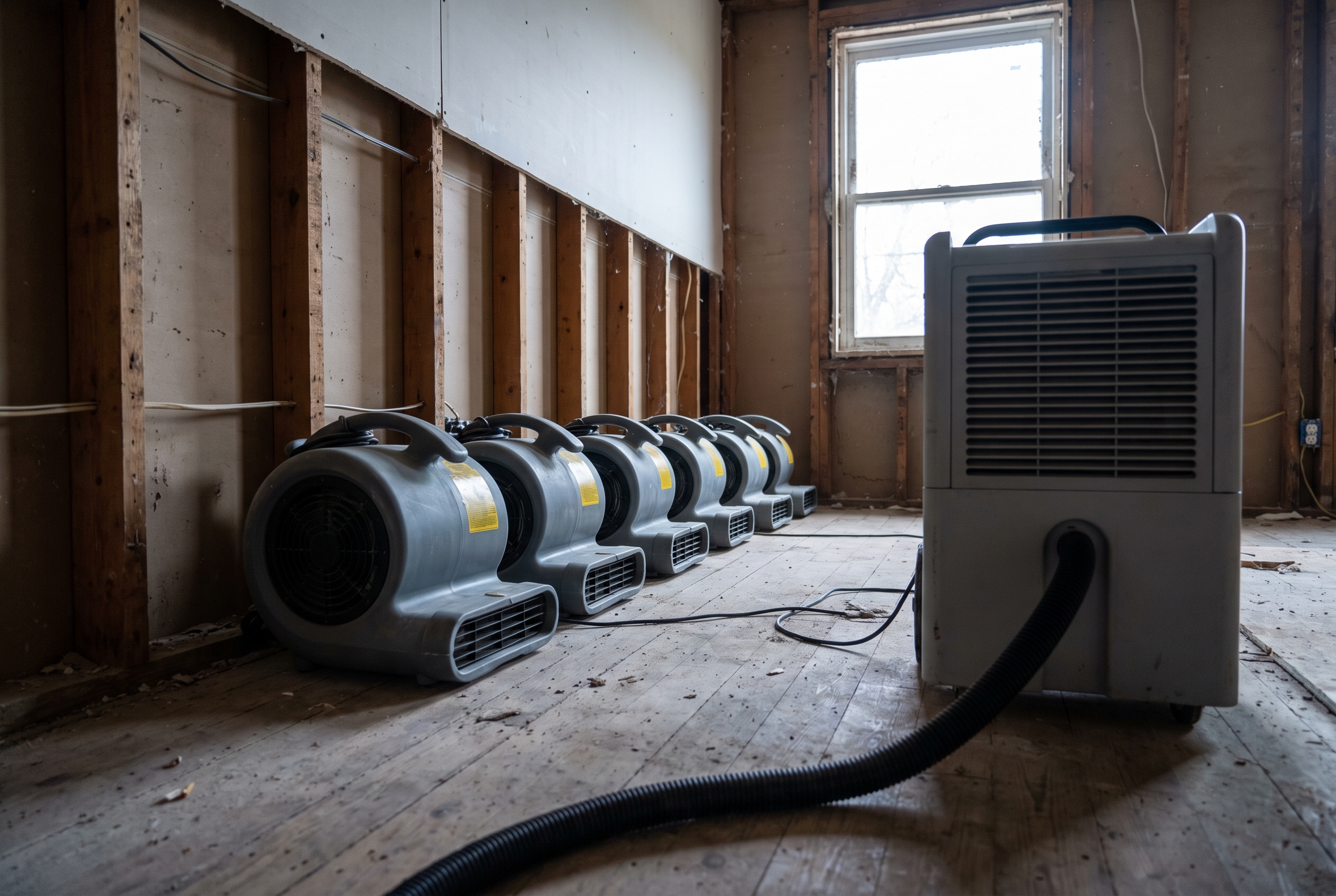
Run it on a real room. A 30 by 50 foot space with 8 foot ceilings is 12,000 cubic feet. Divided by 50, that is 240 pints of dehumidification, which is four 65 pint units or two 140 pint units. One rental dehumidifier from a big box store is not in the same conversation.
So when a bid proposes two machines for an entire flooded first floor, that is not a bargain. It is an underscoped job that will run long, and you will pay for the extra days anyway.
What it costs
National anchors first. Fixr puts the average water damage restoration project around $3,000; Bob Vila puts it at $3,455 with a typical range of $1,305 to $5,707. The extremes run from about $350 for a small clean water job to $50,000 for a catastrophic one. Labor runs $70 to $200 per hour.
Extraction is priced per square foot by water category:
-
Clean water: $3.00 to $4.25 per square foot
-
Gray water: $4.10 to $6.50 per square foot
-
Black water: $7.00 to $7.50 per square foot
Restoration by material: drywall $1.50 to $3.00 per square foot, carpeting $4.75 to $10.50, plaster $6.25 to $18.75, hardwood $10 to $15, mold remediation $4.75 to $5.50.
By class of loss: Class 1 runs $150 to $400, Class 2 runs $500 to $1,000, Class 3 runs $1,000 to $3,000, and Class 4 runs $20,000 to $100,000.
Regional reality. The published figures above are national. There is no reliable city by city survey for storm week pricing, so treat the labor band ($70 to $200 per hour) as the place regional differences show up. In Beaumont and Houston right now, thousands of simultaneous losses mean crews and dehumidifiers are the scarce item, which pushes quotes toward the top of the band and stretches scheduling. In a Midwest metro handling isolated burst pipe calls in winter, the same scope typically sits nearer the middle of the band because equipment is available. In a coastal Florida metro, hurricane season staffing keeps capacity higher year round, but post landfall demand spikes work the same way Texas is seeing this week. Ask any bidder to state their hourly rate and their per unit daily equipment rate, and you can compare apples to apples across three companies in ten minutes.
The line item homeowners misread. Equipment is billed per unit, per day. A six air mover, two dehumidifier job running four days is 24 air mover days plus 8 dehumidifier days, or 32 equipment unit days billed at whatever daily rates the contract states. That is why a single "drying equipment" lump sum is worthless. Make the bid state how many air movers, how many dehumidifiers, the daily rate for each, and the projected number of days. Then ask for the daily moisture log that justifies every extra day beyond the projection.
The 48 hour rule, answered honestly
The EPA says plainly: "If wet or damp materials or areas are dried 24-48 hours after a leak or spill happens, in most cases mold will not grow." The CDC says that if a home was not dried within 24 to 48 hours, assume mold is growing.
That window is a mold growth threshold. It is not a salvage cutoff, and after a storm flood it is largely moot. Street and river floodwater is Category 3, the dirtiest classification, so carpet and carpet padding, saturated fibrous insulation, soaked drywall, ceiling tiles, upholstery and wallpaper come out on contamination grounds even if a crew arrives on hour six. CDC lists exactly those porous items as noncleanable. The 48 hour framing belongs to a burst supply line under your sink, not to what happened in Hardin County.
Expect a flood cut: drywall removed to a line above the visible waterline, insulation pulled from the open cavity, baseboards off, carpet pad discarded. Framing, studs, subfloor, tile, hardwood in some cases, and hard surfaces get cleaned and dried in place rather than demolished. Once demolition is done, EPA advises keeping indoor humidity below 60 percent, ideally 30 to 50 percent, which is precisely what the dehumidifiers are for. Minimum protective equipment for anyone in the space during cleanup is an N-95 respirator, goggles and gloves.
AI workflows for revenue teams
Placeholder house ad for Conservus.ai. Swap with final creative when brand assets are ready.
Partner with Conservus.aiThe insurance trap specific to this storm
The Texas Department of Insurance is blunt about it: a standard homeowners or renters policy does not cover water entering the home from a flood. If you carry a National Flood Insurance Program policy, you must file the claim within 60 days. The NFIP claims line is 877-336-2627 and the TDI help line is 800-252-3439.
Two more things worth knowing. Even without flood coverage, you may need a written denial from your insurer before you can apply for federal disaster assistance, so file and get the denial in writing. And TDI advises photographing damage as soon as it is safe and not throwing away damaged items until an adjuster has seen them.
That last instruction collides head on with the drying imperative. Resolve it this way: photograph and video every room before a single piece of drywall comes off, capture the waterline height against a tape measure, keep a labeled pile or a photo inventory of discarded materials, and ask the restoration company for its own pre demolition documentation. Then let them start. Waiting three days for an adjuster in a mass loss event will cost you more in mold than the photos are worth.
Whom to call and how to check them
In Texas, mold work is licensed. The Texas Department of Licensing and Regulation requires a licensed mold remediator once visible mold covers 25 contiguous square feet or more. Below that threshold, unlicensed cleanup is allowed, including your own.
There is a catch worth understanding before you grab a bucket. Only a licensed remediator can issue a Certificate of Mold Damage Remediation, and that document follows the house at resale. A homeowner who self remediates cannot obtain one for that work. If you plan to sell in the next few years, the certificate is usually worth the licensed crew.
Before you sign anything, verify the mold license through TDLR, ask for proof of general liability and workers compensation coverage, and get the certificate holder's contact so you can confirm the policy is active.
The Texas Attorney General lists the contractor red flags that show up after every declared disaster: low-ball estimates, refusal to leave a contract overnight for your review, emotional pressure, and blanks left in the contract. The office also advises getting multiple estimates, getting everything in writing, verifying disability and workers compensation insurance, never getting too far ahead on payments, and confirming your three business day cancellation right.
One more protection is live right now. Once the governor declares a disaster, charging exorbitant prices for necessities including repair work violates the Texas Deceptive Trade Practices Act. Report price gouging or repair scams to the Attorney General at 1-800-621-0508.
What a fair bid looks like
Hold any proposal against this list:
-
Air mover count and dehumidifier count stated, with the daily rate for each and a projected number of days
-
A written drying goal, referenced to unaffected materials in your house
-
Daily moisture logs promised in writing, delivered to you, not just kept in a file
-
Demolition scope described by material and height (for example, drywall removed to 24 inches, insulation to the same line)
-
Water category stated, which drives the per square foot extraction price
-
Hourly labor rate stated
-
No blank spaces anywhere in the contract
-
No pressure to sign tonight, and a copy you can keep overnight
-
License and insurance documents attached, not promised
AI workflows for revenue teams
Placeholder house ad for Conservus.ai. Swap with final creative when brand assets are ready.
Partner with Conservus.aiWhat to do today
Call two companies today, not next week, because equipment availability in Southeast Texas is the binding constraint this month. Get two written scopes. Then judge them on the equipment count and the moisture log commitment rather than the bottom line, because the cheap bid with two machines is the one that runs twelve days and finds mold in the wall cavity in October.
Related reading
Sources
-
National Hurricane Center, Remnants of Edouard public advisory, September 3, 2026
-
Edouard delivers an outsized flash-flood punch to eastern Texas (Yale Climate Connections)
-
Homeowners and Renters Guide to Mold Cleanup After Disasters (CDC)
-
The IICRC S500 Approach to Determining Initial Equipment Usage (Restoration & Remediation Magazine)
-
S500 Standard for Professional Water Damage Restoration (IICRC)
-
Insurance claim tips for Texas flood victims (Texas Department of Insurance)
-
Mold Remediation FAQ (Texas Department of Licensing and Regulation)
-
Resources for Help in the Aftermath of Disaster (Office of the Texas Attorney General)
Note: This article contains AI-assisted content and has been reviewed by our editorial team.
ABOUT THIS SERVICE: CallTheLocal.com is a directory and lead generation service, not a contractor or service provider. Submitting this form does not obligate you to hire anyone or purchase any service. Your information will be shared with licensed, insured home service professionals in your area who may provide quotes for your project. CallTheLocal.com does not guarantee the quality, timeliness, or outcome of any work performed by service providers you connect with through this service. Always verify licensing, insurance, and references before hiring. Get everything in writing before work begins.