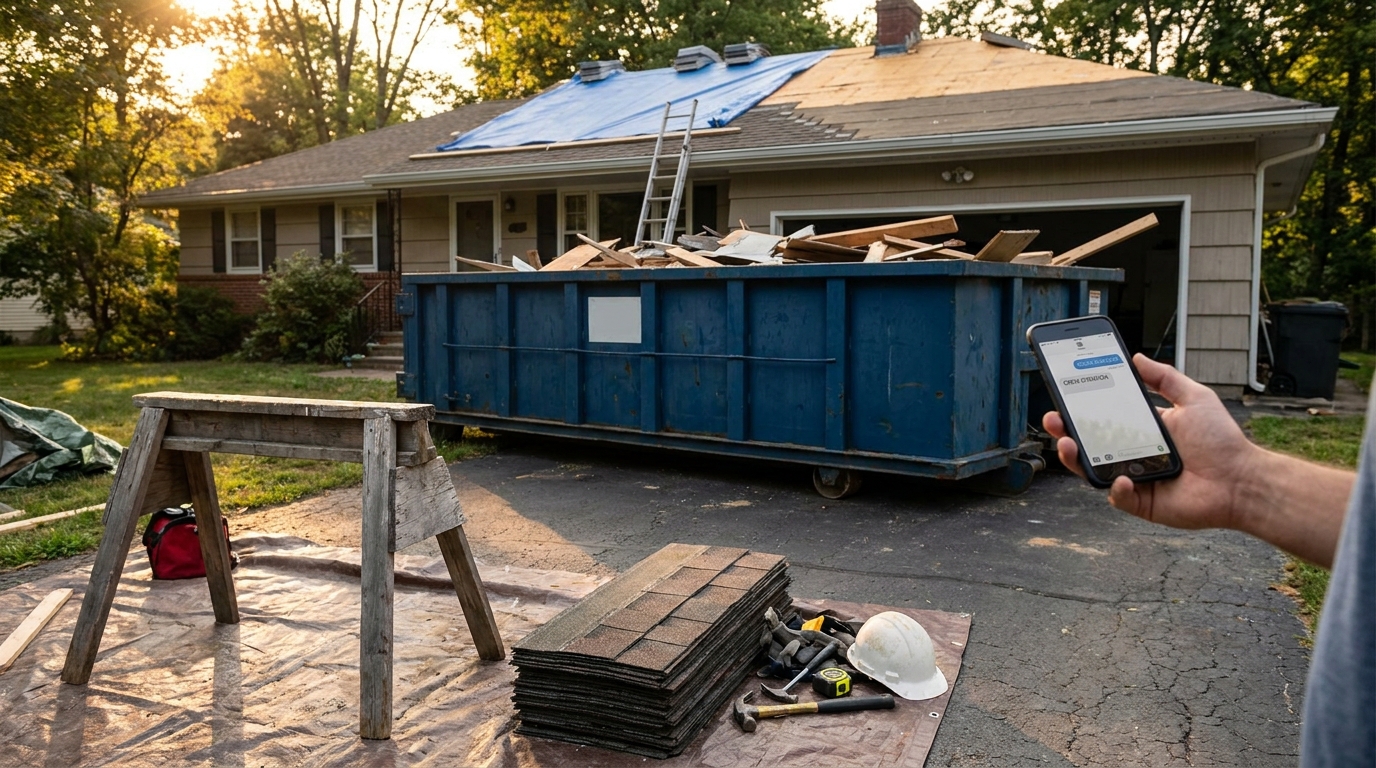
You booked the roofer in April. Confirmed start date, deposit paid, dumpster scheduled. Then comes the text three days before: "Need to push you out about three weeks. Crew situation." No detail, no new date in writing, just a vague apology and a promise to call.
If that has happened to you recently, it probably was not bad luck with one company. It is a measurable, industry wide pattern, and there is enough survey data and peer reviewed research now to explain most of it. There is also a lot of bad information circulating about it, so let's separate what is actually documented from what is not.
Contractors are counting these delays, and they know the cause
In the 2025 Workforce Survey from the Associated General Contractors of America and NCCER, fielded in late summer 2025 across roughly 1,400 firms, 45 percent of respondents said they had experienced project delays caused by shortages of their own workers or their subcontractors' workers. Worker shortages were the single most commonly cited reason for a late project. Separately, 78 percent reported at least one project delayed for any reason at all, which includes materials, permitting, weather, and financing.
Here is the part most coverage leaves out, and it matters if you want an honest read: that 45 percent is down. It was 54 percent in 2024, 61 percent in 2023, and 66 percent in 2022. The labor squeeze on schedules is easing, not accelerating. It is still the top delay cause, but the trend line is going the right direction.
The hiring difficulty behind it is still severe. In that same survey, 92 percent of contractors reported trouble filling open positions, and 57 percent said the candidates who do apply lack essential skills or the right license. Only 10 percent of firms use H-2B or other temporary work visas, so the common assumption that contractors can simply import a legal crew when they are short does not describe how most of this industry actually staffs jobs.
The pool really is thin
Associated Builders and Contractors runs a proprietary model each January estimating how many net new workers the industry needs to attract. For 2026 the figure is 349,000, and for 2027 it is 456,000.
Again, context helps. The same model produced 439,000 for 2025, 501,000 for 2024, and 546,000 for 2023. Demand for new bodies is easing year over year. But 349,000 unfilled positions is still a very large hole, and industry groups attribute most of it to veterans of the trades aging out. You will see a widely repeated claim that more than 40 percent of the construction workforce will retire by 2031. We checked it: NCCER states it as generic "NCCER research" with no named report, author, or date attached, so treat it as an industry estimate about direction rather than a hard number.
The enforcement layer, and the gap that tells the real story
The newest read comes from the 2026 Construction Hiring and Business Outlook from AGC and Sage, fielded November 4 through December 15, 2025, with 951 respondents across 49 states and Washington, D.C. Four numbers from it:
-
33 percent of firms report being affected by immigration enforcement actions in the past six months
-
24 percent report that their subcontractors lost workers
-
11 percent report workers left or failed to appear because of actual or rumored immigration actions
-
6 percent had a jobsite or offsite actually visited by immigration agents
Look at the last two together, because that gap is the whole story. Workers not showing up over an enforcement action, or a rumor of one, is roughly twice as common as an actual visit from agents. The disruption to your project is far more likely to come from a Tuesday morning where four people decided not to drive to the site than from anything that happened on the site itself. That is also why your contractor's explanation is often vague. From their side of it, a crew simply did not arrive, and they may not know why either.
One note on comparing surveys: an older AGC and NCCER survey from summer 2025 produced a similar but lower set of figures (28 percent affected, 5 percent visited, 10 percent workers absent, 20 percent subs losing workers). Those two surveys measure different six month windows with different respondent pools. If you see the higher number from one paired with a number from the other, that combination is not a real finding.
Which trades this actually touches
You will see a lot of inflated shares quoted here, so here is the primary data. NAHB's April 2026 analysis of the 2024 American Community Survey found that immigrants make up 26.3 percent of the total construction workforce, a record high, and roughly one in three workers in the construction trades specifically. Those are two different numbers and they get conflated constantly.
By trade, the highest concentrations are:
-
Drywall and ceiling tile installers: 57 percent
-
Plasterers and stucco masons: 56 percent
-
Roofers: 53 percent
-
Painters: 53 percent
-
Carpet, floor, and tile installers: 51 percent
-
Construction laborers: 43 percent
-
Carpenters: 35 percent
No trade exceeds 60 percent. One important caveat NAHB's own author flags: the American Community Survey does not capture legal status, so these are foreign born shares, not undocumented shares. The two are very different populations.
What this means for you as a homeowner is straightforward. Exterior and finish work carries more schedule exposure than mechanical trades. A roof replacement, a stucco repair, a whole house repaint, or a drywall hang after a water damage job is more likely to slip than a panel upgrade or a water heater swap. Electricians and plumbers are licensed, largely domestically trained, and staffed differently.
Your metro matters far more than the national number
This is the part worth acting on. National averages hide enormous variation. Immigrants are more than 40 percent of the construction workforce in California and Florida, 39 percent in Texas, and 38 percent in Nevada. If you live in one of those states, the trade level percentages above understate your local exposure. If you live somewhere with a much lower share, they overstate it.
Enforcement effects varied just as sharply. In the AGC 2026 Outlook, firms in Alabama and California were the most likely to report subcontractors losing workers, at 49 percent and 40 percent. Firms in Washington, New York, and Nebraska reported little to no direct impact at all. Same country, same six months, completely different experience on the ground.
So when you are estimating how much padding to build into your schedule, judge your own metro. Ask two or three local contractors directly whether they are seeing crew availability problems this season. They will tell you.
Does any of this reach your wallet?
Carefully, yes, but not in the way it is usually presented.
You may run into a specific percentage figure online claiming that a given drop in foreign born construction workers raises construction costs by a precise amount. We tried to trace it. It appears only on content marketing sites attributing it to an unnamed study, and it does not appear in the actual research it is credited to. We are leaving it out rather than repeat it, and you should discount any article that leads with it.
What does hold up is a working paper by Troup Howard, Mengqi Wang, and Dayin Zhang, "How Do Labor Shortages Affect Residential Construction and Housing Affordability?" It uses the staggered 2008 to 2013 rollout of the Secure Communities program as a natural experiment, comparing counties that got the program earlier against those that got it later. Treated counties saw large and persistent reductions in residential construction. Three years after rollout, the median county had forgone close to a full year's worth of construction, and on a quality adjusted basis the average new construction parcel was roughly $50,000 more expensive. Domestic labor did not fully replace the losses, and U.S. born workers in higher skilled construction occupations saw net declines rather than gains.
Read that as a market level, new construction finding. It says enforcement driven labor loss shows up in how much housing gets built and what new housing costs in a county. It does not translate into a percentage markup on your kitchen remodel, and the research does not claim that it does.
The current research on enforcement and labor markets, NBER Working Paper 35129 by Elizabeth Cox and Chloe East, finds that areas with large sudden increases in arrests saw reduced work among likely undocumented immigrants who stayed, and also a decline in the number of U.S. born men at work, which the authors attribute to production complementarities and reduced overall economic activity. Useful context. It contains no construction cost elasticity.
Before you blame labor: it may not be labor
Worth keeping your expectations calibrated. In the AGC 2026 Outlook, 63 percent of firms reported that a project owner postponed, scaled back, or canceled a project in the past six months. The reasons cited most often were funding uncertainty at 37 percent and unavailable or expensive financing at 34 percent, both above labor. Roughly 70 percent of firms reported tariff impacts, and 40 percent had raised bid prices in response.
Translation: your quote may be higher and your start date may be later for reasons that have nothing to do with who is on the crew. Materials pricing, a permit stuck at the county, a previous job that ran long, or a supplier backorder can all show up as "crew situation." Ask which one it is.
What to actually do about it
Book earlier than feels necessary
For exterior and finish work, aim to have a contractor under contract 8 to 12 weeks ahead of when you want work to start, not 3. That applies most to roofing, drywall, plaster and stucco, and painting, and it applies double during peak season and in high concentration metros like California, Florida, Texas, and Nevada. Non urgent interior work has more slack. Emergency work, obviously, is its own category, but even there, having a vetted name already in your phone beats calling cold at 9 p.m.
Ask who is actually doing the work
This is the single highest value question in the whole process, and almost nobody asks it:
-
Does your company carry its own W-2 installers, or do you subcontract the installation?
-
If you subcontract, which company will be on my property, and will you name them?
-
Has that crew worked with you before, and how long?
-
Who is my point of contact if the crew does not show up on day one?
A contractor who will not identify the crew doing your installation is the clearest red flag on this list. Salespeople sell the job, subs do the job, and the gap between those two is where most schedule failures and most quality complaints live.
Put the schedule in the contract, not just in a text
Specifically:
-
Get a start window in writing, for example "work will commence between June 8 and June 15," rather than a single verbal date
-
Add a notification requirement: the contractor must notify you in writing within a set number of days of learning about a delay
-
Add a delay remedy, even a modest one, so a slipped start has a consequence
-
Ask directly what happens to your deposit if the crew never materializes, and get that answer in the contract too
-
Tie payments to completed milestones rather than to dates on a calendar
Red flags
-
A bid dramatically below three others in the same metro. In a market where 92 percent of firms report trouble hiring and 57 percent say applicants lack the right skills or license, an outlier low bid usually means labor is being sourced in a way that will not hold. That is a schedule risk and a quality risk wearing a discount tag.
-
Refusal to name the installing subcontractor. Covered above. Non negotiable.
-
Pressure for a large up front deposit, especially paired with a start date well in the future.
-
Vague delay explanations with no revised written date. "Crew situation" is a reason. "We will restart the week of the 22nd, confirmed in writing" is an answer.
The realistic posture
The labor squeeze is real, it is measurable, and by the contractors' own numbers it is slowly improving. It is also not the only thing pushing your project around, and it is not a reason to panic or to accept an unaccountable schedule.
Book earlier than you think you need to. Find out who is holding the nail gun. Get the start window, the notification requirement, and the delay remedy in writing. And treat a suspiciously cheap bid as a scheduling risk rather than a bargain, because in this market that is usually exactly what it is.
Related reading
-
[The Local Plumber You Just Called May Answer to Wall Street: Inside the Private Equity Buyout of Neighborhood Trades](/guides/local-plumber-private-equity-buyout-neighborhood-trades)
-
DIY EV Charger Installs Are Ending, But Not Everywhere and Not on the Date You Were Told
Sources
-
The 2026 Construction Hiring and Business Outlook, AGC of America and Sage. Survey fielded November 4 to December 15, 2025, 951 respondents across 49 states and D.C.
-
2025 Workforce Survey Analysis, AGC of America and NCCER.
-
New Survey Finds Construction Workforce Shortages Are Leading Cause Of Project Delays As Immigration Enforcement Affects Nearly 1/3 Of Firms, AGC News, August 28, 2025.
-
Which States and Construction Trades Depend the Most on Immigrant Workers?, Natalia Siniavskaia, NAHB Eye On Housing, April 2026, analyzing the 2024 American Community Survey.
-
Report: Construction Needs 349K New Workers in 2026, NCCER, reporting the Associated Builders and Contractors model.
-
Labor Market Impacts of ICE Activity in Trump 2.0, Elizabeth Cox and Chloe N. East, NBER Working Paper 35129, April 2026, revised June 2026.
-
How Do Labor Shortages Affect Residential Construction and Housing Affordability?, Troup Howard, Mengqi Wang, and Dayin Zhang.
-
How Apprenticeships Empower Adult Learners and Bridge the Construction Workforce Gap, NCCER. Cited here only as the traceable origin of the widely repeated 2031 retirement estimate.
Note: This article contains AI-assisted content and has been reviewed by our editorial team.
ABOUT THIS SERVICE: CallTheLocal.com is a directory and lead generation service, not a contractor or service provider. Submitting this form does not obligate you to hire anyone or purchase any service. Your information will be shared with licensed, insured home service professionals in your area who may provide quotes for your project. CallTheLocal.com does not guarantee the quality, timeliness, or outcome of any work performed by service providers you connect with through this service. Always verify licensing, insurance, and references before hiring. Get everything in writing before work begins.