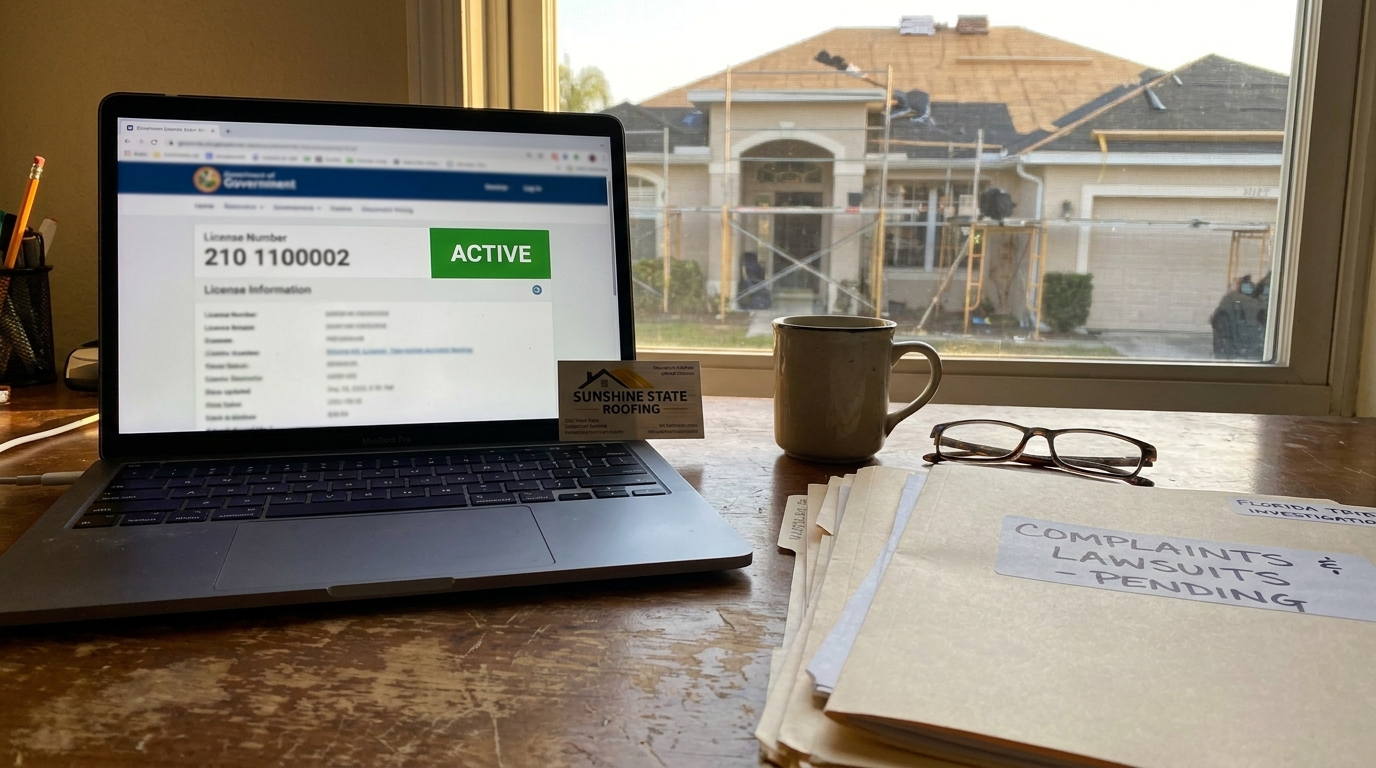
You do everything right. The roofer leaves a business card with a license number on it, you type that number into the state's official lookup at myfloridalicense.com, and the screen comes back Active. No red banner. No warning. So you sign.
Here is the problem, and it is not a small one. An investigation published on Aug. 25 and 26, 2026 by The Florida Trib, a Jacksonville nonprofit newsroom, and carried by public radio stations WGCU and WLRN, found that Florida's Department of Business and Professional Regulation issues and renews contractor licenses without ever reviewing a company's consumer complaint history or civil litigation history. And it rarely takes licenses away afterward. In 2025, DBPR investigated more than 4,800 unlicensed-activity complaints and completed roughly 2,000 enforcement actions. It revoked exactly one company's license for deceptive practices.
So "Active" and "no complaints" are not the same status. They are not even close. Once you understand why, the lookup becomes a useful first step instead of a false finish line, and the rest of your vetting gets a lot more targeted.
What the investigation actually found
Reporter Rhiannon Rashidi built the story around two Jacksonville-area companies whose licenses stayed active while complaints stacked up.
Florida Roof Specialists had 209 complaints logged as of July 17, 2026. In September 2025, the Florida Attorney General sued the company and its owner, Jeremy S. Rogero, under the Florida Deceptive and Unfair Trade Practices Act after roughly 137 consumer complaints. The suit alleges misleading door-to-door solicitation, promises that insurance would cover everything except the deductible, and liens the state called frivolous and baseless. At least 75 homeowners had liens placed on their properties. The company sued more than 250 of its own customers, and in March 2026 the Attorney General went back to court seeking a temporary injunction to stop those suits, as News4Jax and the National Roofing Contractors Association both reported.
The licensing timeline is the part worth sitting with. Rogero was first licensed in 2006 and again in 2014. Then, in 2022, after complaints had already started coming in, he obtained three additional contractor licenses. Their renewals run through 2028. No license was lost.
Lickety Split AC, Plumbing & Electric had 92 complaints under Attorney General investigation. Of its three DBPR licenses, only one, the air conditioning license, displayed any complaint at all on the state's site. It was marked closed with no detail about what happened. The investigation found DBPR posts violations only sporadically.
DBPR declined interview requests, asked for questions in writing, then did not answer them or multiple follow-ups. Its lone statement was that the agency "strives to allocate the use of those resources to maximize the safety, health, and welfare of Floridians." The same year it revoked one license for deceptive practices, it spent $300,000 on a statewide consumer awareness campaign that generated 24 million impressions.
Why the lookup is quiet: two statutes doing the work
This is the part most coverage skips, and it changes what you do about it. The silence on your screen is not a database glitch or a lazy clerk. It is written into Florida law in two places.
First, nobody is required to look. Section 489.115 lists what an applicant must show to get and keep a Florida contractor license. Consumer complaint history is not on the list. Civil litigation history is not on the list. The omission is in the statute itself, not just in how the agency runs its office, which means a well-staffed and highly motivated DBPR still would not be reviewing this at renewal.
Second, most complaints are legally sealed. Section 455.225(10) says the complaint and all information obtained during the department's investigation "are confidential and exempt from s. 119.07(1) until 10 days after probable cause has been found to exist by the probable cause panel or by the department, or until the regulated professional or subject of the investigation waives his or her privilege of confidentiality, whichever occurs first."
Read that again with a homeowner's eyes. A contractor can be sitting on dozens of open complaints, and the public record is required by law to say nothing. An "Active" result is frequently not the absence of complaints. It is the legally mandated silence about them.
There is an inversion here that is genuinely strange. That confidentiality exemption does not apply to enforcement actions against unlicensed people under s. 455.228. So cases against unlicensed operators are public, while complaints against licensed contractors are sealed. Getting licensed buys a company a layer of confidentiality that the guy working out of an unmarked truck does not get.
What a license number does verify
None of this makes the license worthless. It just makes it a floor rather than a rating. Under s. 489.115, a licensed Florida contractor has:
-
Passed a licensing examination
-
Submitted a credit report from a nationally recognized agency showing financial responsibility
-
Carried workers' compensation coverage, or filed an affidavit promising an exemption within 30 days
-
Carried public liability and property damage insurance
-
Been through a criminal history review
-
Been checked for a license revoked or suspended in another state
Board guidelines also set bonding thresholds running up to $20,000 for Division I contractors and $10,000 for Division II. That is a real screen. It filters out people who cannot pass a test, cannot get insured, and cannot show basic financial responsibility. Treat it as the entry ticket, not the review.
What it does not verify
-
Consumer complaint history, current or past
-
Pending Attorney General action
-
Unpaid civil judgments
-
Liens filed against previous customers
-
Prior business names, dissolved entities, and successor companies
That last one is why searching a company name alone is not enough. The Rogero pattern is the clean illustration: one individual, five licenses across two decades, new licenses added after complaints began. If you had searched only the newest company name in 2023, the record would have looked short and clean. Search the qualifying individual, not just the business on the truck.
How to pull the record that actually exists
The information you want does exist. Florida just does not assemble it for you. Four separate sources, roughly 30 to 60 minutes of work:
-
DBPR verification portal. Free at the license verification search. Open the licensee detail page, not just the status line, and look for any posted discipline. Note that DBPR's own how to verify a license page does not tell you about the confidentiality gap behind your result.
-
County clerk of court records. Search the company name, every prior name and DBA, and the qualifying individual. You are looking for two things: liens filed against homeowners, and lawsuits the contractor filed against its own customers. That second search is the one that would have caught Florida Roof Specialists years early. A company suing 250 of its customers is telling you exactly how it handles disputes.
-
Florida Attorney General. Check consumer complaints and enforcement actions. AG activity is public even when DBPR complaints are sealed.
-
Your local building department. Ask for permit history under every business name and every qualifier. A contractor who pulls few permits relative to the volume of work they advertise is worth a second look.
To file your own complaint or report suspected unlicensed activity, use the DBPR complaint page or app, the unlicensed activity line at 866-532-1440, or the complaint center at 850-487-1395.
The recovery fund, and the one detail that voids your claim
Florida runs a Construction Industries Recovery Fund for homeowners who get burned. It is real money, and the gate is narrow.
Under s. 489.141, you must first exhaust any available bond, surety, guarantee, warranty, letter of credit, or insurance. Then you need a final court judgment, a CILB-ordered restitution award, or a binding arbitration award. Disqualifiers include claims where the contractor did not hold a valid, current license at the time of the contract, claims resting on s. 489.129(1)(g), (j) or (k) or s. 713.35, claims by the licensee's spouse, claims by the contractor on the job, jobs where the licensee owned or controlled the property, and situations where you had a separate business relationship with the licensee.
Read that first disqualifier one more time. If the license was not valid and current on the day you signed, the fund is closed to you. Not the day you got the estimate, not the day the card was printed. That single sentence is the strongest financial argument for verifying licensure on the contract date and saving proof.
Section 489.143 sets the payouts for contracts entered on or after July 1, 2024 (effective Jan. 1, 2025): up to $100,000 per Division I claim and $30,000 per Division II claim, with aggregate caps of $2 million per Division I licensee and $600,000 per Division II licensee. Here is the interesting wrinkle: when the fund pays out on a licensee, that license is automatically suspended as of the payment date without any further administrative action, and cannot be reinstated until the money is repaid in full with interest. In a chapter with very few automatic consequences, a fund payout is one of them.
Money structure: what Florida actually regulates
Let's clear up a common misconception, because getting this wrong costs people real money.
Florida does not cap residential deposits. There is no statutory ceiling on what a contractor may ask for upfront. The 10 percent figure people cite from s. 489.126 is not a limit. It is a trigger. When a contractor takes an initial payment of more than 10 percent of the contract price, two duties switch on: they must apply for the necessary permits within 30 days of that payment, and they must start work within 90 days after all permits are issued.
Failing those duties is not just a contract problem. It is criminal, graded by dollar amount, and the same tiers apply to failure to permit under subsection (2) and failure to perform under subsection (3):
-
Under $1,000: first-degree misdemeanor
-
$1,000 to $19,999: third-degree felony
-
$20,000 to $199,999: second-degree felony
-
$200,000 and up: first-degree felony
And here is your highest-leverage document. The statute presumes there was no "just cause" for the delay if the contractor does not comply within 30 days of a written demand sent by certified mail. A text message does not start that clock. A phone call does not start that clock. Certified mail does. If your job has stalled and the money is gone, send the demand letter by certified mail today and keep the receipt.
Deposit benchmarks (custom, not law)
Since Florida sets no cap, you are negotiating against industry practice rather than a rule. Trade guidance puts typical upfront payment at 10 to 33 percent, and treats anything above 50 percent as a red flag. In practice:
-
Roofing: commonly 10 to 30 percent down
-
HVAC changeout: often 30 to 50 percent, because the equipment gets ordered and paid for upfront
-
Kitchen remodel: typically no more than 10 percent down
-
Above 50 percent on anything: walk, or get a very specific written explanation
These are benchmarks for a conversation, not rights you can enforce. The protection you can actually build is structural: tie payments to completed milestones (permit pulled, tear-off done, dry-in complete, final inspection passed), never pay in full before the work is finished, and ask directly whether the contractor will accept a milestone schedule. How they answer that question tells you a lot.
Roofing, storm season, and your 10-day out
If you signed a roofing contract after a storm, s. 489.147 gives you protections most homeowners never hear about.
A residential property owner may cancel a roof repair or replacement contract without penalty within 10 days of signing, or by the official start date, whichever comes first, when the contract was signed within 180 days of an event covered by a gubernatorial state of emergency declaration and the property sits inside the declared area. The contractor is required to print that cancellation notice in the contract. If the notice is missing, you may void the contract within 10 days.
The statute also flatly bans offering a rebate, gift, gift card, cash, coupon, or waiver of the insurance deductible in exchange for a roof inspection or for filing a claim. That last item is the exact inducement the Attorney General alleges in the Florida Roof Specialists case: promises that insurance would cover everything but the deductible. If someone at your door offers to eat your deductible, they are describing a prohibited practice out loud.
Unlicensed work after a storm carries a felony
Storm season brings out operators with no license at all. Section 489.127(2) grades this sharply. A first offense of unlicensed contracting is a first-degree misdemeanor. A repeat offense after a prior finding of guilt is a third-degree felony. But a violation committed during a state of emergency declared by executive order of the Governor is a third-degree felony on the very first offense. Penalties fall under ss. 775.082 and 775.083.
That is the strongest deterrent Florida has on the books, and it is a good reason to re-verify licensure on the day you sign during storm season rather than relying on a check you ran in the spring.
Florida's approach is a choice, and you can see the alternative
California just went a different direction. Under SB 779, operative July 1, 2026, the minimum civil penalty for unlicensed contracting under Business & Professions Code s. 7028.7 rose from $200 to $1,500, a 650 percent jump in the floor, with the $15,000 maximum unchanged. Section 7099.2 adds new minimums for licensed-contractor violations: $500 generally, and $1,500 for violations of ss. 7110, 7114, 7118, or 7125.4. The CSLB may adjust those minimums for inflation every five years against the California CPI.
To be clear, those are penalties on contractors, not fees on homeowners. California also caps home improvement down payments at $1,000 or 10 percent of the contract price, whichever is less. On a $50,000 kitchen remodel, that means $1,000 down, not $5,000. Ohio and Nevada use comparable 10 percent or $1,000 ceilings. Florida has no equivalent. That is not an oversight anyone is hiding. It is a policy choice, and it is fair to ask your legislator what Florida's floor should be.
The five-step vetting sequence
Print this. It is the whole article in one place.
-
Verify the license on the DBPR portal on the day you sign. Screenshot the result with the date visible. Your recovery fund eligibility depends on the license being valid and current at the time of contract, and a screenshot is cheap insurance.
-
Search county clerk records under the company name, every prior name and DBA, and the qualifying individual. Look for liens and, critically, lawsuits the contractor has filed against its own customers.
-
Request the certificate of insurance directly from the insurer, not from the contractor. Confirm general liability, property damage, and workers' comp status. A forwarded PDF proves nothing.
-
Require a written, itemized scope with the permit number, then call the building department and confirm the permit was actually pulled. Jacksonville Area Legal Aid has been telling homeowners the same thing: get itemized written estimates and demand that charges be disclosed in advance.
-
Structure payment against completed milestones, keep the deposit inside trade norms, and if the job stalls, send your demand by certified mail to start the s. 489.126 clock.
The honest limit
None of this makes the lookup tell you the truth. The record you are told to trust is scattered across four separate public sources that the state does not connect: DBPR, the county clerk, the Attorney General, and your building department. Until s. 489.115 requires someone to check complaint history at licensure and renewal, or s. 455.225(10) opens up sooner, assembling that record is your job.
An hour of searching before you sign is a genuinely good trade against a lien on your house. Do the hour.
Related reading
-
Your Water Utility's Letter Probably Says 'Unknown.' That One Word Decides Who Pays.
-
[Your Lawn Can Go From Green to Brown in One Night: Fall Armyworms Are Feeding Right Now](/guides/fall-armyworms-lawn-damage-what-to-do-2026)
-
More Than Half the Lower 48 Is in Drought Right Now, and the Clay Under Your Slab Is Shrinking
Sources
-
State-licensed scams: Florida regulators allow contractors accused of deception to keep licenses, Rhiannon Rashidi / The Florida Trib via WLRN, Aug. 26, 2026
-
Same investigation via WGCU, Aug. 25, 2026
-
Fla. Stat. s. 489.115, licensure qualifications and examination
-
Fla. Stat. s. 455.225, disciplinary proceedings and confidentiality
-
Fla. Stat. s. 489.126, moneys received by contractors
-
Fla. Stat. s. 489.127, prohibitions and penalties
-
Fla. Stat. s. 489.147, prohibited property insurance practices
-
Fla. Stat. s. 489.141, recovery fund conditions and eligibility
-
Fla. Stat. s. 489.143, payment from the recovery fund
-
Jacksonville lawyers warn homeowners after state sues roofing company, News4Jax
-
Florida attorney general seeks temporary injunction for homeowners sued by roofing company, NRCA
-
How Much to Pay a Contractor Upfront, Angi (industry guidance, not Florida law)
Note: This article contains AI-assisted content and has been reviewed by our editorial team.
ABOUT THIS SERVICE: CallTheLocal.com is a directory and lead generation service, not a contractor or service provider. Submitting this form does not obligate you to hire anyone or purchase any service. Your information will be shared with licensed, insured home service professionals in your area who may provide quotes for your project. CallTheLocal.com does not guarantee the quality, timeliness, or outcome of any work performed by service providers you connect with through this service. Always verify licensing, insurance, and references before hiring. Get everything in writing before work begins.
Related reading
- The Crew That Didn't Show Up: 349,000 Missing Workers and Why Your Start Date Keeps Sliding
- One in Three Skilled Tradespeople Are Immigrants: How the 2026 Labor Crackdown Is Stretching Your Project Timeline and Quote
- Home Insurance Is Now 9% of the Average Mortgage Payment: The Five Home-Service Upgrades That Actually Lower Your Premium in 2026
- Vetting a Storm Repair Crew Before You Sign