As of Tuesday, September 8, 2026, the Atlantic has produced five named storms and not a single hurricane. For a homeowner pricing out a roof replacement cost 2026 job, that quiet map has a very practical consequence: in the Gulf and the Southeast, the crews that would normally be three states away chasing insurance claims are home, answering the phone, and quoting local tear-offs.
The roster so far is Arthur (June 17 to 18), Bertha (July 19 to 24), Cristobal (August 12 to 13), Dolly (August 27 to 28) and Edouard (August 31 to September 3). Peak winds across all five topped out at 50 mph. Accumulated Cyclone Energy, the standard measure of how much storm the season has actually generated, stood at roughly 4.4 units as of September 2, the lowest reading since 1941.
Why the sky is empty, briefly
A very strong El Nino is shredding storms before they organize. Water temperatures in the El Nino monitoring region are running 2.07C above average, ahead of where they sat at the same point in 2015, 1997, 1991 and 1982. Phil Klotzbach of Colorado State University put it plainly: "We're crushing all sorts of shear records," with a 97 percent probability that activity stays well below average through mid-September.
NOAA cut its outlook on August 6 to 7 to 13 named storms, 2 to 6 hurricanes and 0 to 2 major hurricanes, and raised the odds of a below-normal season from 55 percent to 75 percent. The climatological peak is September 10. In the satellite era, going back to 1966, the latest a season has ever waited for its first hurricane falls between September 2 and September 11 (1967, 1984, 2001, 2002 and 2013 are the comparison years). If nothing spins up by September 10, 2026 ties the record. On September 11 it sets a new one. That can change fast, so check the current map before you draw conclusions from a headline.
The part most coverage gets wrong: hail moves crews, not hurricanes
Storm-chasing roofing outfits do not follow hurricanes as a rule. They follow hail and severe convective storms, which cover far more roofs across far more states. And in 2026 that market is regionally split.
Through the first half of the year the United States logged 3,706 hail reports against a 2005 to 2015 average of 4,652, close to a 50 percent reduction from 2023 to 2025 levels, according to Moody's. Texas hail reports are down roughly 70 percent versus the 2023 to 2025 average, and Colorado has been quiet. With the two usual heavyweights sitting out, Ohio, Illinois, Wisconsin and Michigan contributed proportionally far more to insured losses this year.
So the "the crews left town, call now" framing is genuinely true for Houston, the Gulf Coast, coastal Florida and much of Texas. If you live in Cleveland, Milwaukee or the Chicago suburbs, your local roofing market may not be slow at all, and you should expect normal wait times.
Slack in the schedule is not a discount
This is the part worth reading twice, because it is where homeowners talk themselves into a bad assumption. A quiet storm season does not lower the price of a roof.
Owens Corning, one of the largest shingle manufacturers in North America, reported roughly $1.3 billion in second-quarter roofing sales, up slightly year over year, and told investors that in-year storm demand was "broadly in line with historic averages and slightly behind prior year." It took price increases in April and in June and reported "solid realization" on both. It also guided third-quarter roofing revenue down mid to high single digits year over year, with margin falling to about 30 percent from 34 percent, and noted that volume was pulled forward into the second quarter ahead of the June increase, leaving distributor inventories elevated.
Materials are not cheap either. Asphalt shingle shipments fell 9.9 percent in the first quarter, to 38.1 million squares from 42.3 million a year earlier, while construction input prices rose 4.8 percent year over year in March, the largest annual gain since January 2023. Volume down, prices up. That is the whole picture.
Owens Corning also notes that more than 80 percent of roofing demand is non-discretionary repair and replacement. Roofs fail on their own schedule, storms or no storms. Demand is not collapsing. It is just not spiking.
Say it plainly: you are not going to get a cheaper roof this month. You are going to get a better-run one.
AI workflows for revenue teams
Placeholder house ad for Conservus.ai. Swap with final creative when brand assets are ready.
Partner with Conservus.aiWhat a quiet month actually buys you
-
Someone answers the phone. In a post-storm market you leave voicemails. Right now, in the affected regions, you get a callback the same day.
-
A real appointment window instead of a tarp, a clipboard and a signature at 7pm.
-
A salesperson who walks the roof. Storm-season bids get written from the driveway with binoculars. A calm-season estimator has time to get on the deck, photograph the flashing, and check the ventilation.
-
Permit and inspection queues moving at normal speed. After a regional event, the municipal building department is the bottleneck, not the crew.
-
Time to compare. Two bids, a week to think, no pressure to decide before the estimator drives to the next street.
How to read two bids line by line
Ask both companies to quote the same scope, and make sure each of these appears as its own line with a number next to it. A rushed post-storm bid tends to bury half of them in an "allowance," which is how a $12,000 job becomes a $16,000 job in week two.
-
Tear-off and disposal. Budget roughly $1.00 to $1.75 per square foot, or about $50 per square including dump fees. Concrete tile or a second existing layer pushes that toward $150 per square. This is the single best line item for comparing two bids, because the work is identical between contractors.
-
Decking replacement. Nobody knows what is under the shingles until the tear-off. You want a per-sheet price in writing, not "as needed."
-
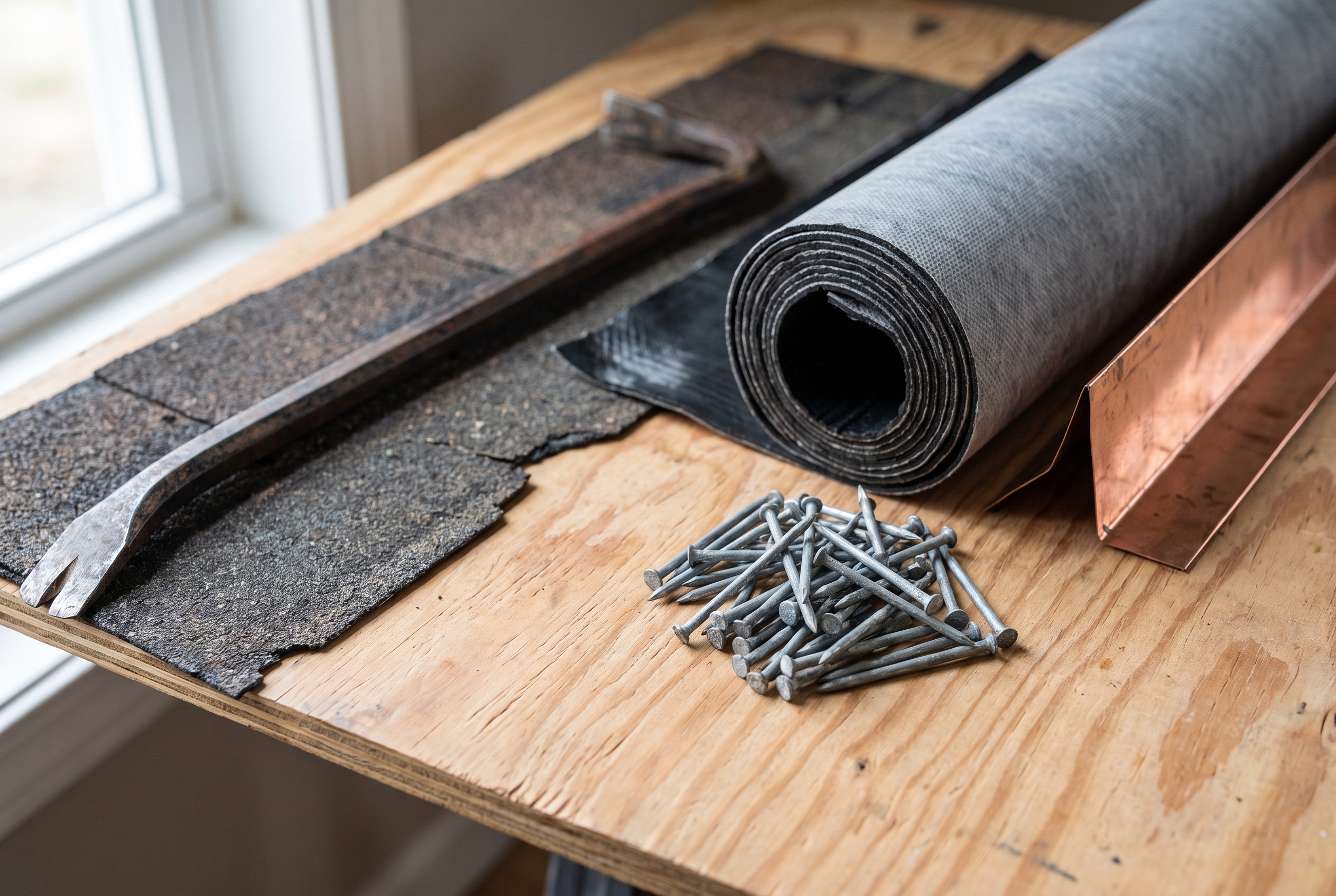
Underlayment type (synthetic versus felt, and what weight).
-
Ice and water shield coverage. Eaves only, or valleys and penetrations too?
-
Drip edge on eaves and rakes.
-
Ventilation. Ridge vent linear footage and net free ventilation area, plus intake at the soffit. Exhaust without intake does nothing.
-
Flashing. Replaced or reused? Chimney, sidewall, step flashing, pipe boots. Reused flashing on a new roof is a leak with a delay timer.
-
Nails per shingle and nailing pattern, which is code-driven in high-wind counties.
-
Permit fee and who pulls it. The contractor should, in their own name.
-
Cleanup, including magnetic sweep, and gutter protection during tear-off.
Regional price check: Houston, Denver, Tampa
These are ranges for a 2,000 square foot home in architectural asphalt, drawn from contractor-published 2026 market guides, so treat them as the shape of the market rather than a quote.
-
Houston: about $7,500 to $14,500, roughly $4.50 to $9.00 per square foot, with the average project landing near $9,752. This is the market where the quiet season is most visible in scheduling.
-
Denver: about $9,000 to $16,000, roughly $4.50 to $8.00 per square foot. Price the Class 4 impact-rated shingle upgrade separately. It costs more up front and may unlock an insurance premium discount, so ask your carrier what the credit is before you decide, not after.
-
Tampa: about $16,500 to $20,500, within a full local range of $13,500 to $30,000. The premium is not gouging. Hillsborough County wind code requires more nailing rows and heavier underlayment, and salt air eats fasteners and flashing, so the spec is simply heavier than in Houston.
If a bid in your market comes in far under the local floor, that is not a bargain, it is a scope difference you have not found yet. Go back to the line items.
AI workflows for revenue teams
Placeholder house ad for Conservus.ai. Swap with final creative when brand assets are ready.
Partner with Conservus.aiVetting, which is what the calm really pays for
Four checks, none of which require any technical knowledge:
-
Verify the license or registration through the state board yourself. Not the number on the truck, the record on the state site.
-
Get the certificate of insurance sent directly from the carrier or agent, addressed to you. A PDF forwarded by the salesperson proves nothing.
-
Check the down payment against your state's cap. California is the clearest example: Business and Professions Code 7159.5 says the down payment on a home improvement contract "shall not exceed one thousand dollars ($1,000) or 10 percent of the contract amount, whichever amount is less," and later payments cannot exceed the value of work performed or materials delivered. A California roofer asking for 30 or 50 percent up front is out of compliance, full stop.
-
Confirm who is actually on your roof. Ask whether the crew is employed by the company you signed with or brokered out to a labor subcontractor, and get the answer in the contract.
The Texas Department of Insurance adds the basics that apply everywhere: get written estimates on company letterhead, get multiple bids so unrealistic pricing stands out, be wary of door-to-door solicitors and of contractors who can only supply out-of-town references, never pay in full up front, withhold final payment until the job is complete, and never sign a blank contract.
The one red flag that needs no expertise
If a roofer offers to waive, absorb, rebate or "eat" your insurance deductible, walk away. It is not a favor and it is not a gray area.
In Texas, HB 2102 (effective September 1, 2019) makes it a criminal offense for a contractor to pay, waive, rebate or absorb a homeowner's deductible, or even to advertise doing so, punishable by up to $2,000 and six months in jail. In Colorado, SB 38 makes it a class 2 misdemeanor. Oklahoma has a comparable ban. Both the contractor and the homeowner can face exposure.
Beyond the legal problem, it tells you something about the bid. The money has to come from somewhere, which means the estimate submitted to your insurer is padded, the materials will be thinner than specified, or both. Texas homeowners can report a deductible-waiver offer to the Attorney General consumer hotline at 800-621-0508.
Two clocks that matter more than the hurricane calendar
Insurance notice deadlines. If you have unrepaired damage from an earlier season, the filing window is finite. Florida is the sharpest example: under Statute 627.70132, notice of a new or reopened property claim must be given within one year of the date of loss, and a supplemental claim within 18 months. For hurricanes, tornadoes, windstorms and severe rain, the date of loss is set by NOAA verification, not by when you noticed the stain on the ceiling. Florida readers carrying damage from the 2025 season may be close to or past that window. Check the date before you spend another month getting bids.
The sealing window. Asphalt shingles have thermally activated sealant strips that need warmth and direct sun to bond, generally around 40F per manufacturer instructions, with 40F to 85F as the comfortable working range. The Asphalt Roofing Manufacturers Association directs installers to follow each manufacturer's cold-weather guidance, hand-seal with approved asphalt roofing cement, and store bundles indoors when it is cold. In Chicago, Denver, Milwaukee or Boston, booking in September or October is the difference between a roof that seals itself this year and one that gets hand-sealed tab by tab in the cold. That is the real deadline in northern markets.
AI workflows for revenue teams
Placeholder house ad for Conservus.ai. Swap with final creative when brand assets are ready.
Partner with Conservus.aiWhat to do this week
If you have been putting off a tear-off, this is a good month to move in the Gulf, the Southeast and Texas. Call two local companies with a physical address in your county, ask for itemized bids on identical scope, and give yourself a week to compare them side by side.
Open the call with three questions:
-
What is your state license or registration number, and what is the physical address of your office?
-
Will your bid break out tear-off, decking per sheet, underlayment, flashing and ventilation as separate line items?
-
Are the installers your employees, and can your carrier send me the certificate of insurance directly?
And one line for whoever knocks on your door after the next storm: "Leave a card with your company name, physical address and license number, and I will call you after I get a second bid." Anyone who cannot live with that answer has told you what you needed to know.
Related reading
Sources
-
Atlantic Hurricane Season Remains Most Tranquil Since 1941, Bloomberg via Claims Journal, September 4, 2026
-
2026 Atlantic hurricane season nears historic territory for latest first hurricane, Fox Weather
-
NOAA releases updated 2026 Atlantic hurricane outlook, Fox Weather, August 6, 2026
-
United States severe convective storm losses, first half of 2026, Moody's
-
Owens Corning Q2 2026 Earnings Call Transcript, Motley Fool, August 12, 2026
-
Asphalt Shingle Demand Falls 9.9% in Q1 as Costs Surge, Roofing Contractor (ARMA data)
-
State law cracks down on roof scams, Texas Department of Insurance
-
Waiving Insurance Deductibles is Illegal in Colorado, Colorado Roofing Association
-
Florida Statute 627.70132, Notice of property insurance claim
-
Recommendations for Installation of Asphalt Roofing Shingles in Cold Weather, ARMA
-
[Roof Replacement Cost in Houston, TX: The 2026 Complete Guide](https://www.roofsquad.com/post/roof-replacement-cost-houston-tx), Roof Squad (contractor-published market guide)
-
Roof Replacement Cost in Denver, Colorado 2026, Core Roofing Systems (contractor-published market guide)
-
How Much Does a Roof Replacement Cost in Tampa, FL? 2026 Real Data, JA Edwards of America Roofing (contractor-published market guide)
-
Tear Off and Replace Roof Cost 2026, SquareDash
-
2026 Atlantic hurricane season, Wikipedia (storm roster and dates)
Storm counts and hurricane status in this article are current as of September 8, 2026 and can change quickly during the September peak.
Note: This article contains AI-assisted content and has been reviewed by our editorial team.
ABOUT THIS SERVICE: CallTheLocal.com is a directory and lead generation service, not a contractor or service provider. Submitting this form does not obligate you to hire anyone or purchase any service. Your information will be shared with licensed, insured home service professionals in your area who may provide quotes for your project. CallTheLocal.com does not guarantee the quality, timeliness, or outcome of any work performed by service providers you connect with through this service. Always verify licensing, insurance, and references before hiring. Get everything in writing before work begins.