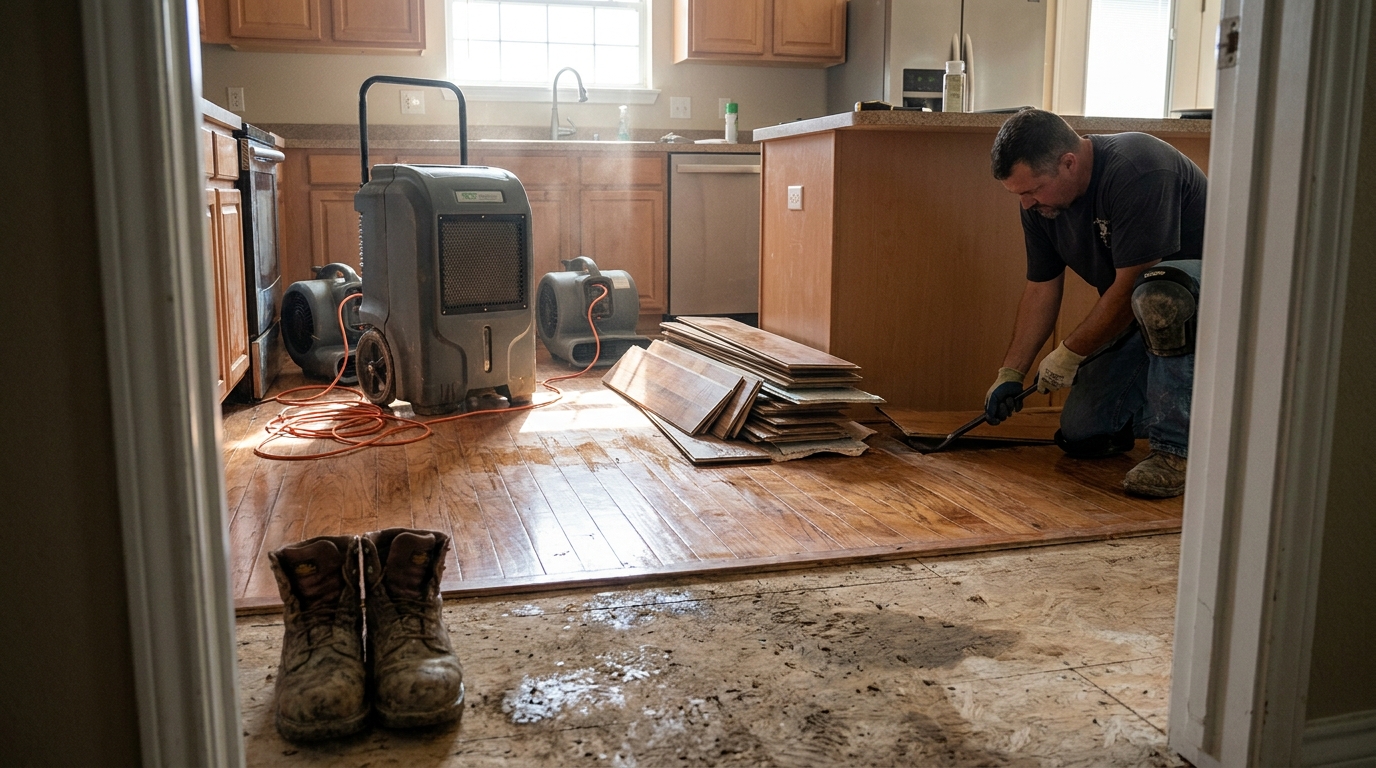
The water is down around Kountze, Honey Island and Beaumont, the fans are running, and the question in most kitchens right now is not whether the floor is ruined. It is which parts are ruined, and what the flooded floor replacement cost comes to once tear-out, disposal and the subfloor are all in the same number. Roughly 15 to 22 inches of rain fell north of Beaumont after Edouard came ashore on Sept. 1, with rain rates of 3 to 4 inches an hour, according to Insurance Journal. If your floor got wet Tuesday, the clock that matters started Tuesday.
How long do you have to dry a floor before mold starts?
Twenty-four to 48 hours. The EPA's guidance is blunt about it: "in most cases, mold will not grow if wet or damp items are dried within 24-48 hours" (EPA Mold Course, Chapter 4). The CDC says the same thing in plainer words, telling people to clean and dry or remove wet items within 24 to 48 hours.
Here is the part people miss. That window opened when the water arrived, not when you got a callback from an adjuster or a restoration company. If it is day five and the carpet pad is still down, the drying decision has largely been made for you. That is not a reason to panic, but it should change how you spend the next phone call: less time price shopping a new floor, more time getting the wet material out and air moving.
Is floodwater different from a burst pipe?
Very. The industry standard restorers work from, IICRC S500, puts "all forms of flooding from seawater; ground surface water and rising water from rivers or streams" in Category 3, the most contaminated tier, described as water that may carry silt, organic matter, pesticides, heavy metals or toxic organic substances (Restoration & Remediation Magazine).
Two houses can have identical-looking wet hardwood and get completely different recommendations, because one took a supply line and one took a bayou over the doorsill. If a contractor is treating bayou water like a dishwasher leak, that is worth a second opinion. Ask any restorer you hire to tell you, in writing, what category they assigned the loss and how that changes what gets removed. Practices for disposing of porous materials in a Category 3 loss vary by firm, so get their specific policy rather than assuming a universal rule.
Which flooring survives a flood?
Short answer: hard, non-porous surfaces set in or on materials that do not swell. Longer answer, in rough order of how well they hold up.
-
Clay tile, stone and brick set in waterproof mortar. The surface is fine. The open question is what is under it, because thinset over a slab can hold moisture long after the tile looks dry. EPA's guidance for hard-surface flooring is to vacuum or damp wipe, dry it, and dry the underlayment if the underlayment is wet.
-
Stained concrete and terrazzo. Both are on the federal list of flood-damage-resistant finishes. Concrete takes a long time to give up moisture, so expect drying and testing rather than replacement.
-
Solid vinyl flooring installed with chemical-set adhesive. Also on the federal list. Note the qualifier: solid vinyl with a chemical-set adhesive, not any vinyl-looking product with any glue.
-
Decay-resistant or pressure-treated wood. Acceptable below the base flood elevation per the same federal reference.
That list comes from FEMA's Technical Bulletin 2, which sorts building materials into five classes, with classes 1 through 3 unacceptable and classes 4 and 5 acceptable below the base flood elevation, as summarized by the Association of State Floodplain Managers. It is worth reading if you are choosing what to put back and you would rather not do this again.
AI workflows for revenue teams
Placeholder house ad for Conservus.ai. Swap with final creative when brand assets are ready.
Partner with Conservus.aiWhich flooring has to come out?
Carpet and pad, laminate, and most engineered wood. Each for a different reason.
Carpet pad is always out. There is no version of this where a soaked pad under a Category 3 loss gets dried in place and reused. EPA's direction for carpet and backing is to extract the water, pull up the carpet and pad, and dry with fans and dehumidifiers. The carpet itself is sometimes salvageable after a clean-water event. After floodwater, plan on replacing both.
Laminate is out. The wear layer is plastic, but the core is high-density fiberboard, and once that core takes on water it swells at the edges and does not come back. If your planks are peaking at the seams, that is the core telling you.
Engineered wood is usually out. Thin real-wood veneer over a plywood or fiberboard core, held together with adhesive that was not designed to sit in water. Occasionally a high-quality engineered floor with a thick plywood core survives a short exposure. Do not count on it.
One more thing worth saying out loud, because "waterproof" is printed on half the luxury vinyl plank in the region: a waterproof plank surface keeps water from soaking into the plank. It does not keep water from being underneath the floor. Installers commonly warn that a click-lock floating floor over a wet slab can cap moisture in place, which slows drying below. That is installer practice rather than a published standard, so ask your restorer specifically whether your floor should come up to let the slab dry.
Can hardwood floors be saved after a flood?
Sometimes, and there are real numbers that decide it. The National Wood Flooring Association's technical guidance sets the target at drying to within 2 percent of the expected in-use moisture content, with mold risk above 15 percent MC, fastener corrosion above 18 percent, and rot at the 28 to 30 percent fiber saturation point (Hardwood Floors Magazine).
The one hard rule: buckled flooring is done. As that guidance puts it, once the flooring has buckled, the fasteners or adhesives are no longer effective and the system will never return to its original state. Cupping can relax. Buckling cannot.
The same source flags a failure mode homeowners never see coming, which is over-drying by a restoration crew. Pushing wood below its normal in-use moisture content causes its own set of problems. If a crew wants to run aggressive heat for a week straight on solid hardwood, ask what target moisture content they are drying to and how they are measuring it.
Does the subfloor need to be replaced too?
That is the question that actually sets your budget, and it is the one most bids gloss over. NWFA's method is to take readings with insulated pin or hammer-probe meters at the surface, the backing and the core, in several spots, and to inspect plywood or OSB for swelling and delamination before anything gets reinstalled.
A gorgeous new floor over a subfloor that was still at 20 percent moisture content when it went down will fail, usually in three to six months, and the second install is on you. Before you sign anything, ask for the moisture readings in writing, with locations and dates, and ask what number the installer requires before they will start. An installer who cannot answer that question is guessing.
AI workflows for revenue teams
Placeholder house ad for Conservus.ai. Swap with final creative when brand assets are ready.
Partner with Conservus.aiHow much does it cost to replace flooring after a flood?
Budget for two line items, not one. Removal and disposal of the old floor runs $2.42 to $4.47 per square foot on its own, and that is the number homeowners forget when they compare bids. The table below pairs Homewyse's May 2026 national averages for basic mid-range installed work with that tear-out cost, plus the total on a 1,200 square foot first floor.
MaterialInstalled, per sq ftWith tear-out, per sq ft1,200 sq ft, all in
Carpet$5.27 to $7.72$7.69 to $12.19$9,228 to $14,628 Laminate$6.91 to $11.81$9.33 to $16.28$11,196 to $19,536 Engineered wood$7.89 to $12.79$10.31 to $17.26$12,372 to $20,712 Vinyl tile$9.16 to $13.63$11.58 to $18.10$13,896 to $21,720 Solid hardwood$13.19 to $16.72$15.61 to $21.19$18,732 to $25,428 Tile$16.38 to $20.21$18.80 to $24.68$22,560 to $29,616
Two honest caveats. These are national averages, not Beaumont, Port Arthur, Lake Charles or Houston quotes, and they tend to run high against what homeowners are actually quoted at retail. And post-storm demand moves pricing in both directions, sometimes within the same week. Use this table the way you would use a blue book value: as a yardstick for reading a bid, not as the bid. Get three, and make sure all three either include tear-out and haul-off or all three exclude it. Comparing a bid with disposal against one without is how a $12,000 job turns into $17,000.
None of the above includes subfloor repair, cabinet toe-kick work, or baseboard and trim, all of which are common on a floodwater job and all of which should be their own line items.
Does homeowners insurance cover flooded floors?
Usually not. The Texas Department of Insurance is direct that flood is excluded from most homeowners policies, and that National Flood Insurance Program policies carry a 30-day waiting period, which means a policy purchased today cannot cover damage from this storm. If you already carry NFIP coverage, two flooring-specific limits are worth knowing: carpet over a finished basement floor is not covered, and the standard policy will not pay to remove non-covered items even when that removal is what stands between a crew and a covered repair.
Federal aid is not filling the gap here either. Hardin and Polk counties issued local disaster declarations after the storm (FOX 26 Houston), but a check of FEMA's declarations database for Texas and Louisiana shows no federal declaration for Edouard as of Sept. 6. The most recent Texas major disaster, DR-4935, was declared Sept. 1 for the July 12 Hill Country flooding, is Public Assistance only, and does not include Individual Assistance or any of the Edouard counties. Practically speaking, there is no FEMA check coming for your floor. Plan the job as an out-of-pocket or insured repair, and keep every receipt and photo anyway in case that changes.
Whom to call, and in what order
Water restoration first, flooring installer second. Reversing that order is the single most common and most expensive mistake after a flood, because the installer needs a dry, documented substrate before they can responsibly quote anything.
Ask the restoration company: what water category did you assign, what are the daily moisture logs going to look like, are you pulling the carpet pad, who hauls the debris, and what is your target moisture content before you call it dry. Ask the flooring installer: what subfloor reading do you require before you start, is tear-out and disposal in this price, and what happens if the subfloor turns out to need replacement once the old floor is up.
Ask both for a license or registration number, current proof of general liability insurance sent directly from the agent, and a written scope before any deposit. Storm-chasing crews show up in flooded ZIP codes within days. The tells are consistent: out-of-state plates and no local address, a large cash deposit demanded up front, pressure to sign today, and a refusal to put moisture readings in writing.
AI workflows for revenue teams
Placeholder house ad for Conservus.ai. Swap with final creative when brand assets are ready.
Partner with Conservus.aiThree signs your floor is coming out no matter what
-
It is buckled. Not cupped, buckled, meaning it has lifted off the subfloor. Fasteners and adhesive have already failed.
-
The core swelled. Laminate or engineered planks with puffed, chipping edges at the seams. Fiberboard does not shrink back.
-
It was carpet over pad and the water sat past two days. Category 3 water plus a saturated pad past the 48-hour window is a tear-out, and the pad goes regardless.
And the one case for patience: solid hardwood that is cupped but flat to the subfloor, on a house that is now dry and running dehumidifiers. Cupping frequently relaxes as the wood equilibrates. Two to three weeks of controlled drying followed by fresh moisture readings costs you almost nothing and occasionally turns a $20,000 replacement into a sand and refinish. That call is worth making with a meter in hand rather than a shop vac and a Saturday.
Related reading
Sources
-
Tropical Depression Edouard slams Texas and Louisiana with heavy rain, flash flooding after making landfall, FOX Weather
-
Over 30K still without power as remnants of Edouard bring more rain, FOX Weather
-
Edouard Causes Life-Threatening Flooding in East Texas, Insurance Journal
-
Disaster declared in parts of Texas from Tropical Storm Edouard, FOX 26 Houston
-
OpenFEMA Disaster Declarations Summaries, FEMA (queried for TX and LA declarations since July 1, 2026)
-
Mold Course Chapter 4, U.S. EPA
-
Installation of flood damage-resistant materials, Association of State Floodplain Managers
-
Technical Bulletin 2, Flood Damage-Resistant Materials Requirements, FEMA (January 2025)
-
Assessing and Addressing Water Damage, Hardwood Floors Magazine (NWFA)
-
The Standards of Our Time: Applying IICRC Categories of Water to a Job Situation, Restoration & Remediation Magazine
-
Insurance claim tips for Texas flood victims, Texas Department of Insurance
-
Installed cost ranges, Homewyse (May 2026): tile, hardwood, vinyl tile, engineered wood, laminate, carpet, flooring removal
Note: This article contains AI-assisted content and has been reviewed by our editorial team.
ABOUT THIS SERVICE: CallTheLocal.com is a directory and lead generation service, not a contractor or service provider. Submitting this form does not obligate you to hire anyone or purchase any service. Your information will be shared with licensed, insured home service professionals in your area who may provide quotes for your project. CallTheLocal.com does not guarantee the quality, timeliness, or outcome of any work performed by service providers you connect with through this service. Always verify licensing, insurance, and references before hiring. Get everything in writing before work begins.