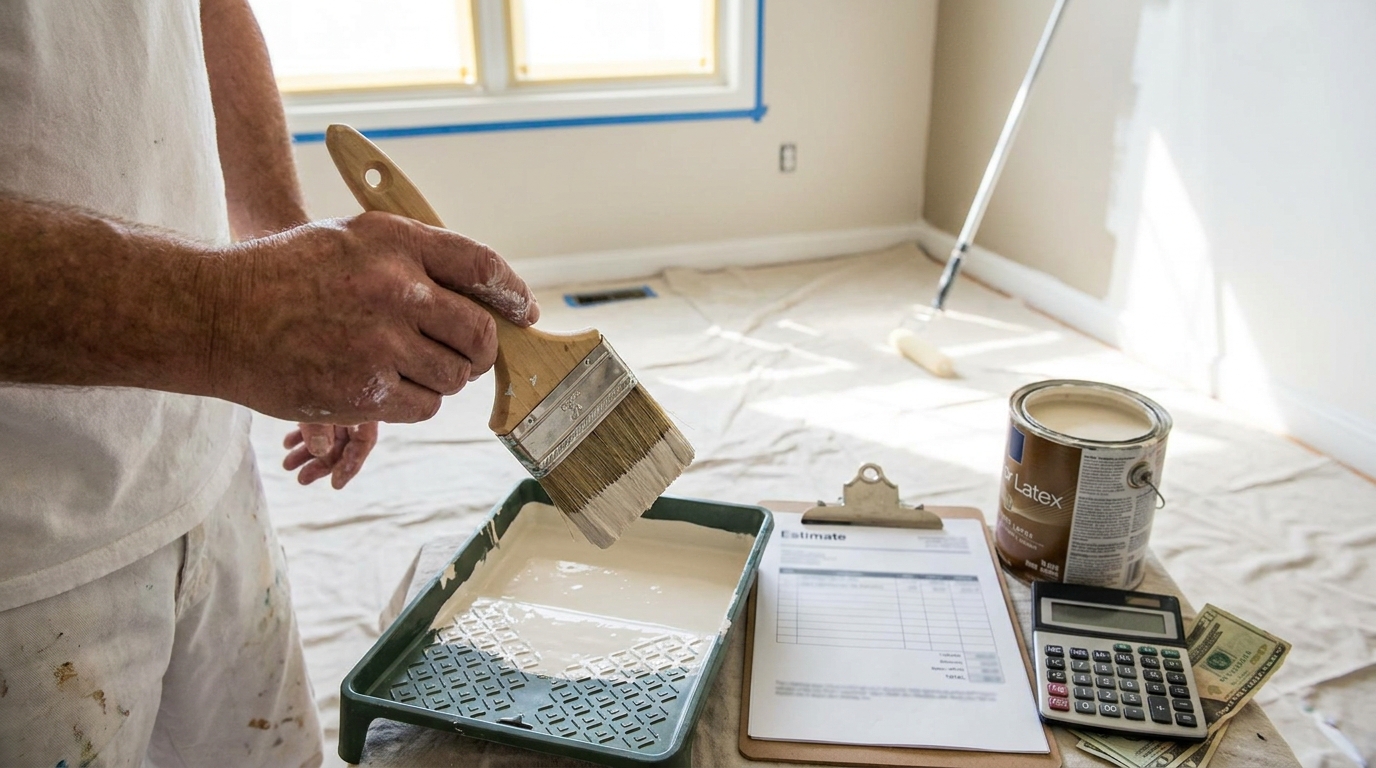
Interior house painting cost runs about $2 to $6 per square foot in 2026, or roughly $2,000 to $8,000 for a 2,000 square foot home. Labor is 75 to 95 percent of that bill. The paint itself is about 15 percent, which is why quotes track hours, not gallons.
That is the number most homeowners come for. It is also the number most likely to mislead you, because the phrase "per square foot" means two different things depending on who wrote the bid. Here is how the money actually breaks down, and what to ask before you sign anything.
What a whole house job really runs
The mainstream cost guides land in the same neighborhood but describe different scopes, and that is where confusion starts.
-
NerdWallet, citing 2026 Angi data, puts interior painting at $2 to $6 per square foot and the average interior job at $2,021, with a typical range of $1,000 to $3,000 and up.
-
This Old House quotes $1 to $4 per square foot of floor space and a total range of $1,800 to $10,000, narrowing to $2,000 to $8,000 for a 2,000 square foot home.
-
HomeAdvisor also lists $2 to $6 per square foot, and puts the cost of hiring a painter anywhere from $200 to $6,000 depending on how much you are painting.
Those are not contradictions. They are different scopes. A $1 to $2 per square foot number is usually walls only. Once you add ceilings at $1 to $2.50 per square foot and trim at $1 to $3 per linear foot, you are in the $2 to $6 band. When you compare bids, compare surfaces first and price second.
Room by room, for a partial job
If you are painting two rooms rather than the whole house, This Old House gives useful anchors: a bathroom around 70 square feet runs $350 to $650, a bedroom around 132 square feet runs $300 to $800, a living room around 340 square feet runs $600 to $2,000, a kitchen runs $200 to $750, and a dining room runs $600 to $1,000. Stairways price by the linear foot at $15 to $30. Interior doors run $40 to $100 each. Kitchen cabinets are their own project at $900 to $3,500, or $3 to $8 per square foot.
Why the bill is almost all labor
This is the part that changes how you read a quote. Labor is 75 to 95 percent of a professional interior paint job according to the Angi data NerdWallet cites, and HomeAdvisor splits it cleanly at 85 percent labor and 15 percent materials.
Run the arithmetic on materials and you can see why. A gallon of paint covers roughly 350 to 400 square feet in one coat, per Sherwin-Williams, with the caveat that coverage varies by surface condition and application method. HomeAdvisor uses about 350 square feet per gallon per coat and prices paint at $25 to $50 per gallon, with designer lines above $100. Two coats over the paintable surfaces of a 2,000 square foot home works out to roughly 26 gallons, or about $650 to $1,300 of paint against a $4,000 to $8,000 bill.
Everything else you are paying for is time: masking, moving furniture, patching, cutting in, drying between coats, cleanup, and the callback if something peels.
Paint prices are climbing, and it barely matters
There is a real price story in paint right now. Federal producer price data for interior architectural coatings shows the index at 161.188 in July 2026 against 151.354 a year earlier, a 6.5 percent increase at the factory gate. Almost the entire move happened in a single month between July and August 2025, when the index jumped 4.8 percent. Exterior coatings rose 4.6 percent over the same year.
For comparison, the broader consumer price category covering tools, hardware, outdoor equipment and supplies rose only 1.6 percent unadjusted over the 12 months through July 2026. Paint is outrunning the rest of the hardware aisle by roughly four to one.
Now apply it. A 6.5 percent increase on $650 to $1,300 of paint adds about $40 to $85 to a job that costs $4,000 to $8,000. That is around 1 percent. So if your quote this year came in several hundred dollars above the one you got last year, paint inflation is not the explanation. Hours are.
AI workflows for revenue teams
Placeholder house ad for Conservus.ai. Swap with final creative when brand assets are ready.
Partner with Conservus.aiWhat the hourly rate actually covers
This Old House puts professional painters at $30 to $60 per hour, with $75 and up for specialty work. HomeAdvisor lists $20 to $50 per hour, $75 to $100 and up in high cost areas, or $200 to $500 per day.
Meanwhile the Bureau of Labor Statistics reports median pay for painters in construction and maintenance at $23.75 per hour, or $49,400 a year, as of May 2025, across 326,900 jobs. Employment is projected to grow 3 percent from 2025 to 2035, with about 24,900 openings a year.
The gap between a $23.75 wage and a $45 billed hour is not markup on you. It is liability insurance, workers compensation, vehicles and fuel, drop cloths and tape and plastic, unbilled drive and setup time, office overhead, and the warranty visit when a corner cracks in month three. A bid well under those ranges usually means someone is skipping one of those line items, and the one most often skipped is insurance.
What raises a quote, ranked by how much it moves
-
Trim, doors and cabinets. This is brushwork, not rolling. Trim at $1 to $3 per linear foot plus doors at $40 to $100 each means a house full of six panel doors and crown molding can cost more than the walls. Cabinets at $900 to $3,500 are effectively a second project.
-
Ceiling height and stairwells. Anything that requires staging, ladders over a stair run, or long cut in lines multiplies hours without adding much surface.
-
Patching and skim coating. Nail pops, anchor holes, water stains and bad prior repairs are all hand time before a drop of finish paint goes on.
-
Color changes. Dark to light usually means an extra coat, sometimes primer on top of that. Same color refresh is the cheapest job on the board.
-
Ceilings and closets. Both are commonly excluded from the cheapest bid and quietly included in the highest one.
The pre-1978 line item most homeowners never see coming
If your house was built before 1978, there is a federal rule sitting inside your quote whether the painter mentions it or not. The EPA's Renovation, Repair and Painting rule covers pre-1978 homes and child occupied facilities, roughly three quarters of which the agency says still contain some lead based paint. Anyone paid to disturb painted surfaces in those homes has to be a certified firm with a certified renovator on site, using contained work areas and specified cleanup.
The threshold that decides whether that cost lands in your bid is specific. Under 40 CFR 745.83, work counts as minor repair and maintenance, and falls outside the rule, only if it disturbs less than 6 square feet of painted surface per room for interior work, or less than 20 square feet outside. Window replacement never qualifies regardless of size, and separate visits to the same room within 30 days are added together as one job. Sanding a full room of trim clears 6 square feet easily.
Expect paperwork. Under 40 CFR 745.84, the firm has to give you the lead hazard pamphlet no more than 60 days before starting, and either get your written acknowledgment of receipt or a certificate of mailing at least 7 days before work begins. If your house predates 1978 and nobody has raised lead, that bid is either incomplete or noncompliant, and it tells you something about how the rest of the crew works.
One exception worth knowing: EPA says homeowners doing work in their own home are generally exempt, unless you rent out part of the home, run a childcare facility there, or are renovating for profit. DIY sanding in a 1950s house is legal. It also means you are on your own for the containment and cleanup a certified crew is required to perform.
AI workflows for revenue teams
Placeholder house ad for Conservus.ai. Swap with final creative when brand assets are ready.
Partner with Conservus.aiPrep you can do, and where it stops paying
Prep is where the hours live, so prep is where the savings live. NerdWallet's list of ways to cut a paint bill is mostly labor removal: move and cover your own furniture, handle patching and sanding yourself, drop scope by skipping ceilings and closets, collect competing bids, buy premium paint for better coverage, and book outside peak season.
Realistic homeowner tasks: clear rooms and closets, pull switch plates and outlet covers, take down curtain rods and hardware, wash walls, and fill small holes. Where it stops paying: patching that a pro has to sand out and redo becomes a change order, and in a pre-1978 house your own sanding forfeits the protections the rule exists to provide. If you are unsure whether your patch will pass, ask the painter during the walkthrough rather than after.
What a real interior quote should itemize
-
Number of coats, and whether primer is included or extra
-
Surfaces included and explicitly excluded: walls, ceilings, trim, doors, closets, baseboards
-
Door and linear foot trim counts, not just "trim as needed"
-
A patching allowance with a stated limit, and what happens past it
-
Paint brand, line and sheen by room
-
Masking, drop cloth and containment plan, plus daily cleanup
-
Start date, working days, and crew size
-
Deposit amount, payment schedule and final walkthrough terms
-
License number, proof of general liability and workers compensation
-
For pre-1978 homes, RRP firm certification and the pamphlet acknowledgment
How to price your own market
Regional spread is real, but be careful where you get it. The per city dollar tables that dominate search results for painting costs are calculator output, not survey data, and they are worth nothing when you are arguing about a bid.
Two sources hold up. First, HomeAdvisor's own range says the quiet part plainly: painters bill $20 to $50 per hour in most markets and $75 to $100 and up in high cost areas. Since labor is roughly 85 percent of the bill, a metro that doubles the billed hour comes close to doubling the whole job for identical work. That is why the same three bedroom repaint lands at $3,000 in one market and $6,000 in another.
Second, if you want a defensible number for your own area, pull painter wages for your state or metro from the BLS Occupational Employment and Wage Statistics tables and compare them to the $23.75 national median. A market 30 percent above the median median wage will carry roughly proportional labor pricing. Then confirm it the old fashioned way, with three local bids on identical scope.
AI workflows for revenue teams
Placeholder house ad for Conservus.ai. Swap with final creative when brand assets are ready.
Partner with Conservus.aiThe two questions that settle a quote
Get three bids, hand each painter the same written scope, and verify license and insurance before anyone opens a can. Then ask these two.
Is your per square foot number floor area or wall area? Cost guides publish per square foot of floor space. Painters price the surface they roll. At an eight foot ceiling in a normally divided house, paintable wall area runs roughly two and a half to three times the floor number, so "$3 per square foot" describes two very different prices. Make the basis explicit in writing.
Was this house built before 1978? If yes, the answer should trigger a conversation about certification, containment and a pamphlet, not a shrug. A painter who handles that question well is usually handling the rest of the job well too.
Related reading
Sources
-
Cost to Paint a House in 2026, Plus 6 Ways to Save (NerdWallet, citing Angi data)
-
Painters, Construction and Maintenance (BLS Occupational Outlook Handbook)
-
CPI Detailed Expenditure Categories, Table 2, July 2026 (BLS)
-
40 CFR 745.84, Information Distribution Requirements (Cornell LII)
-
Occupational Employment and Wage Statistics Tables (BLS OEWS)
Angi figures in this article are cited through NerdWallet's reporting.
Note: This article contains AI-assisted content and has been reviewed by our editorial team.
ABOUT THIS SERVICE: CallTheLocal.com is a directory and lead generation service, not a contractor or service provider. Submitting this form does not obligate you to hire anyone or purchase any service. Your information will be shared with licensed, insured home service professionals in your area who may provide quotes for your project. CallTheLocal.com does not guarantee the quality, timeliness, or outcome of any work performed by service providers you connect with through this service. Always verify licensing, insurance, and references before hiring. Get everything in writing before work begins.